
An alleged charge above an auction result is not necessarily above an advertiser’s maximum bid. Government allegations and a business’s own entitlement to relief are separate questions.
For California businesses buying online advertising, the central question is not simply whether costs rose. It is whether the pricing mechanism differed from what was represented, disclosed, or agreed—and whether an actionable discrepancy caused a provable loss.
Newly Public Allegations, Not a New Lawsuit
The FTC’s November 5, 2026 announcement highlighted newly public allegations in an existing advertising-pricing lawsuit brought with 22 states, including California. November 5 was not the lawsuit’s starting date. The updated complaint is Document 113, filed October 28, 2026, in the Western District of Washington, Case No. 2:26-cv-03097-JHC. See the FTC disclosure and updated complaint. 1 2
The government alleges that undisclosed “soft reserve” pricing increased charges above underlying auction results. The FTC describes alleged maximum increases of up to 50% on ordinary days and 250% on major shopping days. Those are not average increases, charges above advertisers’ maximum bids, or adjudicated damages. California’s False Advertising Law and Unfair Competition Law claims appear in Counts XIV–XV of the complaint. 1 2
Amazon Disputes Deception and Harm
Amazon’s published response disputes deception and advertiser harm. Amazon states that advertisers never pay more than their bids and that inflation-adjusted average cost per click for Sponsored Products search ads remained flat from 2019 through 2024. These are Amazon’s statements, not judicial findings. Neither side’s position should be treated as established merely because it appears in a complaint or public response. 3
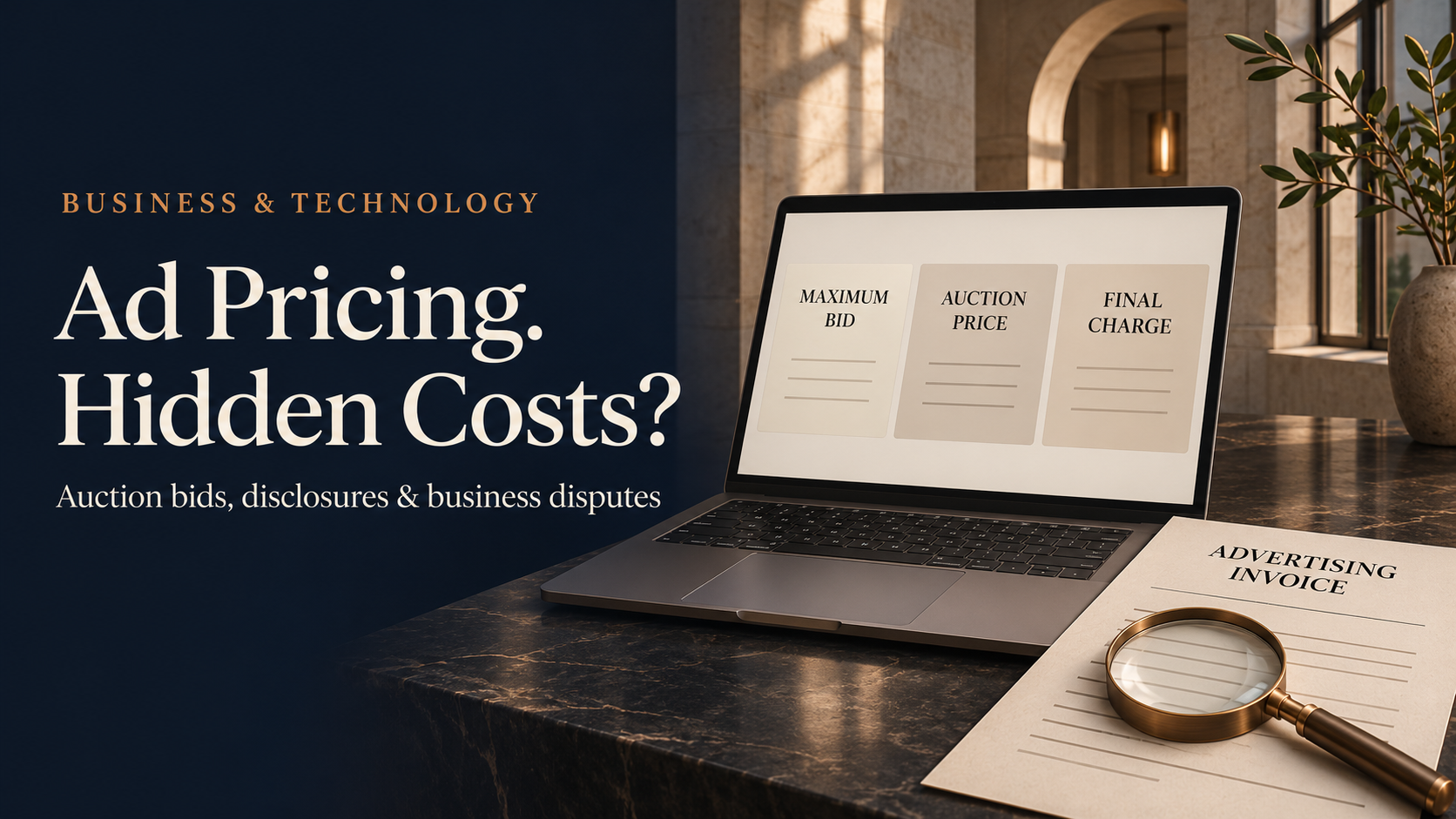
Maximum Bid, Auction Price, and Final Charge
Three numbers can differ: the maximum bid is the advertiser’s submitted bidding ceiling; the auction-generated price is the price produced by the relevant auction mechanism; and the final charge is what the advertiser is actually billed.
Assume a maximum bid of $5, an auction-generated price of $2, and a final charge of $3. The charge remains below the maximum bid but is $1—or 50%—above the auction result: ($3 − $2) ÷ $2 = 50%.
These are illustrative figures, not an actual Amazon transaction or proof of overcharging. A price increase or reserve price is not inherently unlawful. The legal question concerns what pricing mechanism was represented, what was disclosed or agreed, and whether any actionable discrepancy caused loss. Auction rules can be more complex than simply charging the next-highest monetary bid; generalized second-price auctions should not be reduced to that universal formula.
Government Enforcement and Private Remedies Differ
The government lawsuit does not automatically establish an advertiser’s private claim or entitlement to reimbursement. Business and Professions Code sections 17204 and 17535 require private plaintiffs to have suffered injury in fact and lost money or property as a result of the challenged violation. A business must connect its own loss to the challenged conduct. 4 5
Sections 17203 and 17535 authorize injunctive and restitutionary relief, subject to their requirements. Restitution is not synonymous with compensatory damages, lost profits, or recovery of all the defendant’s profits. See section 17203 and section 17535. 6 5
In Korea Supply Co. v. Lockheed Martin Corp. (2003) 29 Cal.4th 1134, 1144–1152, the California Supreme Court explained the UCL’s remedial limits: ordinary compensatory damages and nonrestitutionary disgorgement are unavailable under the UCL merely because the defendant allegedly profited. The nature of the money sought and the plaintiff’s interest in it matter. 7
Any separate contract or misrepresentation claim requires its own elements, causation, evidence, and remedy analysis. Businesses should not assume the FTC Act itself supplies a private damages action merely because the FTC has sued.
Records That Help Evaluate a Dispute
Preserve the records that explain both the promised pricing and the actual charge:
• Advertising agreements and applicable policy versions. • Pricing descriptions and sales or support communications. • Bid settings, campaign histories, invoices, and available transaction records. • Evidence linking the challenged representation or practice to the claimed loss.
Increased advertising spending or disappointing campaign performance alone does not establish actionable deception. Applicable contract terms, dispute procedures, and deadlines also require review. Our AppLovin advertising-dispute article addresses related allegations about advertising metrics; this dispute instead highlights auction-pricing representations and the evidence needed to evaluate them.
Sources
- 1.
- 2.
- 3.
- 4.
- 5.
- 6.
- 7.
Discuss Your Matter
If your business faces disputed commercial charges or a business-contract issue, Mahrouyan Law can evaluate the facts, records, and fit. Learn more about our Business Litigation practice or contact the firm to discuss your circumstances.

Omeed Mahrouyan is the founder of Mahrouyan Law, P.C., a California firm handling business and commercial litigation, property and cargo damage claims, personal injury, landlord representation, startup transactions, and practical intellectual property matters. Clients work directly with him on strategy, drafting, and case decisions.
More about Omeed Mahrouyan →