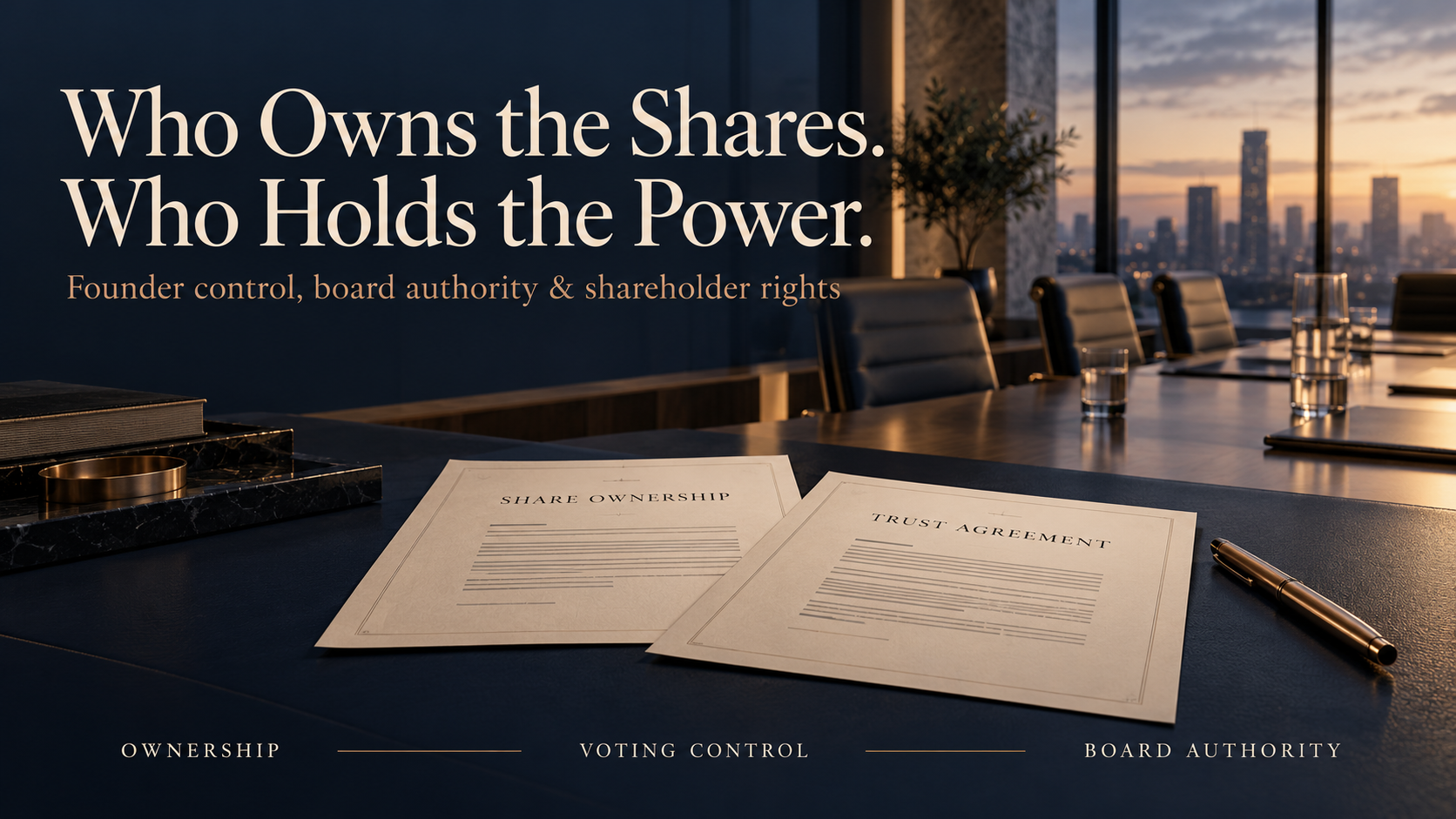
Economic ownership, shareholder voting power, and authority to select directors can belong to different people. Anthropic’s October 26 preliminary prospectus illustrates that distinction.
In its October 26, 2026 announcement, Anthropic said it had filed for a proposed initial public offering and identified the proposed Nasdaq symbol ANT. The announcement did not establish an offering price or share count. A proposed filing is not a completed offering. 3
This discussion concerns the October 26 preliminary prospectus, not a later amended or final offering document. The useful governance question is how financial participation, shareholder votes, and director-selection authority can be separated. Filing with the SEC does not constitute governmental approval of the investment or governance arrangements. 1
Investment Ownership Is Not the Same as Voting Control
According to the original S-1, Class A shares generally receive one vote each. Immediately before completion of the proposed offering, a limited liability company initially owned by the seven co-founders would receive a single Class F share carrying 50.1% of general shareholder voting power, including election of directors other than Class T directors. The filing describes Class F as having no economic rights. 1
That is 50.1% voting power, not 50.1% economic ownership. Financial rights concern participation in the company’s economic value; voting rights concern decisions submitted to shareholders. A special voting share can concentrate the latter without granting a corresponding investment interest. Class A shareholders still have rights; the structure does not make them legally irrelevant. 1
The Trust’s Board-Selection Power Is a Different Lever
The S-1 describes the Long-Term Benefit Trust as generally selecting and removing Class T directors constituting a board majority. Class T shares also have no economic rights. Thus, the founders’ general voting control does not mean that they alone select the entire board. 1
Director-selection authority is not day-to-day management. The filing explains that the trust does not manage daily operations or set corporate strategy. Its role in choosing directors is distinct from the board’s oversight and management’s operational responsibilities. These arrangements remain subject to governing documents, conditions, and sunset mechanisms; this summary does not describe every class or exception. 1
The filing index provides the supporting exhibits. Detailed appointment, amendment, and termination mechanisms should be read in the applicable documents rather than inferred from a headline voting percentage. 2
Controlled-Company Status Does Not Mean Every Exemption Will Be Used
The filing attributes Anthropic’s controlled-company classification under Nasdaq rules to the trust’s power to elect a board majority. Available exemptions and anticipated reliance are different questions: the S-1 identifies expected reliance concerning the nominating and corporate governance committee. It should not be read as saying every available controlled-company exemption will be used. 1
Delaware Public Benefit Corporation Law Supplies the Framework
Anthropic’s California headquarters do not make California law the governing corporate statute here. The filing identifies a Delaware public benefit corporation—a for-profit entity, not a nonprofit merely because it has a public-benefit purpose. 14
Under 8 Del. C. § 365(a), directors must balance shareholders’ financial interests, the interests of people materially affected by the corporation’s conduct, and the public benefit identified in its certificate of incorporation. That balancing framework differs from assuming financial return is the sole statutory consideration. 4
The mission does not give every affected person a direct enforcement right. Section 365(b) limits duties owed to persons because of their interests in the public benefit or exposure to corporate conduct; § 367 restricts who may bring an action to enforce the balancing requirement. Public-benefit status therefore should not be confused with unrestricted public enforcement. 4
What Founders and Investors Should Read
Review stock-class rights, board appointment provisions, voting agreements, amendment thresholds, and sunset provisions. Ask who receives economic value, who votes on which matters, who selects or removes directors, and when special rights change or end. Founder control is not inherently unlawful or proof of a fiduciary breach. The existing Cloudflare founder-control article discusses a separate governance dispute, not a ruling on Anthropic’s structure.
Sources
- 1.
- 2.
- 3.
- 4.
Discuss Your Matter
For questions about your business’s ownership or governance arrangements, you may contact Mahrouyan Law to discuss your circumstances. Read about our Startup & Business Transactions practice.

Omeed Mahrouyan is the founder of Mahrouyan Law, P.C., a California firm handling business and commercial litigation, property and cargo damage claims, personal injury, landlord representation, startup transactions, and practical intellectual property matters. Clients work directly with him on strategy, drafting, and case decisions.
More about Omeed Mahrouyan →