
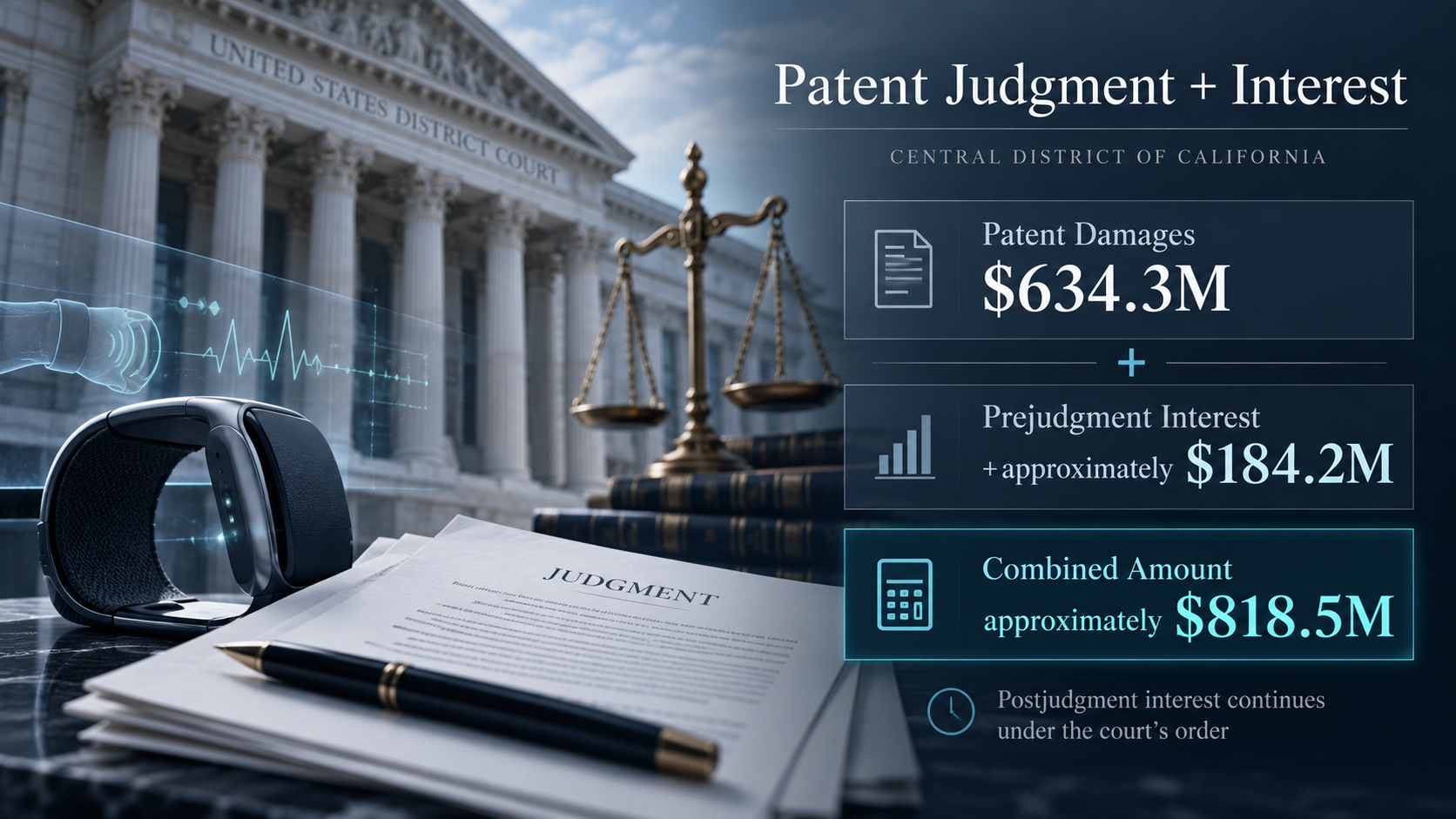
A federal judge added about $184.2 million in prejudgment interest to Masimo’s $634.3 million patent judgment against Apple. Here is why interest can materially increase litigation exposure.
A federal judge in Santa Ana has added approximately $184.2 million in prejudgment interest to Masimo’s $634.3 million patent-infringement judgment against Apple, bringing the combined award to approximately $818.5 million before additional postjudgment interest.
U.S. District Judge James V. Selna issued the interest ruling on October 5, 2026, in Masimo Corporation et al. v. Apple Inc., pending in the U.S. District Court for the Central District of California. The case is relevant in Orange County because Irvine-based Masimo’s litigation is pending in the court’s Southern Division in Santa Ana.
The lesson extends beyond the headline number: a jury’s damages award is not always the final measure of financial exposure. Interest can materially increase the amount associated with a judgment while litigation continues.
The Underlying $634.3 Million Patent Judgment
On November 14, 2025, a federal jury found that Apple infringed claims 11 through 14 of Masimo’s U.S. Patent No. 10,433,776. On July 20, 2026, Judge Selna entered final judgment awarding Masimo $634,313,913 in patent damages and concluded that Apple’s infringement was not willful.
The July judgment expressly reserved prejudgment and postjudgment interest for later determination. The additional $184.2 million was therefore not a second jury verdict and not an enhanced award for willful infringement. It was an interest award.
Why Was Another $184 Million Added?
Federal patent law provides that a successful claimant may receive damages adequate to compensate for infringement, “together with interest and costs as fixed by the court.” See 35 U.S.C. § 284.
In General Motors Corp. v. Devex Corp., 461 U.S. 648, 655–57 (1983), the U.S. Supreme Court explained that prejudgment interest serves to place the patent owner in about the position it would have occupied had royalty payments been made when due, and held that it should ordinarily be awarded absent some justification for withholding it. Money that should have been paid years earlier has economic value during the time it was unavailable.
The Interest Rate Made a Major Difference
The parties disagreed sharply over the calculation. According to Bloomberg Law and MedTech Dive’s reporting on the October 5 order:
- Masimo advocated a 7% California rate, which would have produced approximately $242.7 million;
- Apple advocated an alternative calculation producing approximately $114.5 million; and
- the court rejected both and used Masimo’s borrowing rate, compounded annually, producing approximately $184.2 million.
The choice of rate changed the result by tens of millions of dollars—a reminder that interest is a meaningful part of damages analysis, not an afterthought.
Prejudgment Interest Is Different From Postjudgment Interest
Prejudgment interest addresses the period before judgment—here, the time during which royalty-related money would otherwise have been available to Masimo. Postjudgment interest begins after judgment and can continue while a federal money judgment remains unpaid. It is governed by 28 U.S.C. § 1961.
Reporting states that Judge Selna applied a 4% postjudgment rate to the approximately $818.5 million amount, running from July 20, 2026, until the judgment is satisfied. The amount associated with the judgment can therefore continue to grow, subject to further proceedings.
Interest Is Not Punitive or Enhanced Damages
The court found Apple’s infringement not willful, yet still awarded substantial prejudgment interest. That is because the two remedies serve different purposes: interest compensates for delayed payment, while enhanced patent damages involve different considerations, such as particularly culpable infringement. The October award should not be described as additional punishment.
The Patent Award Is Separate From the Trade-Secret Findings
The July judgment also found that Apple misappropriated two identified Masimo trade secrets, but awarded no monetary relief on those claims. The $634.3 million award and the interest discussed here belong to the patent-infringement judgment, not the trade-secret findings.
Why This Matters Beyond Apple and Masimo
When litigation lasts for years, parties may need to weigh not only:
- the underlying damages;
- litigation expenses;
- attorney-fee exposure where recoverable; and
- collection risk;
but also whether applicable law permits prejudgment or postjudgment interest. The rules vary by claim. This federal patent framework should not be treated as a universal rule for California contract, tort, property, or other commercial disputes.
Interest is one of several categories that separate winning a case from what is ultimately recovered; see also why winning a California lawsuit does not automatically mean recovering attorney fees.
The Bottom Line
The July 2026 judgment awarded approximately $634.3 million in patent damages. The October ruling added approximately $184.2 million in prejudgment interest, bringing the total to roughly $818.5 million before continuing postjudgment interest. It was not another jury award and not a finding of additional misconduct, and the ruling remains subject to further proceedings. For businesses evaluating significant litigation, the headline damages figure may not tell the entire financial story.
Mahrouyan Law, P.C. handles selected intellectual-property matters and business and commercial litigation, and advises founders on intellectual-property ownership, licensing, and startup risk. Specialized patent matters may require patent counsel or appropriate co-counsel depending on the circumstances.
Frequently Asked Questions
Why did Apple’s $634 million judgment increase to about $818.5 million?
Judge Selna awarded approximately $184.2 million in prejudgment interest in addition to the approximately $634.3 million patent damages judgment.
Was the additional $184 million punitive damages?
No. The court separately determined that Apple’s infringement was not willful. The additional amount was prejudgment interest intended to address the time value of money associated with the infringement damages.
Does postjudgment interest continue to accrue?
Reporting on the October 5 order states that the court imposed 4% postjudgment interest beginning July 20, 2026 and continuing until the judgment is satisfied, subject to subsequent proceedings.
Does the same interest rule apply to every California lawsuit?
No. This case applies federal patent law and the federal postjudgment-interest statute. California contract, tort, property, and other claims may be governed by different statutes and rules.
Sources & Authorities
- Masimo Corporation et al. v. Apple Inc., No. 8:20-cv-00048-JVS (JDEx), Dkt. 2917 (C.D. Cal. July 20, 2026) (Final Judgment) — Jury verdict, claims 11–14 of the ’776 patent, $634,313,913 award, no willfulness, trade-secret findings, and reservation of interest.
- 35 U.S.C. § 284 (patent damages, interest, and costs)
- General Motors Corp. v. Devex Corp., 461 U.S. 648 (1983)
- 28 U.S.C. § 1961 (postjudgment interest)
- Bloomberg Law, “Apple Owes $184 Million in Interest on $634 Million Patent Loss” (Oct. 5, 2026)
- MedTech Dive, “Apple ordered to pay Masimo $184M in interest on patent damages” (Oct. 7, 2026) (syndicated copy)
- Orange County Business Journal, “Apple Owes Masimo Another $184M in Patent Case” (Oct. 7, 2026)
Mahrouyan Law handles these matters directly. Read more about how the firm approaches trademarks & practical intellectual property counsel in California, or discuss your own situation with the firm.
Evaluating Damages Exposure in a Business Dispute?
If your business is facing or considering significant commercial or intellectual-property litigation, contact Mahrouyan Law, P.C. to discuss the circumstances.

Omeed Mahrouyan is the founder of Mahrouyan Law, P.C., a California firm handling business and commercial litigation, property and cargo damage claims, personal injury, landlord representation, startup transactions, and practical intellectual property matters. Clients work directly with him on strategy, drafting, and case decisions.
More about Omeed Mahrouyan →