
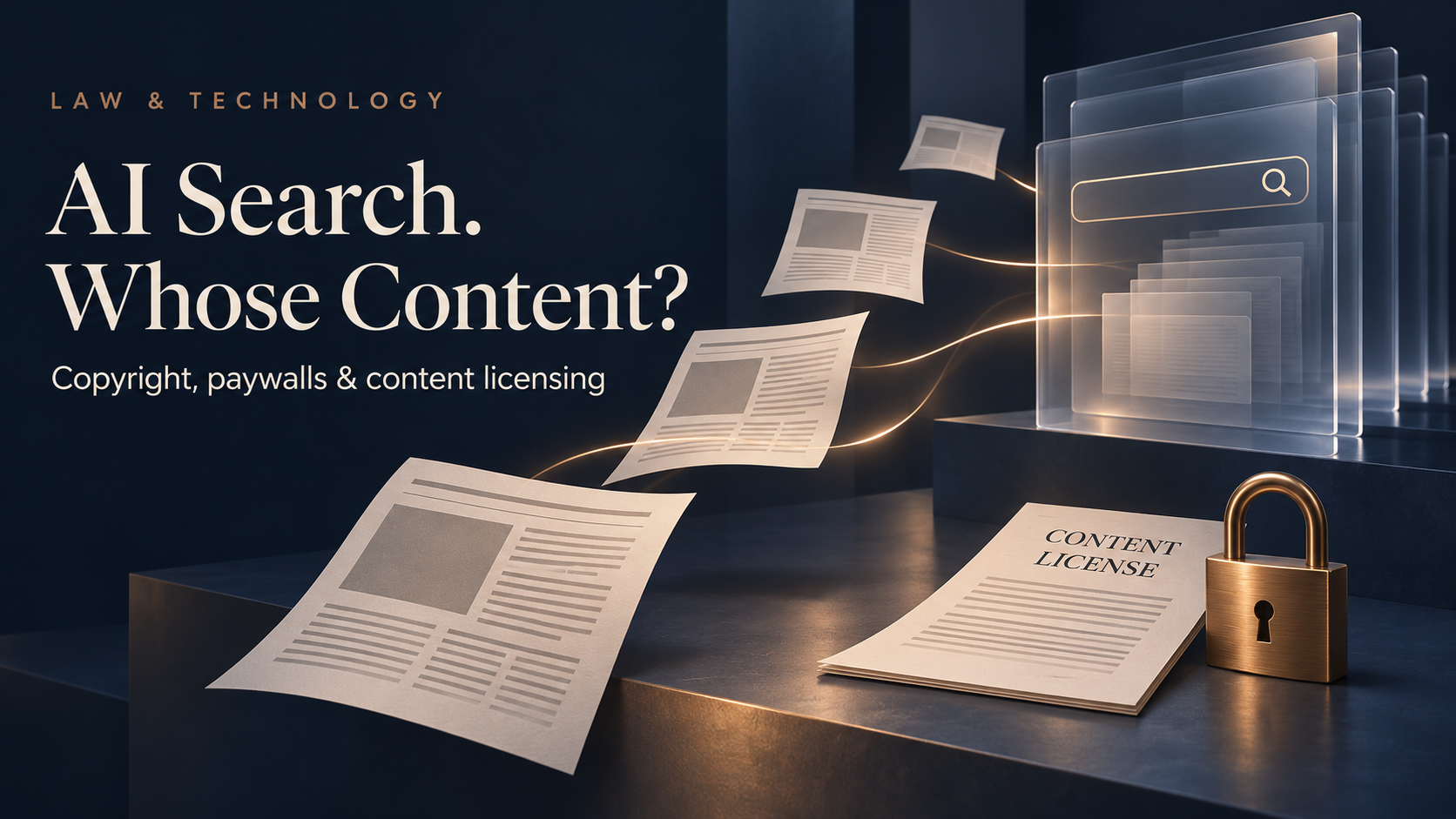
Two separate New York lawsuits raise distinct questions about news copying, commercial APIs, AI responses, and alleged paywall circumvention—not just model training.
On November 2, 2026, publishers filed two separate actions against Brave Software, Inc. in the U.S. District Court for the Southern District of New York. The dispute concerns how news reaches search users and other AI businesses—not simply whether material may be used to train a model.
Two Complaints, Not One Case
Daily News, LP, Chicago Tribune Company, LLC, and Orlando Sentinel Communications Company, LLC brought No. 1:26-cv-09554. The New York Times Company separately brought No. 1:26-cv-09549. The filing stamps and captions identify November 2 filings. See the three-publisher complaint and the Times complaint, each at page 1. 12
Both plead direct, contributory, and vicarious copyright infringement, access-control claims under the Digital Millennium Copyright Act, and New York unjust enrichment. They allege unauthorized copying and distribution, circumvention, and resulting harm. These are plaintiffs’ allegations, not findings. Damages and injunctions are requested relief, not awards or orders. Brave is the sole named defendant in each caption; mentioning customers does not make those companies defendants or establish infringement. 12
Separate Copying, Training, Retrieval, and APIs
Indexing makes material searchable; reproducing protected expression raises a related but distinct issue. Training uses material during model development. Retrieval-augmented generation, or RAG, retrieves external material to help answer a particular query. A commercial API gives other businesses programmatic access to data or services. An API is a delivery mechanism, not proof that every customer trains a model or receives the same content.
The complaints challenge copying into a search index, content supplied to users and other AI companies, and alleged access-control circumvention. Each product and use requires its own analysis. Under 17 U.S.C. § 106, reproduction and distribution are among the copyright owner’s rights, subject to statutory limitations. Underlying news facts are distinct from potentially protected wording, selection, and arrangement; protecting journalism does not confer ownership of every fact it reports. 123
Fair Use Has Four Factors, Not an AI Shortcut
17 U.S.C. § 107 calls for consideration of purpose and character of the use; nature of the copyrighted work; amount and substantiality used; and effect on the potential market or value. Fair use is fact-specific. Commercial use does not automatically defeat it, and describing a service as AI search does not establish it. 4
Attribution, a link to the original article, or copying fewer than a particular number of words is not an automatic safe harbor. The Copyright Office explains that there is no predetermined percentage or word count guaranteeing fair use. What was copied, why, how it was supplied, and whether it substitutes for licensed access all matter; the factors must be weighed together. 4
Paywall Circumvention Is a Separate Question
Both complaints invoke § 1201(a)(1)(A), addressing circumvention of an effective technological access control, and § 1201(a)(2), addressing qualifying circumvention technologies or services and trafficking conduct. A subscription requirement or access restriction is not automatically a qualifying technological measure. The statutory definitions, conduct, and applicable exceptions require separate examination. 125
Fair use of copied material does not automatically authorize bypassing access controls. Section 1201(c)(1) preserves infringement defenses, including fair use, without collapsing the two inquiries. Section 1202 instead concerns copyright-management information and its specified knowledge or intent requirements; neither complaint pleads a § 1202 count. 5
Secondary Liability Requires More Than an API
Contributory and vicarious infringement are separately pleaded theories, not interchangeable labels. Providing an API or earning revenue does not alone establish either. The complaints’ assertions about knowledge, assistance, control, and financial benefit remain allegations requiring analysis under the applicable legal standards; they are not a universal compliance checklist. 12
The Verge’s November 2 report said Brave did not immediately reply to its request for comment. That is not a substantive defense position, and statements in separate litigation should not be treated as Brave’s response here. 6
What Startups and Publishers Should Review
Examine content provenance, licensing scope, permitted downstream uses, retention and reproduction practices, output behavior, and technological access restrictions. Check what vendors actually supply and what customer agreements permit. These considerations inform legal review; they do not guarantee compliance or predict these cases’ outcomes.
Sources
- 1.
- 2.
- 3.
- 4.
- 5.
- 6.
Discuss Your Matter
For questions about your business’s content licensing or technology agreements, you may contact Mahrouyan Law. Read about our Intellectual Property practice and Startup & Business Transactions practice.

Omeed Mahrouyan is the founder of Mahrouyan Law, P.C., a California firm handling business and commercial litigation, property and cargo damage claims, personal injury, landlord representation, startup transactions, and practical intellectual property matters. Clients work directly with him on strategy, drafting, and case decisions.
More about Omeed Mahrouyan →