
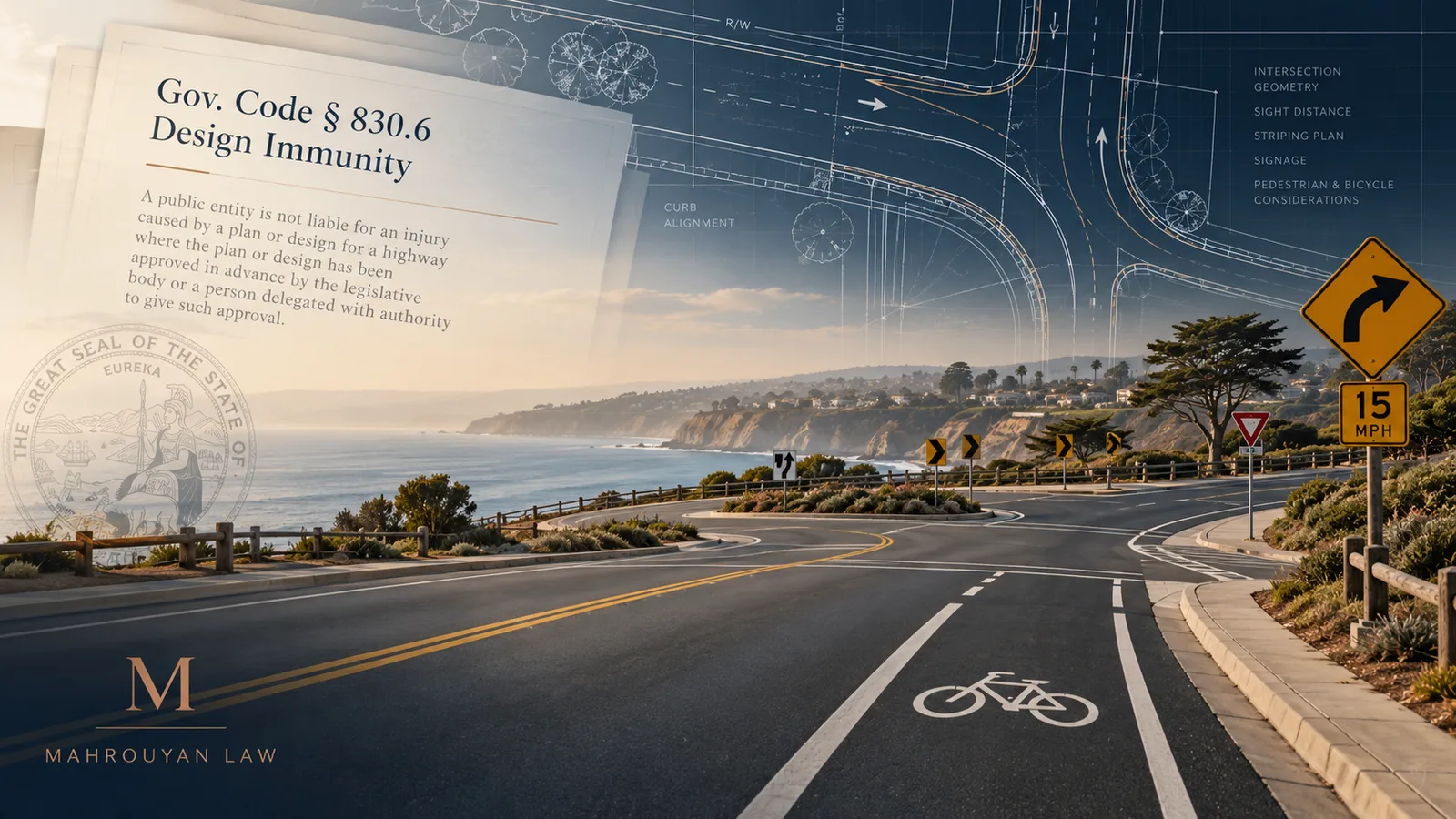
A new published decision explains when warnings incorporated into an approved public-roadway design may themselves receive Government Code section 830.6 protection.
- 2023 Supreme Court
- No categorical immunity for every failure-to-warn claim
- 2026 Court of Appeal
- Approved warnings may themselves be protected by design immunity
- Key distinction
- No warning vs. allegedly inadequate approved warning
- Result
- Summary judgment for City affirmed
What Happened in Tansavatdi?
The case arises from a fatal 2016 bicycle collision in Rancho Palos Verdes. Jonathan Tansavatdi was riding a bicycle near Hawthorne Boulevard and Vallon Drive when he collided with a turning tractor-trailer.
His mother later sued the City of Rancho Palos Verdes, alleging a dangerous condition of public property and inadequate warnings concerning the roadway configuration.1
A public entity can be liable for a dangerous condition of its property only when the plaintiff establishes the statutory elements of Government Code section 835. The courts in Tansavatdi did not decide that the roadway was dangerous; the litigation ultimately focused on a governmental-immunity doctrine known as “design immunity.”5
The case proceeded in Los Angeles County Superior Court and was decided on appeal by the Second Appellate District, Division Four—one of many Los Angeles County civil cases shaped by public-entity rules.
What Is Design Immunity?
Government Code section 830.6 can protect a public entity from liability for injuries caused by an approved plan or design of public property when the statutory requirements are satisfied. California courts generally identify three elements:3
- a causal relationship between the plan or design and the accident;
- discretionary approval of the plan or design before construction; and
- substantial evidence supporting the reasonableness of the plan or design.
The doctrine exists in part to prevent juries from simply second-guessing reasonable discretionary infrastructure-design decisions after an accident.
But design immunity is not automatic. The government must establish its statutory elements, and the reasonableness requirement, although favorable to public entities, is not meaningless. California law also recognizes circumstances in which previously established design immunity can later be lost.
What Did the California Supreme Court Decide in 2023?
This case previously reached the California Supreme Court. In Tansavatdi v. City of Rancho Palos Verdes (2023) 14 Cal.5th 639, the Supreme Court held that design immunity does not categorically eliminate a separate failure-to-warn theory simply because the underlying roadway design itself is immune.2
In other words, a public entity could potentially be immune from liability for creating an approved roadway design yet still face a separate claim that it failed to warn users about a dangerous condition associated with that design.
But the Supreme Court expressly left an important question unresolved: what if warnings were actually provided and those warnings themselves were considered as part of the approved roadway design? The 2026 Court of Appeal decision addresses that question.
What Did the Court of Appeal Decide in 2026?
On remand, the City submitted evidence that signs, pavement markings, and other warnings already present along the roadway were considered and retained as part of its approved 2009 design plans.
The plaintiff did not contend that there were no warnings. Instead, her expert argued that the City should have provided additional or different warnings, such as other signs, roadway markings, or warning devices.
The Court of Appeal drew a distinction between no warning and an existing warning that was part of the approved design but was allegedly inadequate. The court held that when some warning of the alleged danger exists, that warning forms part of an otherwise reasonable approved design, and the plaintiff argues that additional or different warnings were needed, the claim may itself become a challenge to the design of the warning and therefore fall within section 830.6 design immunity.
The court affirmed summary judgment for the City.
Why the No-Warning Distinction Matters
The 2023 Supreme Court decision preserved the possibility of a failure-to-warn claim that is legally independent of the immune design. The new decision explains why the analysis can change when a warning already exists as part of that design.
If the claim is, “The City created an immune roadway design but completely failed to provide any warning of the allegedly dangerous condition,” the warning theory may potentially remain independent of the design.
But if the claim is, “The City incorporated warnings into its approved roadway design, but it should have used different or better warnings,” the Court of Appeal reasoned that the dispute may effectively concern the design of the warnings themselves. That is where design immunity may apply.
Design Immunity Is Not Unlimited
The Court of Appeal expressly cautioned that design immunity does not protect every warning decision. The public entity must still satisfy the ordinary requirements of section 830.6—most importantly, substantial evidence supporting the reasonableness of the plan or design.
The court described that standard as generous to governmental entities but not limitless. It also recognized California doctrine under which design immunity can be lost when changed physical conditions make a previously reasonable design dangerous and the requirements for loss of immunity are satisfied.
What About Signage Immunity?
Government Code section 830.8 separately addresses liability arising from the failure to provide traffic or warning signals, signs, markings, or devices. The statute contains an exception where a warning was necessary for a dangerous condition affecting the safe movement of traffic that would not be reasonably apparent to, or anticipated by, a person exercising due care.4
The 2026 Court of Appeal did not need to decide the case under section 830.8 because it affirmed summary judgment based on design immunity under section 830.6.
What Does This Mean for Someone Injured on a Public Road?
A roadway injury involving a public entity may require analysis of issues that do not arise in an ordinary private-party accident case. Potential questions include:
- Was the property in a dangerous condition?
- Did the public entity create the condition or have notice of it?
- Was the challenged condition part of an approved design?
- What warnings existed, and were they themselves part of the approved design?
- Is there substantial evidence supporting the design’s reasonableness?
- Did physical conditions materially change after approval?
- Did the alleged absence of a warning independently contribute to the injury?
- Does another statutory immunity apply?
The answer can depend heavily on historical plans, engineering documents, traffic studies, photographs, collision history, design approvals, and expert evidence. Not every public-road injury supports a claim, which is why California personal injury matters involving public roads usually begin with the records.
Claims against California cities and other public entities can also involve special Government Claims Act procedures and shorter claim-presentation deadlines that do not apply in the same way to ordinary private-party injury claims. A separate Insight explains how government-claim timing affected the Harland case.
A Secondary Issue: The Section 998 Offer
The Court of Appeal also addressed a separate litigation-cost issue involving the City’s Code of Civil Procedure section 998 settlement offer. The plaintiff argued that the offer was invalid because it required a “general release.” The court rejected that argument: reading the offer as a whole, it concluded that the release was limited to the claims and parties in the existing litigation because the offer expressly stated that it was made “in full settlement of this action,” and it affirmed the related expert-fee award.6
For another recent section 998 decision, see California Court Clarifies the “Last Offer Rule” for Personal Injury Settlement Offers.
Footnotes
- Tansavatdi v. City of Rancho Palos Verdes, No. B343512 (Cal. Ct. App., 2d Dist., Div. 4, Sept. 24, 2026), certified for publication. ↩
- Tansavatdi v. City of Rancho Palos Verdes (2023) 14 Cal.5th 639. ↩
- Cal. Gov. Code § 830.6. ↩
- Cal. Gov. Code § 830.8. ↩
- Cal. Gov. Code § 835. ↩
- Cal. Code Civ. Proc. § 998. ↩
Sources & Authorities
- Tansavatdi v. City of Rancho Palos Verdes, No. B343512 (Cal. Ct. App., 2d Dist., Div. 4, Sept. 24, 2026) — Published Court of Appeal opinion.
- Tansavatdi v. City of Rancho Palos Verdes (2023) 14 Cal.5th 639 — California Supreme Court opinion, S267453.
- Cal. Gov. Code § 830.6
- Cal. Gov. Code § 835
- Cal. Gov. Code § 830.8
- Cal. Code Civ. Proc. § 998
Mahrouyan Law handles selected California personal injury matters directly. Read more about how the firm approaches personal injury in California, or discuss your own situation with the firm.
Discuss Your Matter
Mahrouyan Law handles selected California personal-injury matters, including motor-vehicle, premises, and other serious-injury claims. Claims involving cities and other public entities can raise additional issues involving governmental immunities, claim-presentation requirements, roadway design, and specialized procedural rules.

Omeed Mahrouyan is the founder of Mahrouyan Law, P.C., a California firm handling business and commercial litigation, property and cargo damage claims, personal injury, landlord representation, startup transactions, and practical intellectual property matters. Clients work directly with him on strategy, drafting, and case decisions.
More about Omeed Mahrouyan →