
Injured after slipping at a California store? Learn what premises-liability law requires, how notice is proven, and what evidence to preserve.
A fall inside a grocery store, restaurant, hotel, gym, or shopping center can happen in seconds. The legal question is more complicated: was it simply an accident, or did the business fail to use reasonable care to keep the property safe?
California does not make a store automatically liable whenever a customer falls. In many slip-and-fall cases, the most important issue is notice: did the business know—or through reasonable care should it have known—about the dangerous condition in time to address it?
What Must You Prove?
Premises liability is a form of negligence, grounded in the ordinary-care principle of Civil Code section 1714. Under CACI No. 1000, a plaintiff generally must prove that the defendant owned, leased, occupied, or controlled the property; was negligent in its use or maintenance; that the plaintiff was harmed; and that the negligence was a substantial factor in causing that harm.
For a dangerous condition, CACI No. 1003 describes negligence where a condition created an unreasonable risk of harm, the defendant knew or reasonably should have known about it, and the defendant failed to repair it, protect against it, or adequately warn. Proving merely that someone fell is not enough.
The Central Question Is Often Notice
If an employee saw a spill and ignored it, actual notice may be relatively straightforward. The harder case is when no one knows when the spill occurred. California permits proof of constructive notice—that the condition existed long enough that a reasonably careful business should have discovered and addressed it (see CACI No. 1011).
In Ortega v. Kmart Corp. (2001) 26 Cal.4th 1200, a customer slipped on milk near a refrigerator display. The California Supreme Court held that constructive notice may be shown through circumstantial evidence, and that evidence a business failed to inspect within a reasonable period may support an inference that the condition existed long enough to be discovered. Missing inspection records do not automatically establish negligence.
How Long Must a Spill Exist?
There is no fixed number of minutes, and Ortega does not create a universal inspection schedule. A busy supermarket aisle may call for different precautions than a rarely used area. Relevant evidence may include:
- when employees last inspected the area and any cleaning logs;
- employee and customer traffic and the type of business;
- whether similar hazards regularly occur;
- the appearance of the substance or defect; and
- surveillance footage showing when the condition developed.
Does a Warning Sign Defeat the Claim?
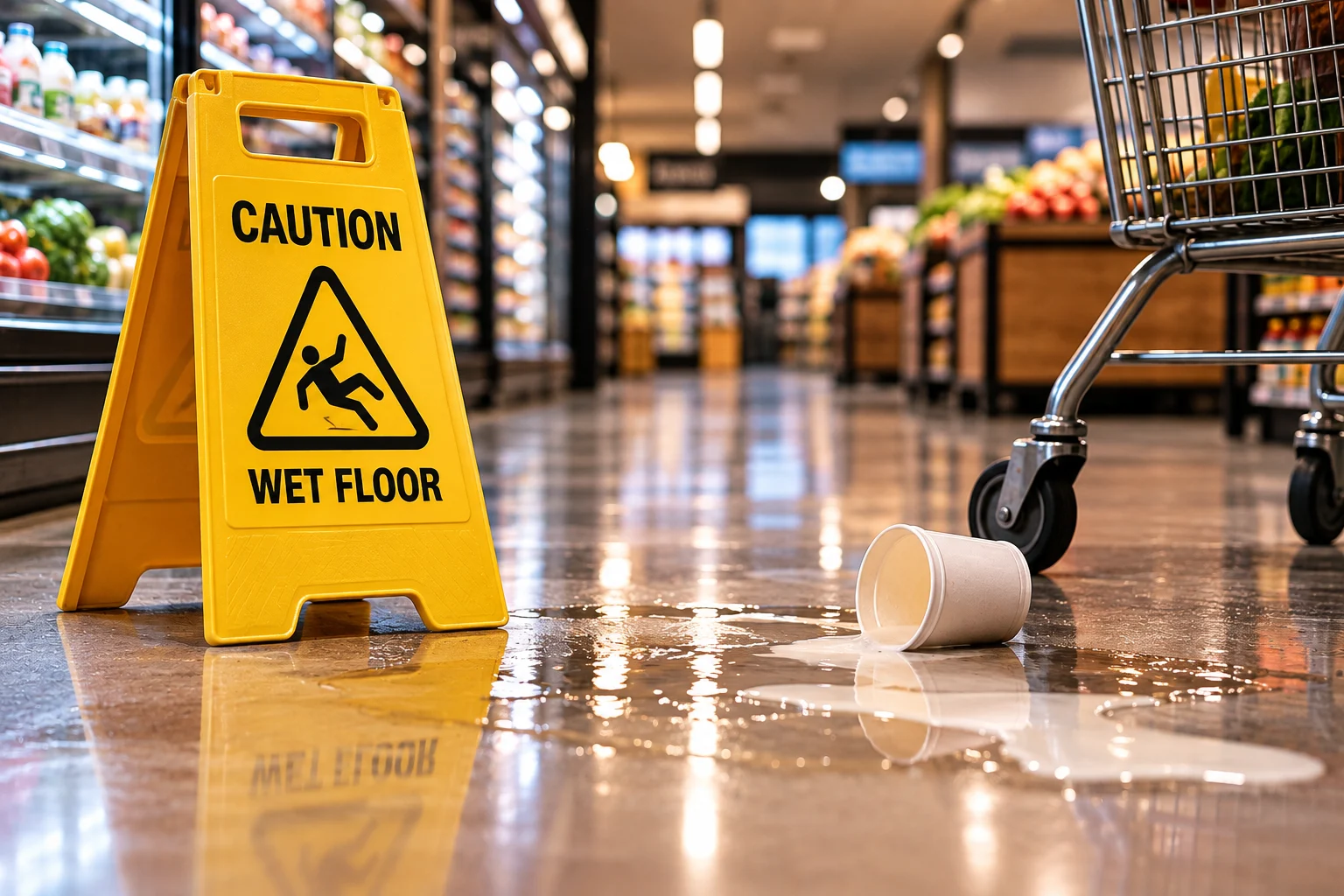
Not automatically—but it is relevant, because reasonable care can include an adequate warning. A barrier blocking a wet area differs from a small sign customers cannot reasonably see. Placement, visibility, lighting, distance, foot traffic, and whether customers still had to cross the hazard all matter. A photograph taken shortly after the incident can be useful.
What if the Hazard Was Obvious?
An open and obvious condition can affect the duty to warn, but it does not necessarily end the case. As CACI No. 1004 and Jacobs v. Coldwell Banker Residential Brokerage Co. (2017) 14 Cal.App.5th 438 reflect, reasonable care may still require protective measures when it is foreseeable that people will encounter the danger despite recognizing it—for example, stairs, entrances, or pathways a visitor realistically must use.
What if I Wasn’t Watching Where I Was Walking?
California follows comparative fault. If a factfinder assigns part of the responsibility to the injured person—for example, for looking at a phone or ignoring a warning—damages may be reduced by that percentage without necessarily eliminating the claim.
Who Is Responsible?
Not always the name on the storefront. Responsibility generally depends on ownership, possession, or control of the area where the fall occurred, which may involve the business, a separate property owner, a property manager, a janitorial service, or a maintenance contractor. Leases, management and maintenance agreements, and actual conduct can all matter—especially in shopping centers, hotels, and parking structures.
Evidence the Business May Hold
The business may possess better evidence than the injured customer, such as surveillance footage (if it exists), incident reports, inspection and cleaning logs, employee schedules, maintenance records, and witness statements. Video can show what happened before the fall: a spill sitting for an extended period presents a very different notice question than one created moments earlier. Because footage may be overwritten, early preservation efforts matter, though they cannot guarantee evidence will be retained.
What Damages May Be Recoverable?
If liability is established and proven by the evidence, damages may include reasonable medical expenses, lost earnings, diminished earning capacity, and noneconomic damages such as pain and suffering. There is no fixed formula; see How Much Is My Personal Injury Case Worth in California? for a fuller discussion of valuation.
How Long Do I Have?
For an ordinary personal-injury action, Code of Civil Procedure section 335.1 generally provides two years. Government property is different: Government Code section 911.2 generally requires a claim against a public entity to be presented within six months after accrual, and dangerous conditions of public property are governed by a separate framework, including Government Code section 835. Late-claim procedures, accrual rules, and immunities may also apply, so a fall on public property should be evaluated promptly.
What Should You Do After a Serious Fall?
The most useful early steps usually preserve evidence rather than argue fault. Where appropriate:
- photograph the condition before it changes and identify witnesses;
- report the incident to the business;
- preserve the shoes and clothing involved and relevant receipts;
- obtain appropriate medical evaluation; and
- describe what happened accurately, without guessing about facts you do not know.
The Bottom Line
California premises liability turns on reasonable care, control of the premises, notice of the dangerous condition, causation, and evidence—not simply the fact that an accident occurred.
Mahrouyan Law, P.C. represents individuals in selected California personal injury and premises-liability claims, including serious slip, trip, and fall matters.
Frequently Asked Questions
Is a store automatically liable if I fall inside?
No. A plaintiff generally must prove negligence, including an unsafe condition and sufficient evidence connecting the defendant’s conduct to the injury.
What if the store says it did not know about the spill?
Actual knowledge is not always required. Constructive notice may be established where the evidence supports an inference that the condition existed long enough that reasonable inspection would have discovered it.
How long must a spill be on the floor before a store is liable?
California has no universal number of minutes. The inquiry depends on the circumstances, including the location, type of business, inspection practices, and evidence concerning how long the hazard existed.
Does a wet-floor sign automatically defeat a slip-and-fall claim?
No. A warning is relevant, but whether it satisfies reasonable care depends on its placement, visibility, the nature of the danger, and the surrounding circumstances.
What if I was partly at fault?
California uses comparative fault. A plaintiff’s own negligence can reduce the damages awarded without necessarily eliminating the claim.
How long do I have to sue after a California slip and fall?
For an ordinary personal-injury action, Code of Civil Procedure § 335.1 generally provides two years. Government-property claims may involve much shorter claim-presentation deadlines.
Sources & Authorities
- Cal. Civil Code § 1714
- Judicial Council of California Civil Jury Instructions (2026 ed. & July 2026 supp.), CACI Nos. 1000, 1003, 1004, 1011
- Ortega v. Kmart Corp. (2001) 26 Cal.4th 1200
- Jacobs v. Coldwell Banker Residential Brokerage Co. (2017) 14 Cal.App.5th 438
- Cal. Code Civ. Proc. § 335.1
- Cal. Gov. Code §§ 835, 911.2
Mahrouyan Law handles these matters directly. Read more about how the firm approaches personal injury in California, or discuss your own situation with the firm.
Seriously Injured in a Fall at a Business?
If you were seriously injured because of a dangerous condition on commercial property, contact Mahrouyan Law, P.C. to discuss the circumstances and available options.

Omeed Mahrouyan is the founder of Mahrouyan Law, P.C., a California firm handling business and commercial litigation, property and cargo damage claims, personal injury, landlord representation, startup transactions, and practical intellectual property matters. Clients work directly with him on strategy, drafting, and case decisions.
More about Omeed Mahrouyan →