
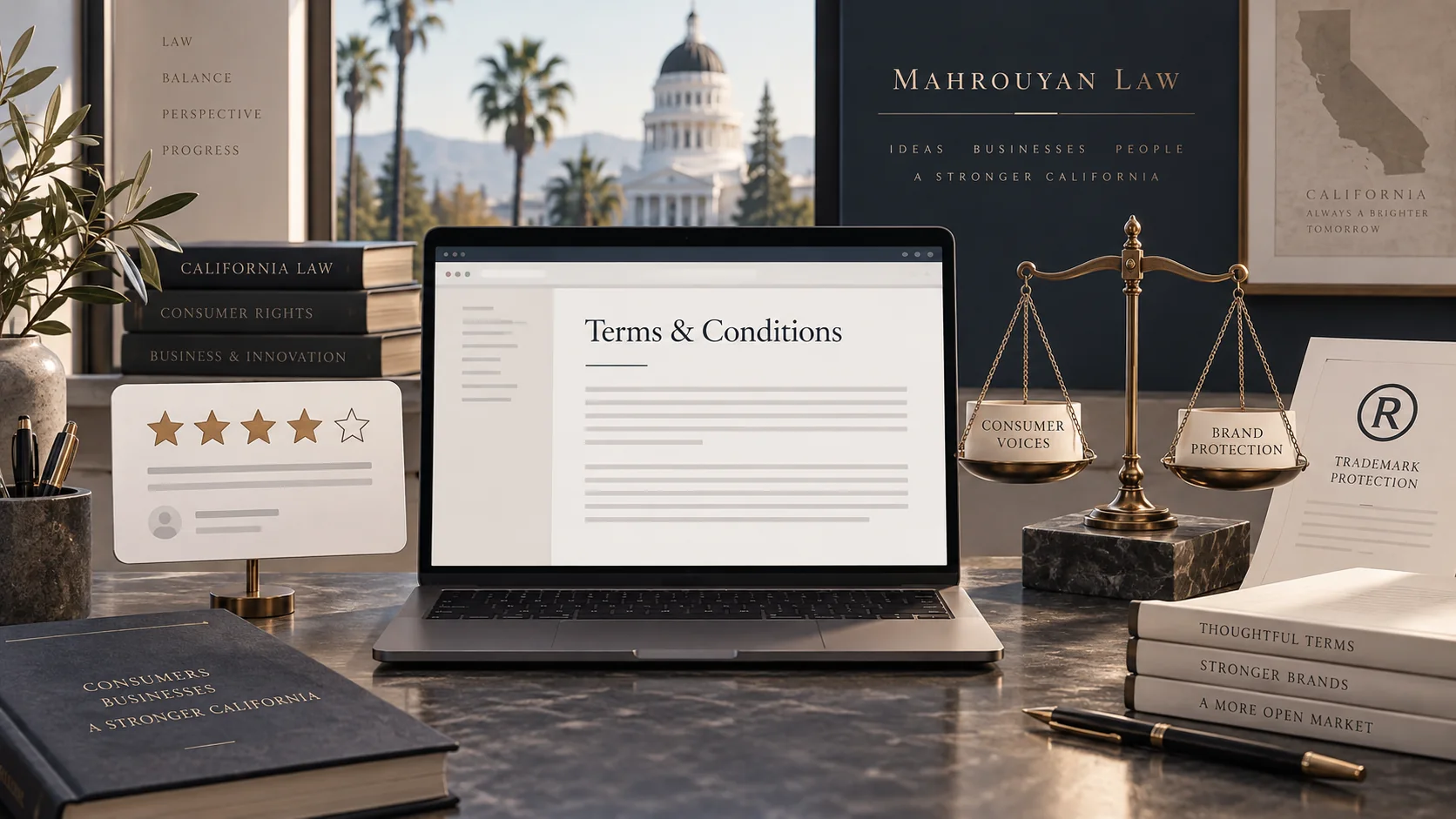
California businesses may protect trademarks and control website access, but they may not contract away consumers’ right to criticize the business. In Scott, Ulta’s particular terms did not cross that line.
- Ulta judgment affirmed
- Decision
- Civil Code § 1670.8
- Law
- Contract language is read in context
- Key principle
What Was the Case About?
Several consumers filed a putative class action against Ulta Beauty entities challenging provisions in Ulta’s online Terms and Conditions under California Civil Code section 1670.8, sometimes called the “Yelp Law.”
The statute generally prohibits consumer contracts from requiring customers to waive the right to make statements about a seller, its employees, goods, or services. It also prohibits threatening to enforce an unlawful provision or otherwise penalizing protected consumer speech.
The plaintiffs challenged two parts of Ulta’s terms.
One provision addressed trademarks and trade dress. It stated, among other things, that Ulta’s trademarks could not be used in ways that caused confusion or “disparaged or discredited” Ulta.
Another provision allowed Ulta to suspend or terminate a customer’s website access for conduct that violated the agreement or that Ulta believed was harmful to its interests or those of others.
The Los Angeles County Superior Court sustained Ulta’s demurrer without leave to amend. The Court of Appeal affirmed.
Why the Word “Disparage” Was Not Enough
The plaintiffs focused heavily on the words “disparages or discredits.”
But the Court of Appeal did not read those words in isolation.
They appeared in a paragraph specifically addressing trademarks and trade dress, alongside restrictions concerning uses of Ulta’s marks with other products and uses likely to confuse customers.
Separate provisions addressed customer reviews and comments.
Read as a whole, the court concluded that the trademark paragraph dealt with brand and trademark use, not a general prohibition against criticizing Ulta.
That distinction matters.
A website term does not become an unlawful consumer non-disparagement provision merely because it contains the word “disparage.”
The contractual context matters.
What About the Right to Block Website Access?
The plaintiffs also challenged language allowing Ulta to suspend or terminate website access for certain harmful conduct.
The Court of Appeal again rejected the broader interpretation.
The provision did not prohibit customers from making statements about Ulta.
It reserved Ulta’s ability to control access to its own website.
Standing alone, that was not a waiver of consumers’ right to criticize the company.
That does not mean a company may retaliate against customers for protected negative reviews.
An actual threat, enforcement effort, or penalty aimed at protected consumer speech may raise a different issue under section 1670.8.
What Does California Civil Code Section 1670.8 Prohibit?
California Civil Code section 1670.8 addresses consumer-review rights in two important ways.
First, a consumer contract may not require the consumer to waive the right to make statements regarding the seller, its employees, goods, or services.
Second, a business may not threaten to enforce an unlawful provision or otherwise penalize a consumer for protected speech.
The statute authorizes civil penalties of up to $2,500 for a first violation; $5,000 for the second and each subsequent violation; and an additional penalty of up to $10,000 for a willful, intentional, or reckless violation.2
In Scott, however, the Court of Appeal found no prohibited speech waiver in the challenged provisions.
What Did the Court Leave Unresolved?
The opinion is also important for what it did not decide.
Earlier in 2026, the Court of Appeal decided Arterberry v. Peet’s Coffee, Inc. (2026) 122 Cal.App.5th 33.3
Arterberry addressed whether civil penalties under section 1670.8 may be recovered merely because a prohibited provision appears in a consumer contract when the business never attempted to enforce it or penalize the consumer.
The plaintiffs in Scott challenged Arterberry’s reasoning.
But the Scott court expressly declined to decide whether Arterberry was correct because it concluded that Ulta’s challenged terms did not violate section 1670.8(a)(1) in the first place.
Businesses therefore should not read Scott as resolving every question concerning civil penalties under the Yelp Law.
What Does This Mean for Businesses Drafting Website Terms?
The practical takeaway is not that California businesses should use broad anti-review clauses.
Website terms should instead distinguish clearly among trademark and brand-protection rules; acceptable-use restrictions; content-moderation policies; website access and termination rights; and consumers’ right to criticize a company or its products.
The clearer those provisions are, the easier it is to show that legitimate brand protection is not intended to silence customer criticism.
Businesses drafting customer and commercial agreements should also consider how the terms are actually enforced.
A provision that is lawful on its face could raise a different legal issue if it is used to penalize a consumer for protected criticism, including in later commercial contract disputes.
Why Trademark Context Matters
The decision also illustrates why intellectual-property provisions should be drafted with their purpose in mind.
Trademark clauses often address source confusion; misuse of logos or brand elements; false affiliation; unauthorized commercial use; and misuse of trade dress.
Those issues differ from a customer simply posting: “I did not like this product.”
The more clearly a contract distinguishes legitimate trademark and intellectual-property protection from consumer-review rights, the lower the risk that those provisions will be read as one sweeping restriction on speech.
The Broader Lesson
Scott v. Ulta Beauty reinforces a basic contract principle: context matters.
California protects consumers’ right to criticize businesses.
At the same time, businesses may protect legitimate trademarks and manage access to their own websites.
The drafting challenge is keeping those concepts separate.
Terms that are precise about what conduct is restricted and why are less likely to create confusion about whether customer speech is being restricted.
Footnotes
Sources & Authorities
- Scott v. Ulta Beauty, Inc., No. B345741 (Cal. Ct. App., 2d Dist., Div. 5, Sept. 18, 2026) — published opinion — Primary authority for the challenged terms, procedural history, contextual analysis, holding, and unresolved Arterberry issue.
- Cal. Civ. Code § 1670.8 — Official statutory text governing consumer-speech waivers, enforcement or penalties, and civil penalties.
- Arterberry v. Peet’s Coffee, Inc. (2026) 122 Cal.App.5th 33 — published opinion — Addresses the separate question of civil penalties when no enforcement, threat, or penalty is alleged.
Mahrouyan Law handles these matters directly. Read more about how the firm approaches startup & business transactions in California, or discuss your own situation with the firm.
Discuss Your Matter
Mahrouyan Law advises businesses and founders on selected contracts, website terms, trademark, intellectual-property, and commercial-dispute matters. Careful drafting can help businesses protect legitimate interests without creating unnecessary contractual risk.

Omeed Mahrouyan is the founder of Mahrouyan Law, P.C., a California firm handling business and commercial litigation, property and cargo damage claims, personal injury, landlord representation, startup transactions, and practical intellectual property matters. Clients work directly with him on strategy, drafting, and case decisions.
More about Omeed Mahrouyan →