
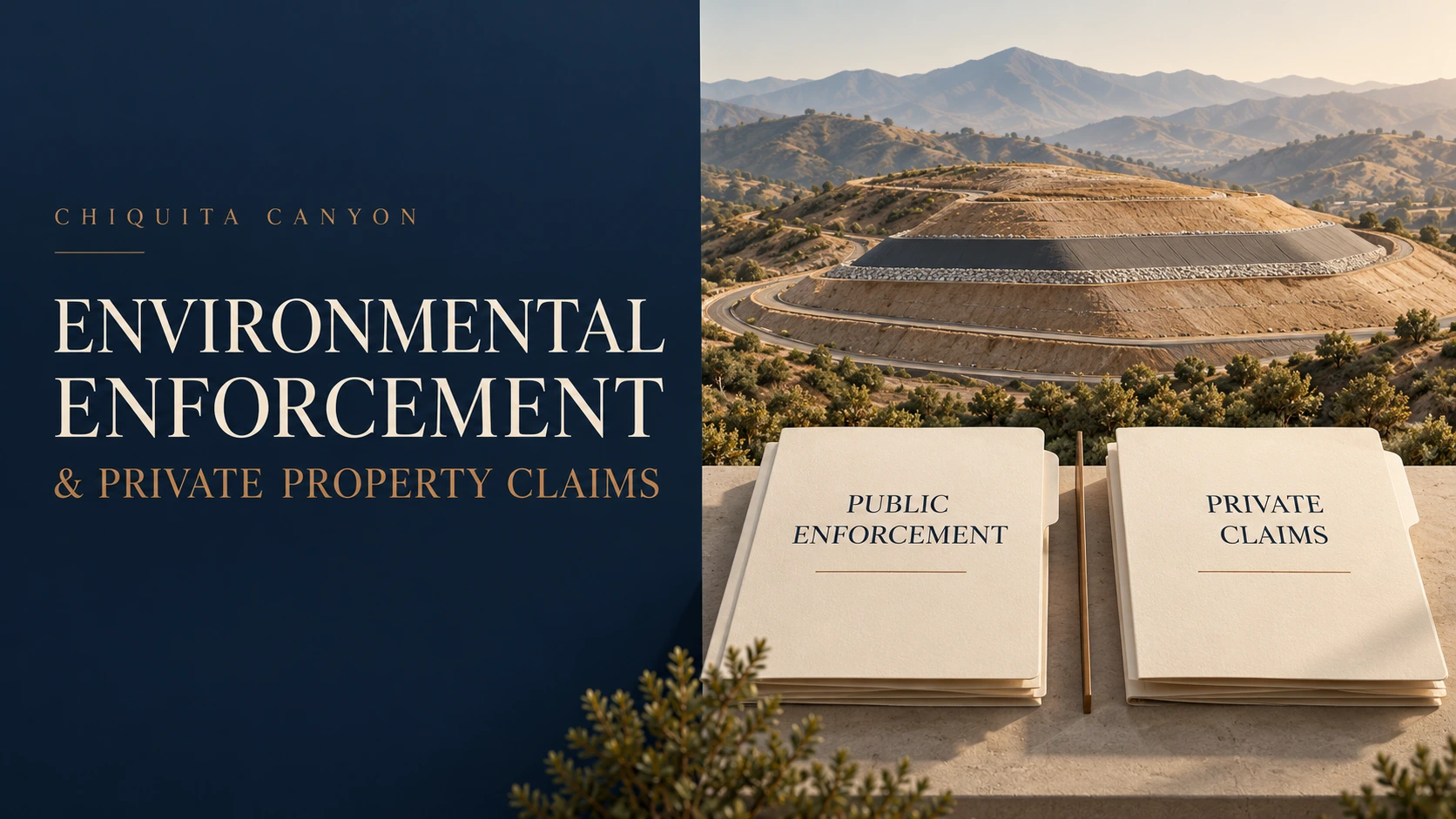
Government enforcement and private property-damage recovery serve different purposes. A new state lawsuit does not automatically establish an individual owner’s right to compensation.
On October 27, 2026, California Attorney General Rob Bonta and the Department of Toxic Substances Control announced a lawsuit involving the owners and operators of Chiquita Canyon Landfill in Los Angeles County. The new state action is distinct from existing county enforcement and private resident litigation. 1
The state alleges hazardous-waste management failures involving leachate—liquid that travels through or drains from landfill waste—including improper handling and releases. These are allegations, not judicial findings. The filing is not a verdict, settlement or established compensation program. 2
1. Public Enforcement and Private Compensation Serve Different Purposes
The state seeks civil penalties, injunctions and other equitable relief, including an environmental abatement fund. Those remedies address compliance, pollution and protection of natural resources; they are distinct from compensation for a particular owner’s property losses. The fund is requested relief, not an established program. 2
Government actions are not categorically incapable of providing monetary relief to affected people. This complaint also requests restoration of money or property acquired through unfair competition. But requested restitution is not the same as an award of property-damage compensation, and the complaint does not itself establish any individual owner’s entitlement. 2
2. Private Recovery Requires Its Own Legal Basis and Proof
Depending on the circumstances, potential theories may include nuisance, trespass or negligence. Each has distinct requirements. Nuisance may concern substantial interference with property use or enjoyment; trespass concerns unauthorized entry, including causing a thing to enter property. Negligence requires its own duty and fault analysis. Proximity to the landfill alone does not establish a claim. 3
A claimant generally must establish the applicable claim, a causal connection and legally recoverable harm. A regulatory allegation does not supply that proof. Nor does hazardous material at the landfill establish contamination of a particular neighboring parcel. The relevant question is what happened to the claimant’s property and whether the evidence connects it to actionable conduct. 3
3. Claimed Losses Must Be Supported
Repair expenses, loss of use, reduced property value and business losses require supporting evidence. They are not automatically recoverable or necessarily cumulative. California’s property-damage rules distinguish repair costs from diminished value, with qualifications; the same loss cannot be recovered twice simply by asserting multiple legal theories. 4
Business losses also require care. Lost revenue is not automatically lost profit: a claim for lost profits requires reasonable certainty and a reasonable basis for calculation, with expenses deducted. Our article on business-interruption losses explains these proof issues in more detail. 4
Photographs, repair invoices, property records and business records can help document the condition of property, expenses and claimed interruption. Preserve relevant dates and communications as well. These materials can assist evaluation; they do not themselves prove causation, contamination or liability. Avoid assuming that a government filing replaces the evidence needed for your own dispute.
Sources
- 1.
- 2.
- 3.
- 4.
Discuss a Property-Damage Dispute
If you are evaluating a property-damage dispute, you can discuss the circumstances with Mahrouyan Law. Learn more about our Commercial Property, Equipment & Cargo Damage practice. Recovery depends on the facts and applicable law.

Omeed Mahrouyan is the founder of Mahrouyan Law, P.C., a California firm handling business and commercial litigation, property and cargo damage claims, personal injury, landlord representation, startup transactions, and practical intellectual property matters. Clients work directly with him on strategy, drafting, and case decisions.
More about Omeed Mahrouyan →