
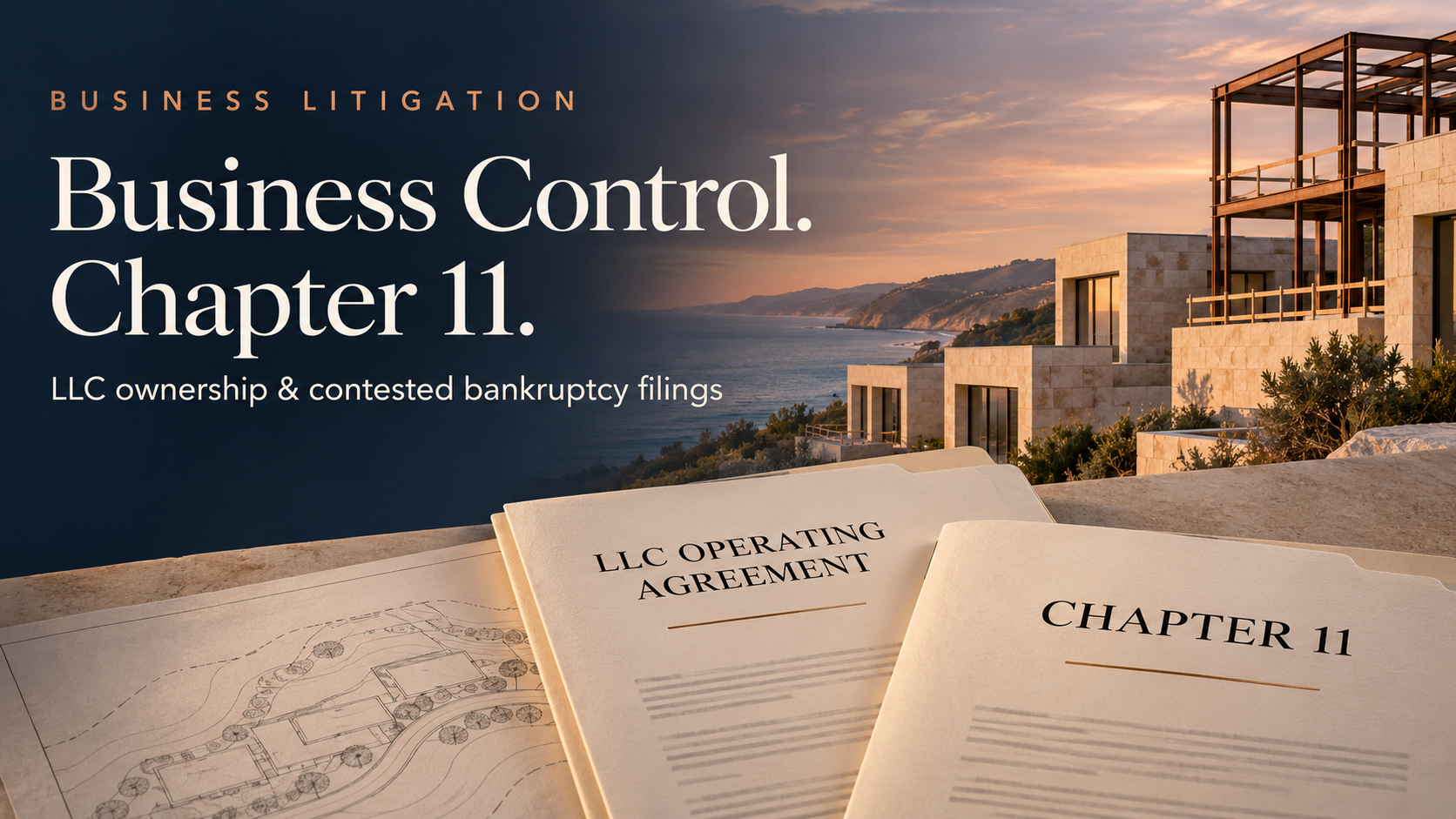
LLC authority and a legitimate bankruptcy purpose are separate questions. A reported Malibu development dispute illustrates why both need careful analysis.
A reported dispute over the Case, a five-home Malibu development, puts those distinctions in focus. Wall Street Journal reporting, available in a Dow Jones-distributed version, describes Scott Gillen’s development role, Barry Shy as his partner, and financing through an LLC tied to Shy. The competing accounts of funding and project control are allegations, not findings.
Two Entity Cases, Not a Personal Bankruptcy
Commercial docket indexes identify In re 600 Spring, LLC, No. 9:26-bk-11018-RC, and In re Glass Tunnel LLC, No. 9:26-bk-11019-RC, as separate Chapter 11 proceedings filed July 16, 2026, in the Central District of California. An entity’s filing does not make its manager a personal bankruptcy debtor.
The 600 Spring docket index and Glass Tunnel docket index each record October 27 opposition papers concerning dismissal motions alleging bad faith. These commercial indexes are not the court’s official website. An entry establishes indexed filing activity; it does not establish that a motion’s assertions are true or that dismissal is warranted.
Who Can Authorize the Petition?
Filing authority begins with governing documents and applicable entity law. An operating agreement, amendments, management structure, and required approvals can matter. Equity ownership, authority to manage ordinary business, and authority to approve bankruptcy are not necessarily identical. A manager’s signature or a 50% ownership interest does not conclusively settle authorization.
Price v. Gurney, 324 U.S. 100, 106 (1945), explains that authority to act for a corporation comes from applicable local law. That older corporate case supplies a general distinction, not an LLC-specific answer. Authorization is discussed here as a general governance issue, not as an established allegation in the Malibu proceedings.
Good Faith Is a Separate Inquiry
Under 11 U.S.C. § 1112(b), a party in interest may seek relief for cause. The current statute directs dismissal or conversion to Chapter 7 according to creditors’ and the estate’s best interests, subject to exceptions and alternatives, including appointment of a trustee or examiner. Dismissal ends the case; conversion continues it under a different chapter.
In re Marsch, 36 F.3d 825 (9th Cir. 1994), recognizes that lack of good faith can constitute cause. Courts examine the circumstances and bankruptcy purpose rather than a single fact or the filer’s stated intentions. Marsch involved an individual’s effort to avoid an appeal bond despite sufficient assets—a materially different setting. It does not determine the Malibu outcome or replace today’s statutory framework.
What Chapter 11 Does—and Does Not—Resolve
A control dispute alone does not establish bad faith. Legitimate bankruptcy purposes can include restructuring obligations or conducting an orderly sale or liquidation. Section 1123(b)(4) expressly permits a plan providing for sale of all or substantially all estate property and distribution of proceeds. Whether a particular filing serves those purposes remains case-specific.
Under 11 U.S.C. § 362, filing generally stays specified litigation and collection activity against the debtor and protected property. Exceptions and relief from stay matter. The stay does not stop every lawsuit, automatically protect every owner or guarantor personally, or conclusively decide disputed debts and ownership rights.
The Business Takeaway: Preserve the Approval Record
Review operating agreements, financing documents, guarantees, approval requirements, and contemporaneous communications before a control dispute escalates. Keep records showing what was authorized, by whom, and under which provisions. Separate the underlying ownership and contract dispute from bankruptcy procedure. Bankruptcy itself proves neither misconduct nor insolvency; the documents, evidence, and applicable law drive the analysis.
Discuss an LLC Governance or Commercial Dispute
Explore Mahrouyan Law’s Business Litigation and Startup & Business Transactions practices, or contact the firm about an ownership, operating-agreement, or contract dispute. Bankruptcy procedure may require separate counsel and analysis.

Omeed Mahrouyan is the founder of Mahrouyan Law, P.C., a California firm handling business and commercial litigation, property and cargo damage claims, personal injury, landlord representation, startup transactions, and practical intellectual property matters. Clients work directly with him on strategy, drafting, and case decisions.
More about Omeed Mahrouyan →