The Ninth Circuit held that federal aviation-security immunity can extend beyond an airline’s initial report of suspicious activity to conduct flowing from law enforcement’s response—but the protection is not absolute, and the statute contains important limits.
- U.S. Court of Appeals for the Ninth Circuit
- Court
- September 23, 2026
- Published opinion filed
- Summary judgment for Delta affirmed
- Disposition
- 2–1, with a dissent by Judge Higginson
- Panel
Ninth Circuit Addresses Airline Security-Report Immunity
Federal law gives airlines a specific protection when they report possible security threats to law enforcement. A new published Ninth Circuit decision addresses how far that protection reaches.
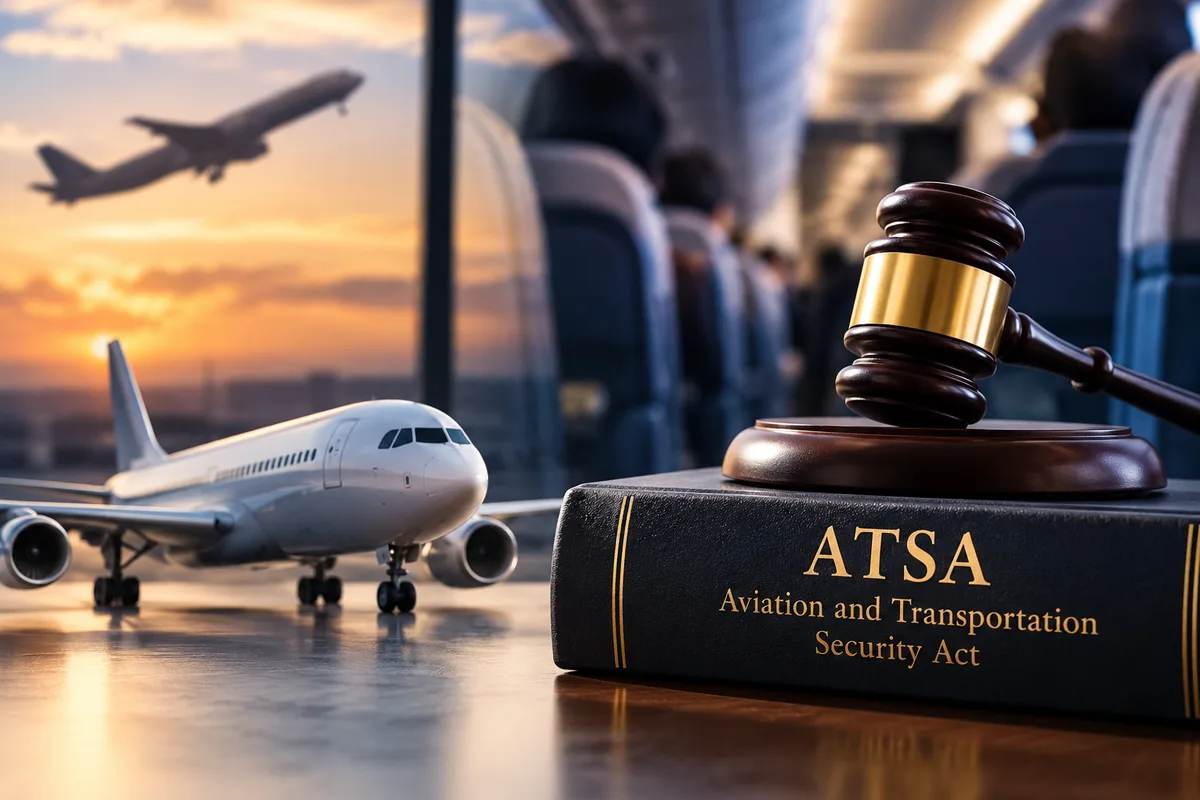
In Bandary v. Delta Air Lines, Inc., the court considered, as a question of first impression in the circuit, whether immunity under the Aviation and Transportation Security Act (ATSA) covers only the report itself—or also what happens after law enforcement responds.
What Happened in Bandary v. Delta
In May 2015, Atef Bandary was a passenger on a Delta flight from Atlanta to Salt Lake City.
Several passengers testified that they were concerned about Bandary’s conduct. At least one—an off-duty pilot for another airline—reported his concerns directly to flight attendants, and the lead flight attendant later learned of other passenger concerns from colleagues. Accounts of what happened next were disputed at trial.
After consulting with the captain, the lead flight attendant approached Bandary. The encounter escalated, and she sought help from a federal law-enforcement agent on board. The agent intervened, and Bandary was restrained with flight-attendant assistance until the plane landed.
Bandary sued Delta under the Montreal Convention, alleging physical injuries from the restraint and resulting emotional injuries.
Why the $7.2 Million Jury Verdict Did Not Control
A jury found that Delta was not entitled to ATSA immunity. After accounting for contributory negligence, it awarded Bandary about $7.2 million in bodily-injury and emotional-distress damages.
The district court then granted Delta a new trial, finding the damages excessive, and vacated the verdict in its entirety. Delta next moved for summary judgment based on ATSA immunity, and the district court granted it.2
The Ninth Circuit reviewed that summary-judgment ruling. Because the verdict had been vacated, it was no longer operative—the court explained that the parties were left as if no trial had taken place. The Ninth Circuit did not itself overturn a jury award.
What the Aviation and Transportation Security Act Protects
Under 49 U.S.C. § 44941(a), an airline or airline employee that makes a voluntary disclosure of a suspicious transaction relating to air piracy, a threat to aircraft or passenger safety, or terrorism to appropriate law-enforcement or security officials generally is not civilly liable for that disclosure.
Congress adopted the protection so that airlines and their employees would not hesitate to share security information.3
The Ninth Circuit's New Rule
Bandary argued that the immunity covered only the act of reporting, not later conduct by airline employees. The majority, in an opinion by Judge Nguyen, disagreed.
The court held that ATSA immunity applies both to the initial disclosure to law enforcement and to conduct stemming from law enforcement’s decisions following that disclosure.4
In doing so, the Ninth Circuit joined the Second Circuit in Baez v. JetBlue Airways Corp., 793 F.3d 269 (2d Cir. 2015), and the Fifth Circuit in Abdallah v. Mesa Air Group, Inc., 83 F.4th 1006 (5th Cir. 2023).
Applying that rule, the majority concluded that there was no genuine dispute that the conduct reported would appear suspicious to a reasonable airline employee, that the agent—not Delta alone—directed the restraint, and that Bandary showed no triable physical injury before the agent became involved.
Because Delta was immune for the physical injuries, the court held that Bandary could not recover the claimed emotional injuries under the Montreal Convention theory presented.
ATSA Immunity Is Not Absolute
The decision should not be summarized as “airlines cannot be sued after calling law enforcement.” That would be too broad.
Under § 44941(b), the immunity does not apply to a disclosure made with actual knowledge that it was false, inaccurate, or misleading, or with reckless disregard for its truth or falsity. The Ninth Circuit noted that this exception was not at issue in Bandary.5
The opinion also recognized, citing Abdallah, that ATSA does not immunize harm that occurs solely because of the airline’s own actions. In Abdallah, an airline’s independent decision to delay a flight after security officials found no concern fell outside the immunity.6
Judge Higginson dissented. He would have reversed, reasoning that the earlier jury’s finding that the suspicious-activity disclosure requirement was not met showed a genuine factual dispute about whether Bandary acted suspiciously. The dissent is not controlling.7
What the Decision Means
A personal-injury claim can turn on more than whether someone was hurt and what the injuries are worth. Separate doctrines, including statutory immunity, can decide whether a particular defendant may be held liable at all.
In airline incidents involving security reports, courts may examine what was communicated to law enforcement, whether it qualified under § 44941, whether a statutory exception applies, who made the decisions that led to the alleged injury, and whether the challenged conduct flowed from law enforcement’s decisions or solely from the airline’s independent actions.
Mahrouyan Law is not involved in Bandary and does not handle aviation-law matters as a specialty. In the firm’s personal injury practice, liability questions can depend on threshold legal rules as well as proof of injury and damages—an issue that also arose in the firm’s discussion of an Orange County rideshare arbitration award.
For how liability, evidence, and insurance affect case value more generally, see How Much Is My Personal Injury Case Worth in California?
Footnotes
- Bandary v. Delta Air Lines, Inc., No. 24-7204, slip op. at 10 n.1, 12–16 (9th Cir. Sept. 23, 2026) ↩
- Bandary, slip op. at 8–9, 16 (verdict, new trial, vacatur, and summary judgment) ↩
- Bandary, slip op. at 11–12 (citing Air Wisconsin Airlines Corp. v. Hoeper, 571 U.S. 237, 248–49, 257 (2014)) ↩
- Bandary, slip op. at 12–13 (immunity extends to conduct flowing from law enforcement’s decisions after a qualifying disclosure) ↩
- 49 U.S.C. § 44941(b) (statutory exceptions); Bandary, slip op. at 10 n.1 (exceptions not at issue) ↩
- Bandary, slip op. at 16 (conduct solely attributable to the airline; Abdallah) ↩
- Bandary, slip op. at 17–18 (Higginson, J., dissenting) ↩
Sources & Authorities
- U.S. Court of Appeals for the Ninth Circuit — Bandary v. Delta Air Lines, Inc., No. 24-7204 (Sept. 23, 2026) — Read Official Opinion (PDF) → — Published opinion; primary source for the facts, procedural history, holding, and dissent.
- 49 U.S.C. § 44941 — Immunity for reporting suspicious activities — Official U.S. Code text, Office of the Law Revision Counsel.
- Baez v. JetBlue Airways Corp., 793 F.3d 269 (2d Cir. 2015) — As described in the Ninth Circuit opinion.
- Abdallah v. Mesa Air Group, Inc., 83 F.4th 1006 (5th Cir. 2023) — As described in the Ninth Circuit opinion.
Mahrouyan Law handles selected California personal injury matters directly. Read more about how the firm approaches personal injury in California, or discuss your own situation with the firm.
Discuss Your Matter
Mahrouyan Law handles selected California personal injury matters. If you have questions about who may be responsible for an injury—and whether any legal protection may limit a claim—you can contact the firm to discuss your situation.

Omeed Mahrouyan is the founder of Mahrouyan Law, P.C., a California firm handling business and commercial litigation, property and cargo damage claims, personal injury, landlord representation, startup transactions, and practical intellectual property matters. Clients work directly with him on strategy, drafting, and case decisions.
More about Omeed Mahrouyan →