
A California AI company says OpenAI's GPT-6 Astra creates reverse trademark confusion. Learn what that theory means and why startup trademark clearance matters.
A smaller company does not automatically lose a trademark dispute simply because a later user becomes much more famous. That unusual problem is at the center of a newly filed California lawsuit against OpenAI.
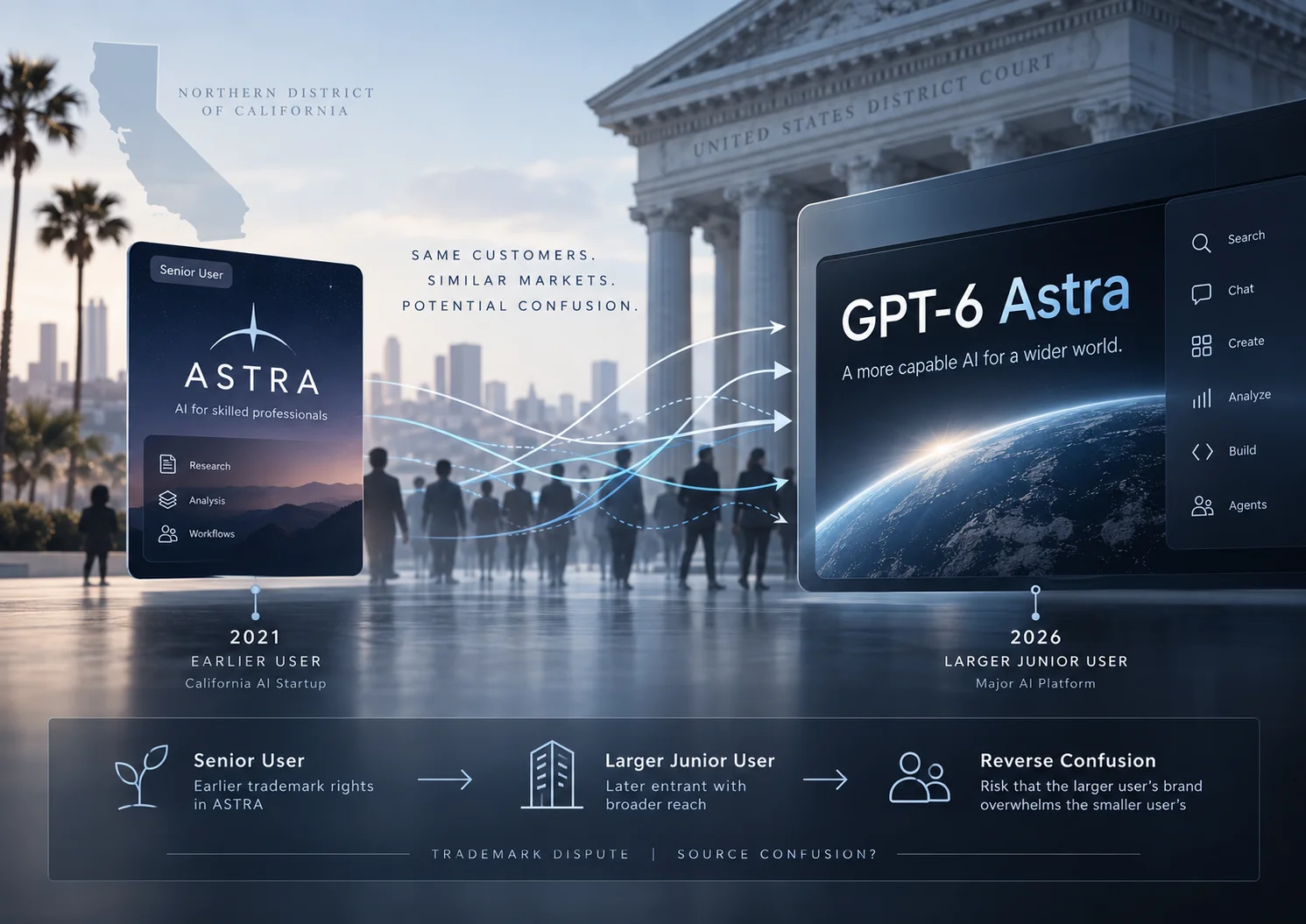
On October 5, 2026, Del Mar-based TradeSun, Inc. filed a federal trademark action against OpenAI entities in the Northern District of California over OpenAI’s use of the name Astra for GPT-6 Astra. TradeSun alleges that it has used ASTRA for its artificial-intelligence software since 2021 and owns federal Registration No. 6,746,198. OpenAI publicly introduced GPT-6 Astra in September 2026.
TradeSun’s theory is not simply that consumers will mistake OpenAI for TradeSun. It alleges the opposite: OpenAI’s far greater visibility may cause customers encountering TradeSun’s older ASTRA product to assume that TradeSun is affiliated with OpenAI. Trademark law calls that theory reverse confusion.
The allegations remain disputed. OpenAI has reportedly said the complaint “lacks any merit whatsoever,” and no court has found infringement.
What Is Reverse Trademark Confusion?
Traditional, or “forward,” confusion usually involves a later company adopting a mark similar to an established brand, leading customers to believe the later company’s product comes from or is sponsored by the established brand.
Reverse confusion turns that around. The later user is much larger or more prominent, and its use becomes so visible that customers encountering the earlier, smaller trademark owner may believe its product comes from, or is affiliated with, the larger junior user.
The Ninth Circuit expressly recognizes this theory. In Marketquest Group, Inc. v. BIC Corp., 862 F.3d 927 (9th Cir. 2017), the court explained that reverse confusion occurs when consumers dealing with the senior user mistakenly believe they are dealing with the junior user. It also made clear that reverse confusion is not a separate claim; it is a theory for establishing likelihood of confusion in an ordinary infringement case.
What TradeSun Alleges
According to federal trademark records, TradeSun’s ASTRA registration covers software-as-a-service offerings using artificial intelligence for document classification, data extraction, and data processing. It issued May 31, 2022 and claims first use in commerce on May 21, 2021.
OpenAI introduced GPT-6 Astra in September 2026 as part of its AI-model lineup, available through ChatGPT and enterprise and developer channels. According to the complaint, the companies’ products and potential customers overlap enough that OpenAI’s use of Astra creates a likelihood of confusion.
Those are TradeSun’s allegations. OpenAI has not conceded that the products are related, that consumers are likely to be confused, or that TradeSun is entitled to any relief.
Does Earlier Use Automatically Mean TradeSun Wins?
No. Priority matters in trademark law, but earlier use and federal registration do not by themselves decide infringement. The central question remains whether the challenged use is likely to cause consumer confusion.
Published Ninth Circuit authority, including AMF Inc. v. Sleekcraft Boats and Ironhawk Technologies, Inc. v. Dropbox, Inc., 2 F.4th 1150 (9th Cir. 2021), evaluates that question through a fact-specific analysis that may include:
- the strength and similarity of the marks;
- relatedness of the goods or services;
- evidence of actual confusion and overlapping marketing channels;
- the degree of purchaser care and the junior user’s intent; and
- likely expansion of the parties’ product lines.
Why a Famous Junior User Creates a Different Problem
These factors are not a mechanical scorecard. An identical word can sometimes coexist lawfully for unrelated goods or services, while similar marks can create actionable confusion where commercial contexts substantially overlap.
Imagine Startup A has legitimately used a mark for years. Then a much larger company launches a product under the same or a similar name. Customers may begin asking whether Startup A is a smaller version of the larger company’s product, a licensee, or a business trying to capitalize on the larger brand.
The legal concern is that a larger junior user’s commercial strength may overwhelm the identity of the smaller senior user’s mark. Whether that has happened in the TradeSun litigation remains to be proven.
Federal Registration Helps—but It Does Not End the Case
Federal registration can provide important procedural and substantive advantages, but it is not an automatic judgment against every later use of the same word. A defendant may dispute likelihood of confusion, the scope or strength of the rights, commercial relatedness, validity, defenses, or the requested remedy.
USPTO records also show that an April 2026 third-party cancellation proceeding against the ASTRA registration was terminated in July after the petitioner withdrew. That procedural termination is not a ruling on the merits and is not evidence that OpenAI infringed the mark.
Why Trademark Clearance Before Launch Matters
Whatever happens in the lawsuit, the dispute illustrates an important startup lesson: trademark clearance is most useful before a company is committed to a name. For a technology company, a product name quickly becomes embedded in code, APIs, documentation, customer agreements, domains, app listings, advertising, and investor materials.
A conflict discovered before launch may require choosing a different name. The same conflict discovered after a major launch can carry far greater operational and commercial consequences. Meaningful clearance also looks beyond exact matches to similar marks and the goods or services they are used for—part of broader startup formation, IP ownership, and launch planning.
What Records Should a Startup Keep?
Businesses building a brand should keep reliable records showing when and how the mark was adopted and used. Depending on the business, these may include:
- dated product screenshots, website archives, and release histories;
- customer contracts, invoices, and sales records;
- launch announcements, marketing materials, and domain records; and
- USPTO specimens and documents showing the company’s clearance and naming process.
What Is TradeSun Asking the Court to Do?
TradeSun is seeking restrictions on OpenAI’s challenged use of the Astra name and monetary remedies tied to the alleged infringement. Those are requests in a newly filed complaint. No court has ordered OpenAI to stop using Astra, found OpenAI liable, or awarded TradeSun damages or profits.
The Broader Lesson for Startups
A trademark dispute is not automatically won by the company with the largest market presence, nor by the party holding a registration. A larger junior user can potentially create actionable reverse confusion, but infringement still requires a fact-specific likelihood-of-confusion analysis—and it has not been established in the TradeSun case.
Mahrouyan Law, P.C. provides trademark clearance and intellectual-property counsel to California startups and businesses, including federal applications, ownership, licensing, cease-and-desist issues, and selected IP disputes.
Frequently Asked Questions
What is reverse trademark confusion?
Reverse confusion can occur when a larger junior trademark user becomes so commercially prominent that consumers encountering the smaller senior user’s mark mistakenly believe the senior user’s product is affiliated with or comes from the larger junior user.
Does the company that uses a trademark first automatically win?
No. Priority can be important, but trademark infringement generally also requires likelihood of confusion and depends on the marketplace context, scope of rights, defenses, and other facts.
Does a federal trademark registration guarantee victory in an infringement case?
No. Registration can provide important rights and evidentiary advantages, but infringement still requires the applicable legal showing, including likelihood of confusion.
Is reverse confusion a separate trademark claim?
No. The Ninth Circuit treats reverse confusion as a theory of likelihood of confusion within a trademark-infringement claim.
Has a court ruled that OpenAI infringed TradeSun's ASTRA mark?
No. TradeSun filed its complaint on October 5, 2026. The allegations have not been adjudicated, and OpenAI disputes them.
Sources & Authorities
- TradeSun, Inc. v. OpenAI OpCo, LLC et al., No. 3:26-cv-11360 (N.D. Cal. filed Oct. 5, 2026) — complaint (allegations only)
- USPTO TSDR — ASTRA, Reg. No. 6,746,198 (TradeSun, Inc.)
- USPTO TTAB — Cancellation No. 92091356 (terminated July 13, 2026)
- OpenAI — Introducing GPT-6 Astra
- Marketquest Group, Inc. v. BIC Corp., 862 F.3d 927 (9th Cir. 2017)
- Ironhawk Technologies, Inc. v. Dropbox, Inc., 2 F.4th 1150 (9th Cir. 2021)
- AMF Inc. v. Sleekcraft Boats, 599 F.2d 341 (9th Cir. 1979)
- Lanham Act, 15 U.S.C. § 1114
Mahrouyan Law handles these matters directly. Read more about how the firm approaches trademarks & practical intellectual property counsel in California, or discuss your own situation with the firm.
Choosing a Name—or Facing a Similar Mark?
If you are selecting a new product or company name, or another business has begun using a similar mark, contact Mahrouyan Law, P.C. to discuss trademark clearance and available options.

Omeed Mahrouyan is the founder of Mahrouyan Law, P.C., a California firm handling business and commercial litigation, property and cargo damage claims, personal injury, landlord representation, startup transactions, and practical intellectual property matters. Clients work directly with him on strategy, drafting, and case decisions.
More about Omeed Mahrouyan →