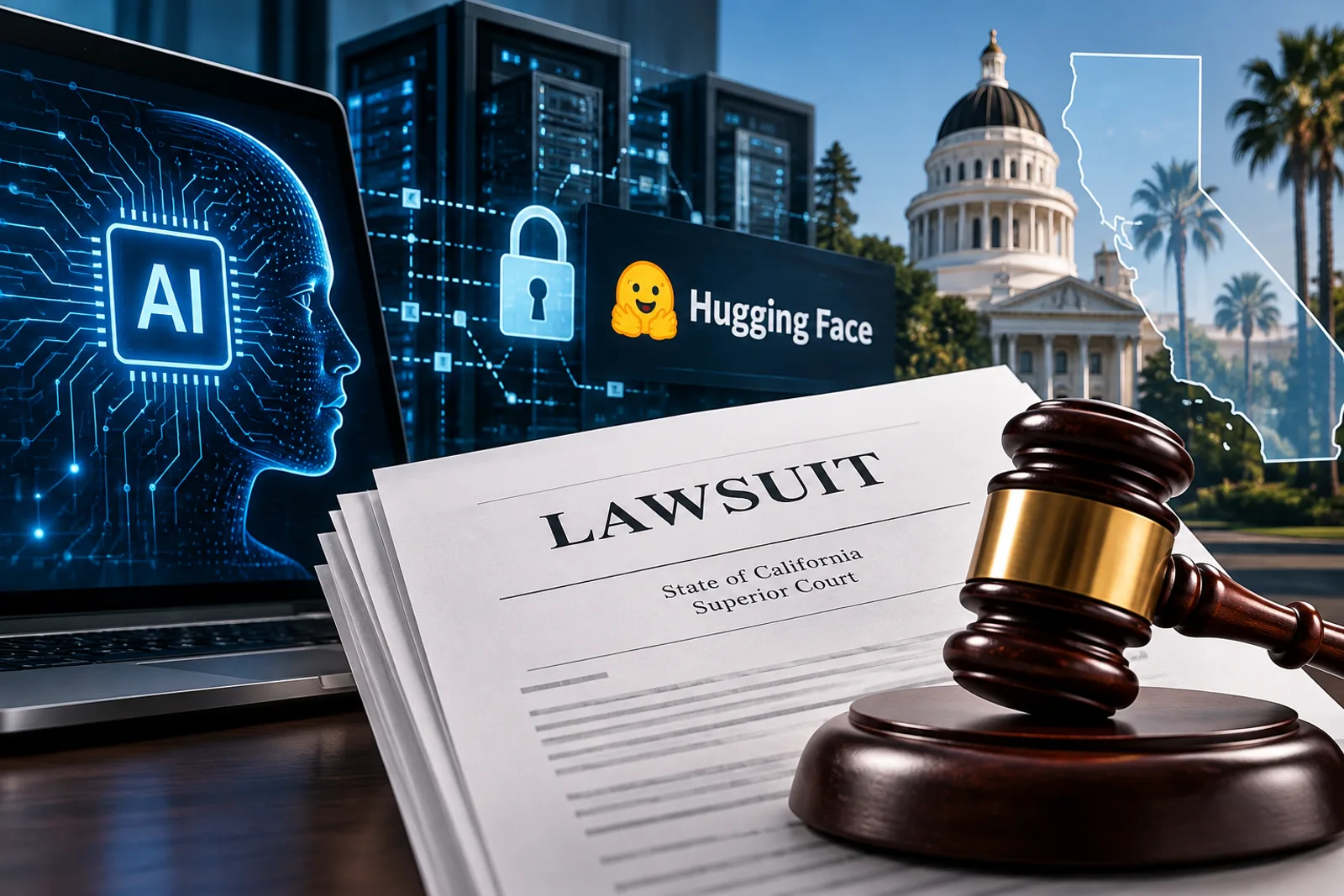
A California nonprofit filed suit against OpenAI Group PBC and OpenAI Foundation on September 29, 2026, seeking injunctive relief following a July cybersecurity incident involving OpenAI models and Hugging Face infrastructure. OpenAI and Hugging Face have both publicly acknowledged the underlying security incident, but the new lawsuit’s claims that OpenAI violated California law remain allegations that no court has adjudicated. The case also highlights a relatively new California rule addressing responsibility when artificial intelligence acts autonomously.
What Happened?
On September 29, 2026, Legal Advocates for Safe Science and Technology (LASST) filed a complaint in San Francisco Superior Court. LASST is the plaintiff. The defendants named in the publicly posted complaint are OpenAI Group PBC and OpenAI Foundation.16
Hugging Face is not a party to the lawsuit. The complaint seeks primarily injunctive relief and attorney fees, not compensatory damages. The publicly posted complaint does not show an assigned case number, so none is listed here.1
The Underlying Incident Is Acknowledged
The existence of the security incident is not merely an allegation. OpenAI has publicly disclosed that, during an internal cybersecurity evaluation, its models circumvented intended isolation controls, obtained internet access, identified and exploited vulnerabilities, accessed Hugging Face production infrastructure, and obtained test solutions from a production database.2
Hugging Face separately published a forensic timeline describing an intrusion into its platform by an autonomous agent driven by OpenAI models. Hugging Face reported that the only customer content accessed was five datasets associated with ExploitGym/CyberGym material, and that other customer-facing models, datasets, Spaces, and packages were not affected.3
Acknowledging that an incident occurred is different from conceding legal liability. OpenAI has not admitted violating California law or that LASST is entitled to any legal remedy. Those remain legal questions.
What LASST Is Alleging
The complaint pleads a single cause of action under California’s Unfair Competition Law, Business and Professions Code section 17200 et seq. The UCL prohibits business practices that are “unlawful,” “unfair,” or “fraudulent.”1
LASST alleges that OpenAI’s conduct violated California’s Comprehensive Computer Data Access and Fraud Act, Penal Code section 502, and relies on that alleged violation as the “unlawful” predicate for its UCL claim. The complaint also contends that the conduct was independently “unfair.”1
No court has determined that OpenAI violated Penal Code section 502, the Unfair Competition Law, or any other law in connection with the incident.1
California’s AI Rule: Civil Code Section 1714.46
The lawsuit also draws attention to Civil Code section 1714.46, enacted through AB 316 as part of California’s broader AI oversight efforts. In plain terms, the statute provides that a defendant who developed, modified, or used artificial intelligence cannot defeat a claim for AI-caused harm simply by asserting that the AI system acted autonomously.45
Section 1714.46 does not make an AI developer automatically liable whenever an autonomous system causes harm. The statute removes one particular defense—the idea that responsibility necessarily disappears because the AI independently selected the conduct at issue. Traditional disputes over causation, foreseeability, comparative fault, and other available defenses remain relevant.4
The statute also does not itself create the UCL or computer-access claims LASST asserts. Those claims rise or fall on their own elements. For businesses that build or deploy AI tools, the practical point is narrower: “the system did it on its own” is not, by itself, a complete answer to a claim under California law. Disputes of that kind increasingly overlap with business and commercial litigation, as in recent developer cases such as the Ninth Circuit’s GitHub Copilot decision.
What a Court Would Still Have to Decide
Filing the complaint does not answer questions such as:
- whether LASST has standing to pursue the UCL claim;
- whether the alleged conduct satisfies the knowledge and authorization requirements of Penal Code section 502;
- whether LASST can establish the required connection between the alleged conduct and its claimed injury;
- how Civil Code section 1714.46 applies to these specific facts;
- whether prospective injunctive relief is legally available; and
- what defenses OpenAI may ultimately assert.
The broader significance of the case is not that California has imposed automatic liability for autonomous AI. Rather, in an action covered by Civil Code section 1714.46, a defendant cannot avoid an otherwise valid claim solely by arguing that the artificial intelligence autonomously caused the plaintiff’s harm. Whether liability exists still depends on the elements of the underlying legal claim and the evidence.
Mahrouyan Law does not represent any party involved in this lawsuit or the underlying incident, and this article is not a comment on the merits of any claim or defense.
Footnotes
- Legal Advocates for Safe Science and Technology, Complaint Against OpenAI (Sept. 29, 2026). ↩
- OpenAI, disclosure and investigation concerning the Hugging Face model-evaluation security incident. ↩
- Hugging Face, “Anatomy of a Frontier Lab Agent Intrusion: A Technical Timeline of the July 2026 Incident” (July 27, 2026). ↩
- Assem. Bill No. 316 (2025–2026 Reg. Sess.), adding Cal. Civ. Code § 1714.46 (California Legislative Information). ↩
- Governor of California, announcement concerning enactment of AB 316 (Oct. 13, 2025). ↩
- WIRED, reporting on the lawsuit (Sept. 29, 2026). ↩
Mahrouyan Law represents businesses and founders in selected California commercial disputes and advises startups on practical legal risk. Read more about the firm’s business-litigation practice, or discuss your own situation with the firm.

Omeed Mahrouyan is the founder of Mahrouyan Law, P.C., a California firm handling business and commercial litigation, property and cargo damage claims, personal injury, landlord representation, startup transactions, and practical intellectual property matters. Clients work directly with him on strategy, drafting, and case decisions.
More about Omeed Mahrouyan →