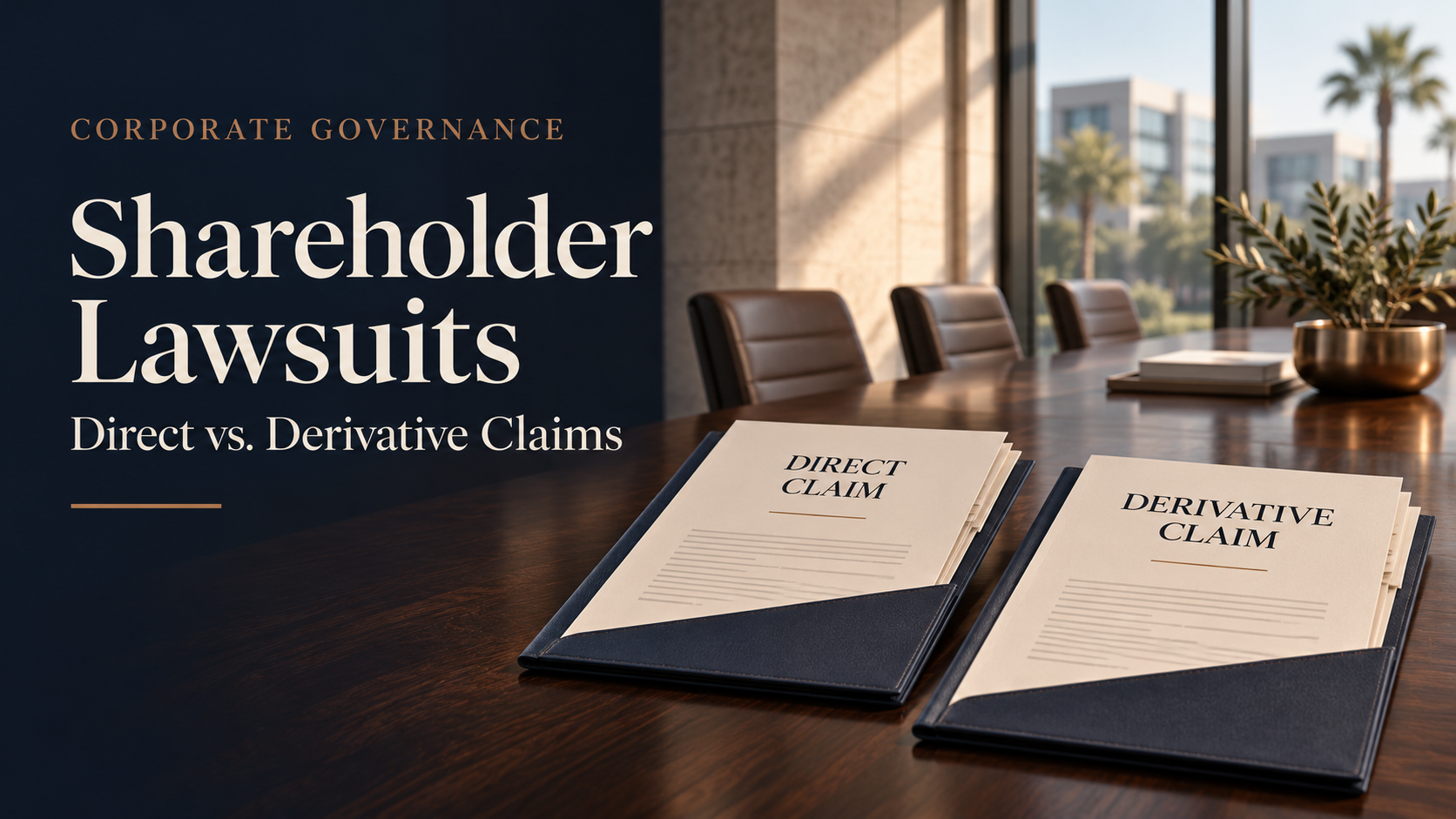
The same events can produce different shareholder lawsuits. A reported Rivian derivative settlement is distinct from the $250 million investor class action—and the difference turns on whose right is being enforced.
Related events can produce different lawsuits. Investors may assert their own rights, while derivative plaintiffs pursue rights that belong to the corporation itself. Resolving one proceeding does not necessarily resolve the other; the actual claims, releases, and court orders control what is settled and what remains.
According to Law360’s November 3, 2026 report, parties notified a California federal court that they had reached a settlement of derivative claims involving alleged nondisclosure of Rivian’s vehicle production costs before its initial public offering. 2
Separately, Rivian’s Form 10-Q for the quarter ended September 30, 2026 disclosed a $250 million securities class-action settlement, with final approval and judgment entered in May 2026. That $250 million figure belongs to the investor class action, not to the reported derivative settlement. 1
The underlying misconduct remains alleged. A settlement is not a finding or admission of wrongdoing, and the reported derivative agreement’s full terms and any final court approval have not been independently confirmed.
Two Different Kinds of Shareholder Lawsuit
The practical distinction turns on whose right is being enforced and who is injured:
“Class action” describes a representative procedure; “direct” and “derivative” describe whose right is being enforced. A direct claim can be pursued through a class action, so the terms are not interchangeable.
| Question | Direct claim | Derivative claim |
|---|---|---|
| Whose right is enforced? | The shareholder’s own right | A right belonging to the corporation |
| What injury matters? | Injury supporting the shareholder’s own claim | Injury to the corporation |
| Who generally benefits from relief? | The affected shareholder or investor class | The corporation, with shareholders potentially benefiting indirectly |
The Delaware Inquiry
For Delaware corporate-law claims, the Supreme Court of Delaware framed the question in Tooley v. Donaldson, Lufkin & Jenrette, Inc.: who suffered the alleged harm, and who would receive the benefit of any recovery or other remedy? 4
That inquiry cuts both ways. Harm affecting many shareholders does not automatically make a claim derivative, and not every decline in share value creates a direct claim. Tooley is a framework for classifying corporate-law claims; it is not the test for establishing federal securities liability, which has its own elements.
Why Derivative Procedure Matters
Federal Rule of Civil Procedure 23.1 imposes specific requirements on derivative actions. Subsection (a) addresses enforcement of an entity’s right and requires that the plaintiff fairly and adequately represent similarly situated shareholders or members. Subsection (b)(3) requires particularized allegations about any effort to obtain the desired action from the board or comparable authority, and the reasons for not obtaining that action or not making the effort. Subsection (c) requires court approval of any settlement, voluntary dismissal, or compromise, with notice given as the court directs. 3
Those pleading requirements are distinct from the substantive demand and demand-excusal standards of the applicable corporate law, and naming directors as defendants does not automatically excuse demand. The rule’s approval requirement also means a reported agreement is different from an approved settlement. Because a derivative claim belongs to the corporation, a derivative resolution does not necessarily provide shareholders with an additional cash payment.
Practical Takeaway
For founders and business owners, the useful steps come before filing. Identify whose rights were injured—the owner’s or the entity’s. Confirm the entity’s governing law, because Delaware corporate rules do not automatically apply to every California corporation or LLC. Then confirm the procedural requirements that apply to the chosen claim, which can include demand on the board, particularized pleading, and court supervision of any resolution.
Sources
- 1.
- 2.
- 3.
- 4.
Discuss Your Matter
For a shareholder, governance, or business dispute, explore Mahrouyan Law’s Business Litigation and Startup & Business Transactions practices, or contact the firm to discuss your circumstances.

Omeed Mahrouyan is the founder of Mahrouyan Law, P.C., a California firm handling business and commercial litigation, property and cargo damage claims, personal injury, landlord representation, startup transactions, and practical intellectual property matters. Clients work directly with him on strategy, drafting, and case decisions.
More about Omeed Mahrouyan →