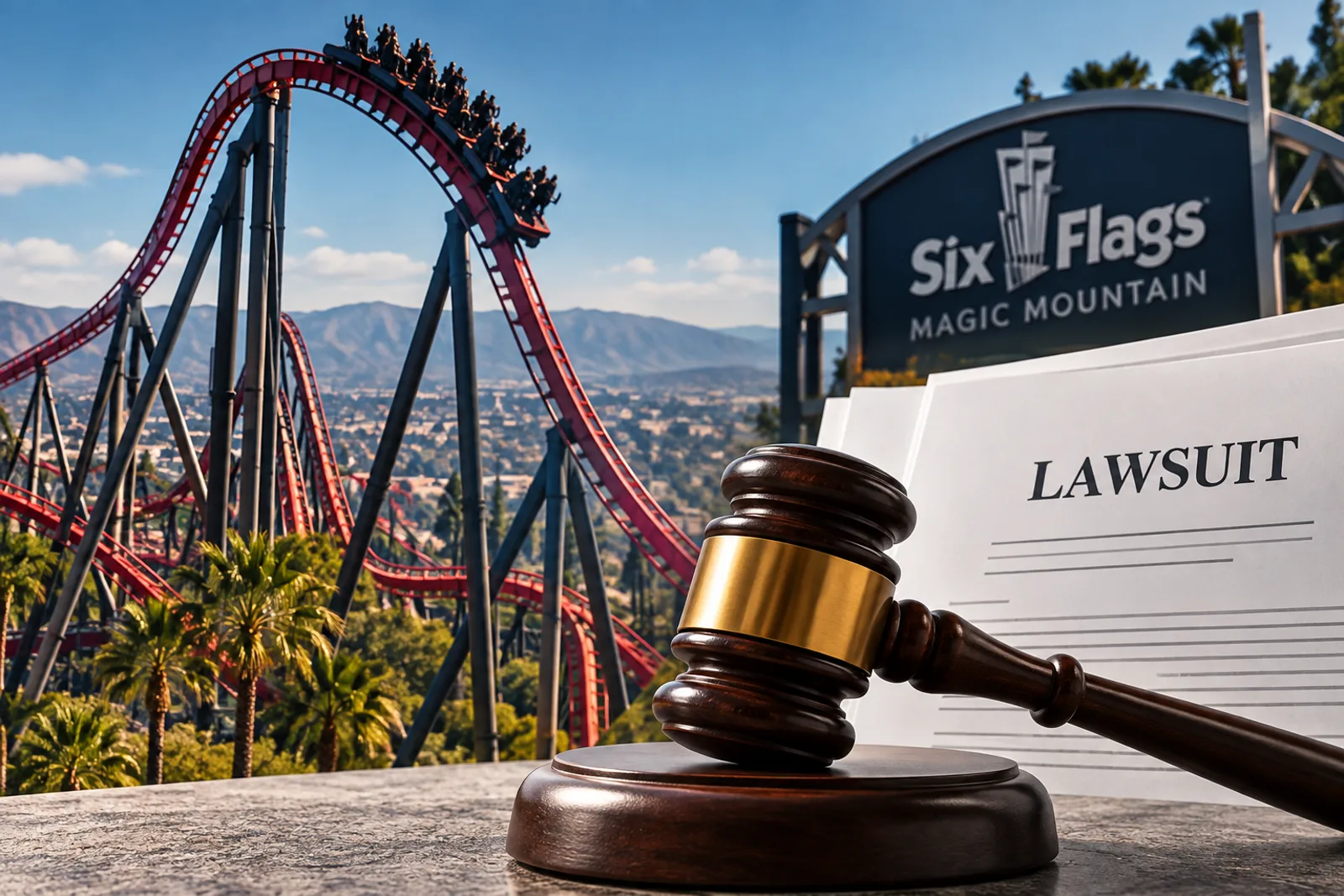
Six Flags Magic Mountain announced on September 29, 2026 that it is permanently retiring X2, days after three lawsuits were filed in Los Angeles County alleging serious injuries associated with the roller coaster. The lawsuits remain pending, and no court has determined that X2 caused the alleged injuries. The developing litigation also raises a broader question under California law: what duty does an amusement-park operator owe its riders?
Six Flags Permanently Retires X2
On September 29, 2026, Six Flags Magic Mountain announced that it will permanently retire X2. The park stated that more than 16 million guests have ridden the attraction since it reopened as X2 in 2008, that the ride consistently passed a multitude of safety tests, and that it chose to close the ride because guest confidence had been affected.1
Retiring a ride is a business decision. It is not an admission of liability, and it does not establish that the ride caused any injury.
Three Injury Lawsuits Are Now Pending in Los Angeles
Three separate complaints were filed in Los Angeles County Superior Court on September 21, 2026: the Greer-Wilkinson matter (Case No. 26STCV29927), the Guillen matter (Case No. 26STCV29908), and the Wilk matter (Case No. 26STCV30013).234
The complaints allege that the principal injured riders suffered serious injuries after riding X2. They name Six Flags entities and several S&S entities that plaintiffs allege were involved in the ride’s design, manufacture, engineering, servicing, or related functions, and assert theories including product defects, inadequate warnings, negligence and common-carrier liability, premises liability, and related claims. These allegations have not been adjudicated, and no defendant has been found liable.234
The Associated Press has reported that the ride was closed in July and that a California state investigation remains ongoing. No final agency determination about causation or ride safety should be inferred from the existence of that investigation.5
California Gives Roller-Coaster Riders Heightened Legal Protection
The central legal question for California personal injury claims involving amusement rides is the standard of care. In Gomez v. Superior Court (2005) 35 Cal.4th 1125, the California Supreme Court held that the operator of a roller coaster or similar amusement-park ride can qualify as a “carrier of persons for reward” under Civil Code sections 2100 and 2101.6
Under Civil Code section 2100, a carrier of persons for reward must use the utmost care and diligence for the safe carriage of its passengers. That is a higher standard than the ordinary care most defendants owe, and it is the same framework California applies in other common-carrier liability contexts.6
This heightened duty does not make an amusement-park operator automatically liable whenever a rider is injured. A plaintiff still must establish the elements of the particular claim, including causation. The common-carrier rule is not strict liability.
What About Safety Inspections?
California separately regulates permanent amusement rides through the Division of Occupational Safety and Health’s Amusement Ride and Tramway Unit. The state’s regulatory framework includes operational inspections, annual records audits, safety requirements, and injury and accident reporting.7
A ride’s regulatory or inspection history can be relevant, but an inspection does not by itself resolve every issue in a later civil lawsuit. Questions concerning duty, breach, product design, warnings, notice, and causation depend on the evidence and the claims actually presented.
What Still Has to Be Proven?
The pending cases potentially involve several distinct legal theories:
- operator or common-carrier negligence;
- product design or manufacturing issues;
- warnings;
- notice of prior incidents;
- premises liability; and
- medical and factual causation.
These theories are legally different. A claim against a ride operator is not the same as a product claim against a manufacturer, and each has its own elements and defenses. None of them can be assumed from the filing of a lawsuit or the retirement of a ride. Causation in particular, and the related question of damages, is usually decided on medical and technical evidence, as discussed in How Much Is My Personal Injury Case Worth in California?
The X2 litigation is still at an early stage. What makes the dispute legally significant beyond the immediate headlines is California’s treatment of roller-coaster operators as potential carriers of persons for reward — a doctrine that can impose a heightened duty of care while still requiring plaintiffs to prove the remaining elements of their claims.
Mahrouyan Law does not represent any party in the X2 lawsuits, and this article is not a comment on the merits of any claim or defense.
Footnotes
- Six Flags Magic Mountain, “Retiring X2” (Sept. 29, 2026). ↩
- Greer-Wilkinson complaint, Los Angeles County Superior Court Case No. 26STCV29927 (filed Sept. 21, 2026). ↩
- Guillen complaint, Los Angeles County Superior Court Case No. 26STCV29908 (filed Sept. 21, 2026). ↩
- Wilk complaint, Los Angeles County Superior Court Case No. 26STCV30013 (filed Sept. 21, 2026). ↩
- Associated Press, reporting on X2’s retirement, pending litigation, and California investigation. ↩
- Gomez v. Superior Court (2005) 35 Cal.4th 1125. ↩
- California Department of Industrial Relations, Amusement Ride and Tramway Unit; Cal. Code Regs., tit. 8, § 344.8. ↩
Mahrouyan Law evaluates selected California personal-injury matters and may work with experienced co-counsel where the nature or complexity of a case requires additional resources. Read more about the firm’s approach to personal injury in California, or discuss your own situation with the firm.

Omeed Mahrouyan is the founder of Mahrouyan Law, P.C., a California firm handling business and commercial litigation, property and cargo damage claims, personal injury, landlord representation, startup transactions, and practical intellectual property matters. Clients work directly with him on strategy, drafting, and case decisions.
More about Omeed Mahrouyan →