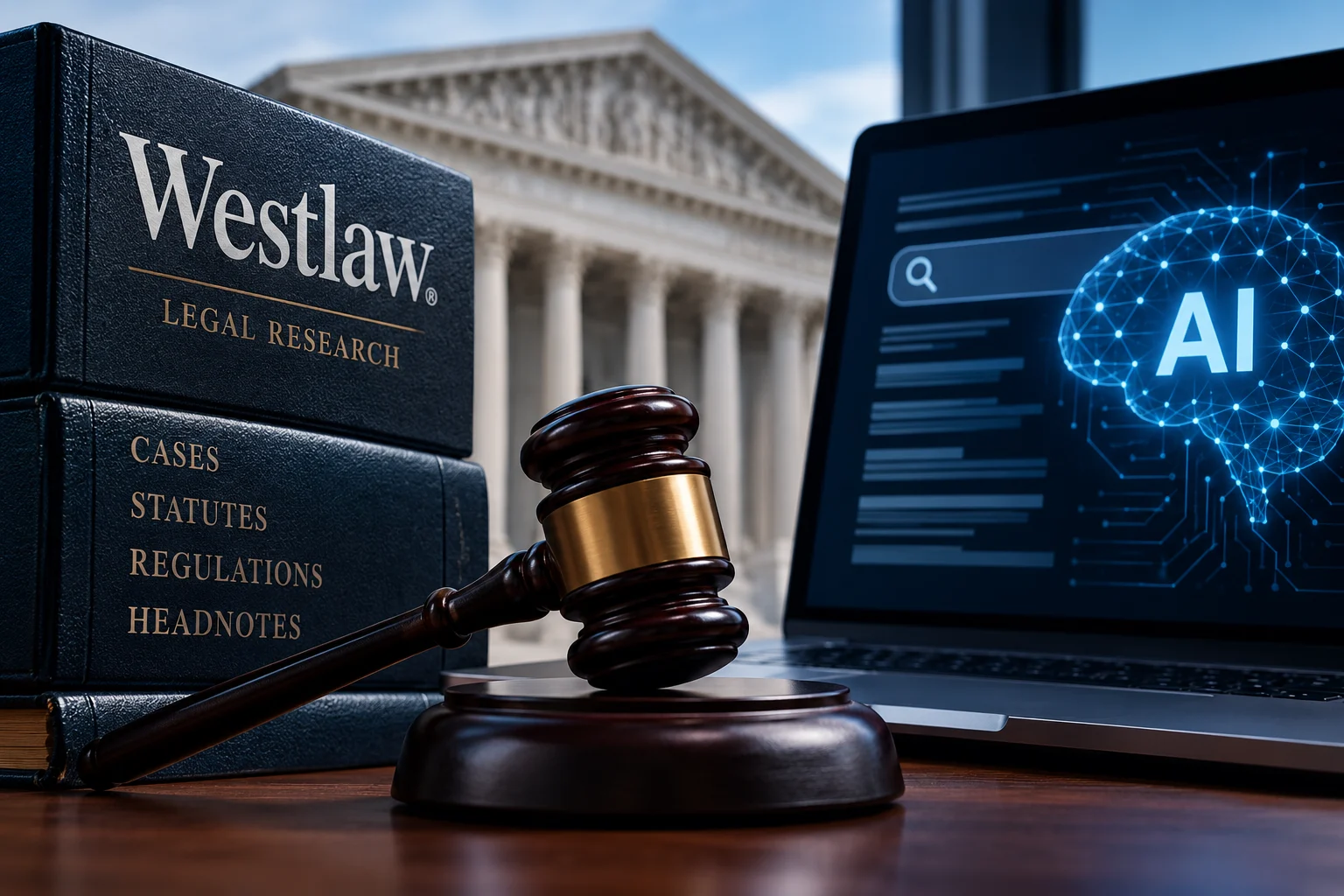
The Third Circuit held that ROSS Intelligence's use of Westlaw headnotes to train a competing AI legal-research system was not fair use—but expressly distinguished generative AI.
The first federal appellate ruling squarely addressing fair use in AI training is significant—but considerably narrower than the headline “AI training is copyright infringement.”
In Thomson Reuters Enterprise Centre GmbH v. ROSS Intelligence Inc., No. 25-2153 (3d Cir. 2026), the U.S. Court of Appeals for the Third Circuit affirmed a ruling that ROSS Intelligence's use of thousands of copyrighted Westlaw editorial headnotes to train a competing AI-powered legal-research system was not fair use.
The decision matters for AI developers, publishers, and startups evaluating training data. But it does not hold that copyrighted material can never be used to train an AI system, and it does not resolve the central copyright questions surrounding generative AI.
In fact, the court expressly distinguished ROSS's technology from models capable of generating new expression.
What ROSS Used to Train Its Legal-Research System
Westlaw publishes judicial opinions along with editorial material created by Thomson Reuters, including headnotes summarizing particular points of law.
The distinction matters: the case concerned Thomson Reuters's editor-written headnotes—not ownership of the underlying judicial opinions.
ROSS developed an AI-powered legal-search system that answered natural-language questions by returning relevant passages from existing judicial opinions.
To train that system, ROSS hired a contractor to prepare approximately 25,000 training memoranda. According to the appellate record, contractors used thousands of Westlaw headnotes to formulate legal questions that were paired with judicial-opinion passages. Those materials were then converted into machine-readable training data.
The district court granted partial summary judgment to Thomson Reuters concerning 2,243 headnotes, concluding that they were protected by copyright and that ROSS's use was not fair use. The Third Circuit affirmed that partial summary judgment on copyrightability and on ROSS's fair-use defense; the appeal addressed those specified issues, not every issue in the underlying lawsuit.
Why the Court Rejected Fair Use
Fair use under 17 U.S.C. § 107 requires courts to consider four statutory factors:
- the purpose and character of the use;
- the nature of the copyrighted work;
- the amount and substantiality used; and
- the effect of the use on the potential market for or value of the copyrighted work.
The Third Circuit concluded that the first, third, and fourth factors weighed against ROSS, while the second factor slightly favored it.
Factor One: Highly Commercial and Minimally Transformative
ROSS argued that it used the headnotes only as intermediate material to train an AI system rather than displaying them to end users. But the court focused on the ultimate purpose of the use.
Westlaw's headnotes help legal researchers locate relevant law. ROSS used those headnotes to develop another legal-research system designed to help users locate relevant law—and intended its product to compete with Westlaw.
The court therefore concluded that ROSS's use was highly commercial and minimally transformative. Calling the activity “AI training” did not itself make the use transformative.
Factor Two: The Nature of the Headnotes Slightly Favored ROSS
Although the court found the headnotes sufficiently original to receive copyright protection, it recognized that they summarize judicial opinions and legal principles and therefore contain more factual characteristics than highly expressive works such as novels or artwork. The court treated this factor as comparatively less important to the overall analysis.
Factor Three: More Copying Than the Court Considered Justified
The court emphasized that each headnote constituted an individual copyrighted work and that ROSS copied the entire text of the headnotes used in its training materials.
Evaluating that copying against ROSS's purpose, the court found it unnecessary to accomplish ROSS's basic objective because ROSS already had access to approximately ten million uncopyrighted judicial opinions. Convenience was not sufficient justification for copying the protected editorial material.
Factor Four: Competitive and Licensing Markets
First, ROSS was developing a product intended to compete directly with Westlaw in the legal-research market. The court reasoned that widespread use of the headnotes to develop substitute legal-research products could diminish their value to Thomson Reuters.
Second, the court considered a developing market for licensing headnotes as AI-training data. Thomson Reuters had already used its headnotes to train its own AI search products, and the court found evidence that a licensing market for this type of training data was developing.
That does not mean copyright owners automatically control every hypothetical AI-training market. The court's analysis was tied to the evidentiary record before it.
The Critical Limitation: ROSS Was Not Generative AI
ROSS's system was not a generative AI model. It did not use training data to create new text or other original expression; it identified and returned passages from existing judicial opinions.
The court noted that, unlike the systems at issue in cases involving Anthropic and OpenAI, ROSS's platform could not generate original expression. It also emphasized evidence that ROSS intended to develop a commercial substitute for Westlaw.
Accordingly, summarizing the decision as “federal appeals court rules AI training on copyrighted works is illegal” would materially overstate the holding. When generative models learn from copyrighted works and later produce new expression, whether that training qualifies as fair use is a question the Third Circuit did not answer.
What the Decision Means for AI Startups
For founders and AI developers, the practical lesson is not simply “license everything.” Fair use remains a fact-specific inquiry. The more useful lesson is that training-data provenance and product purpose matter.
Before using third-party material for training, a company should be able to identify:
- where the dataset originated;
- whether the company owns or licenses the relevant rights;
- what representations data vendors or contractors have made;
- whether equivalent public-domain or uncopyrighted sources are available;
- how much protected material is being copied;
- what purpose the training serves;
- whether the resulting product substitutes for the copyright owner's product; and
- whether an existing or reasonably expected licensing market may be affected.
Those issues can affect copyright exposure, investor diligence, commercial agreements, and the value of the company's technology—core startup and business transactions questions. Addressing them before a financing round or lawsuit is generally easier than reconstructing the training history afterward.
What Does This Mean in California?
The decision comes from the Third Circuit, which covers Delaware, Pennsylvania, New Jersey, and the U.S. Virgin Islands. It is not binding Ninth Circuit precedent in California.
Several major generative-AI copyright disputes are proceeding in California federal courts, and those cases involve materially different technology and factual records. Still, ROSS is likely to be studied as persuasive authority because it is a federal appellate decision directly analyzing copyrighted material used in an AI-training process.
AI, Copyright, and Startup IP Planning
ROSS reinforces a basic principle: technical innovation does not eliminate ordinary intellectual-property questions. Companies building AI products should understand not only who owns their source code and models, but also where their training data came from and what rights they have to use it.
Mahrouyan Law, P.C. advises startups and businesses concerning intellectual-property ownership, licensing, contractor and vendor agreements, technical assets, and related commercial disputes.
For a related AI-copyright issue, see our analysis of the Ninth Circuit's decision involving GitHub Copilot and copyright-management information, which addresses AI output rather than whether training-data use itself constitutes fair use.
Frequently Asked Questions
Did the Third Circuit rule that AI training on copyrighted material is illegal?
No. The court applied the fact-specific fair-use analysis to ROSS's use of Westlaw headnotes. It did not announce a categorical rule that copyrighted material can never be used in AI training.
Did the decision resolve whether generative AI training is fair use?
No. ROSS's system did not generate original expression, and the Third Circuit expressly distinguished disputes involving generative AI and large-language models.
Why did ROSS lose its fair-use defense?
Among other things, the court found ROSS's use highly commercial and minimally transformative, concluded that it copied more of the headnotes than justified, and found harm to both the competing legal-research market and a developing licensing market for AI-training data.
Were the judicial opinions themselves copyrighted by Thomson Reuters?
No. The dispute concerned Thomson Reuters's editor-created Westlaw headnotes. The underlying judicial opinions available to ROSS were uncopyrighted.
Is the Third Circuit decision binding on California courts?
It is not binding Ninth Circuit precedent. It may nevertheless be considered persuasive authority in future disputes involving similar copyright and AI-training questions.
Sources & Authorities
- Thomson Reuters Enterprise Centre GmbH v. ROSS Intelligence Inc., No. 25-2153 (3d Cir. 2026) (precedential opinion)
- 17 U.S.C. § 107 (fair use)
- Ballard Spahr, “Third Circuit Addresses Fair Use in AI Training but Leaves Generative AI Questions Unresolved” (Oct. 2026) — secondary source for the decision's first-of-its-kind significance
Mahrouyan Law handles these matters directly. Read more about how the firm approaches trademarks & practical intellectual property counsel in California, or discuss your own situation with the firm.
Building an AI Product?
If your company is developing an AI product or evaluating ownership and licensing issues involving training data or other technical assets, contact Mahrouyan Law, P.C. to discuss the circumstances.

Omeed Mahrouyan is the founder of Mahrouyan Law, P.C., a California firm handling business and commercial litigation, property and cargo damage claims, personal injury, landlord representation, startup transactions, and practical intellectual property matters. Clients work directly with him on strategy, drafting, and case decisions.
More about Omeed Mahrouyan →