
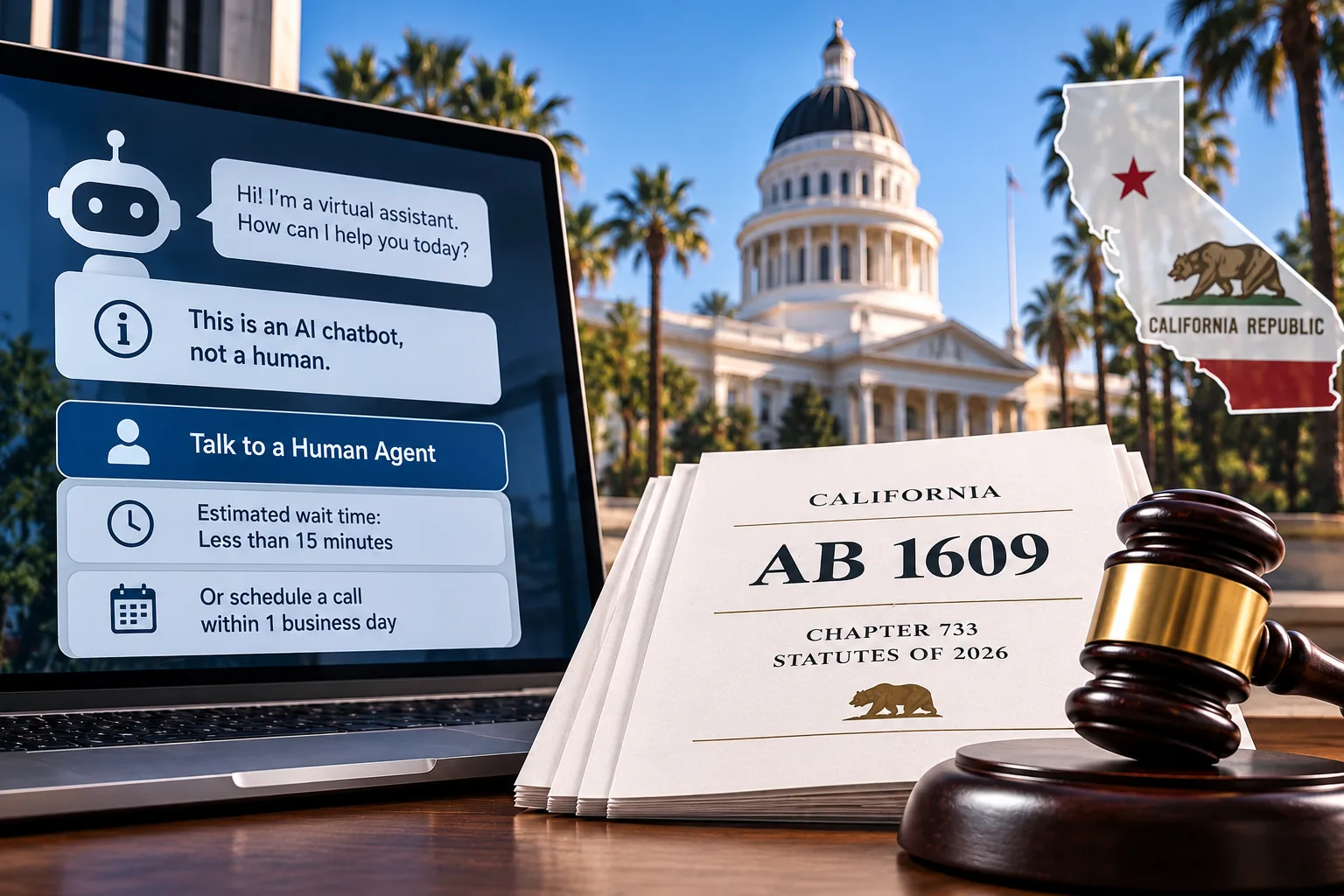
California enacted AB 1609 on September 28, 2026, creating new rules for customer-service chatbots and access to human representatives at certain large private businesses. Despite shorthand descriptions of the law as a “15-minute customer-service rule,” the statute does not guarantee that every customer will speak to a human within 15 minutes. Instead, it establishes disclosure, human-access, and good-faith response requirements for businesses that meet the statute’s size threshold. AB 1609 takes effect January 1, 2027.
Which Businesses Does AB 1609 Cover?
Beginning January 1, 2027, AB 1609 applies only to a “large private business”: a business with more than $500 million in gross annual revenue nationally that provides goods and services to customers.1
A “customer” is a natural person residing in California, and residence is determined by the customer’s account address. AB 1609 does not apply to every California business. Founders building customer-service tools for larger clients may still find the rules relevant to product design and startup and business transactions work.1
When Must a Chatbot Identify Itself?
A covered business may not represent that a customer-service chatbot is human.
Separately, if a reasonable person interacting with the chatbot is likely to be misled into believing they are talking with a human, the business must provide a clear and conspicuous disclosure that the chatbot is artificially generated and not human. That disclosure must appear in the medium through which the chatbot interacts with the customer.1
The disclosure duty is tied to the reasonable-person standard. The statute does not prescribe a single uniform script for every interaction regardless of context.
What Does the “15-Minute” Rule Actually Require?
During at least its regular business hours, a covered business must offer a simple feature on all of its customer-service platforms that lets customers request connection to a human customer-service agent. Commonly understood commands, prompts, menu selections, or verbal requests satisfy this requirement.1
After a request, the business must make a good-faith effort to provide one of two things:
- connection to a human customer-service agent within 15 minutes of the request; or
- a specific appointment time, within one business day of the request, when a human agent will call or connect with the customer.
This is not an absolute 15-minute guarantee. The obligation is a good-faith effort, and the one-business-day appointment is an equally valid alternative. The statute also provides a specialized alternative for businesses subject to 16 CCR section 1707.2, a California pharmacy regulation: they may satisfy this requirement by returning a phone call within one business hour.
Once a customer reaches a human agent, the business must also make a good-faith effort to avoid any individual hold or wait longer than 15 minutes, and to keep cumulative hold, wait, or escalation-queue time from exceeding one hour in total.1
Does Every Business Have to Offer Phone Support?
No. A covered business that provides goods and services through online platforms and already has telephonic customer service must post its customer-service telephone number clearly and conspicuously on its website.1
AB 1609 does not require a business that did not use telephonic customer service as of January 1, 2027 to create a new phone channel, provided it offers other methods by which customers can promptly connect with a human agent consistent with the statute. More broadly, the law does not require a business to add communication platforms it had not made available by that date.
Requests made by email, web contact form, or voicemail are not subject to the 15-minute connection or response requirement.1
Enforcement, Penalties, and Exceptions
An action to enforce AB 1609 may be brought by a public prosecutor. A violating business is liable for a civil penalty of up to $5,000 for an initial violation and up to $10,000 for each subsequent violation. These are civil penalties in a public enforcement action, not damages payable to customers, and the statute expressly states that it does not establish a private right of action.1
Use of commercially reasonable and practicable standards designed and intended to achieve compliance satisfies the statute’s good-faith-effort requirements.
The law also contains specific exclusions and protections, each subject to the conditions stated in the statute:
- services provided subject to, and in compliance with, specified Public Utilities Commission rules for telecommunications and water service;
- exclusive business lines not intended for general customer use, including business-to-business communications;
- hospital communications relating to health care services, as defined;
- consumer reporting agencies under the federal Fair Credit Reporting Act; and
- an inability to comply caused by unforeseen circumstances beyond the business’s reasonable control, or by extraordinary or emergency situations, including information-technology or telecommunications outages.
AB 1609 adds to California’s broader AI oversight framework and is cumulative of obligations under other law.23
AB 1609 does not require every California company to provide a human representative within 15 minutes. For businesses above the statute’s $500 million revenue threshold, however, it creates a clearer framework for identifying AI customer-service systems and providing meaningful access to human support. Companies deploying customer-service automation should review both their chatbot disclosures and their escalation procedures before relying on shorthand descriptions of the new law.
Mahrouyan Law does not represent any company discussed in this article, and this article is not a comment on any particular business’s compliance.
Footnotes
Mahrouyan Law advises founders and growing businesses on practical legal risk. Read more about the firm’s startup and business transactions practice or its business-litigation practice.

Omeed Mahrouyan is the founder of Mahrouyan Law, P.C., a California firm handling business and commercial litigation, property and cargo damage claims, personal injury, landlord representation, startup transactions, and practical intellectual property matters. Clients work directly with him on strategy, drafting, and case decisions.
More about Omeed Mahrouyan →