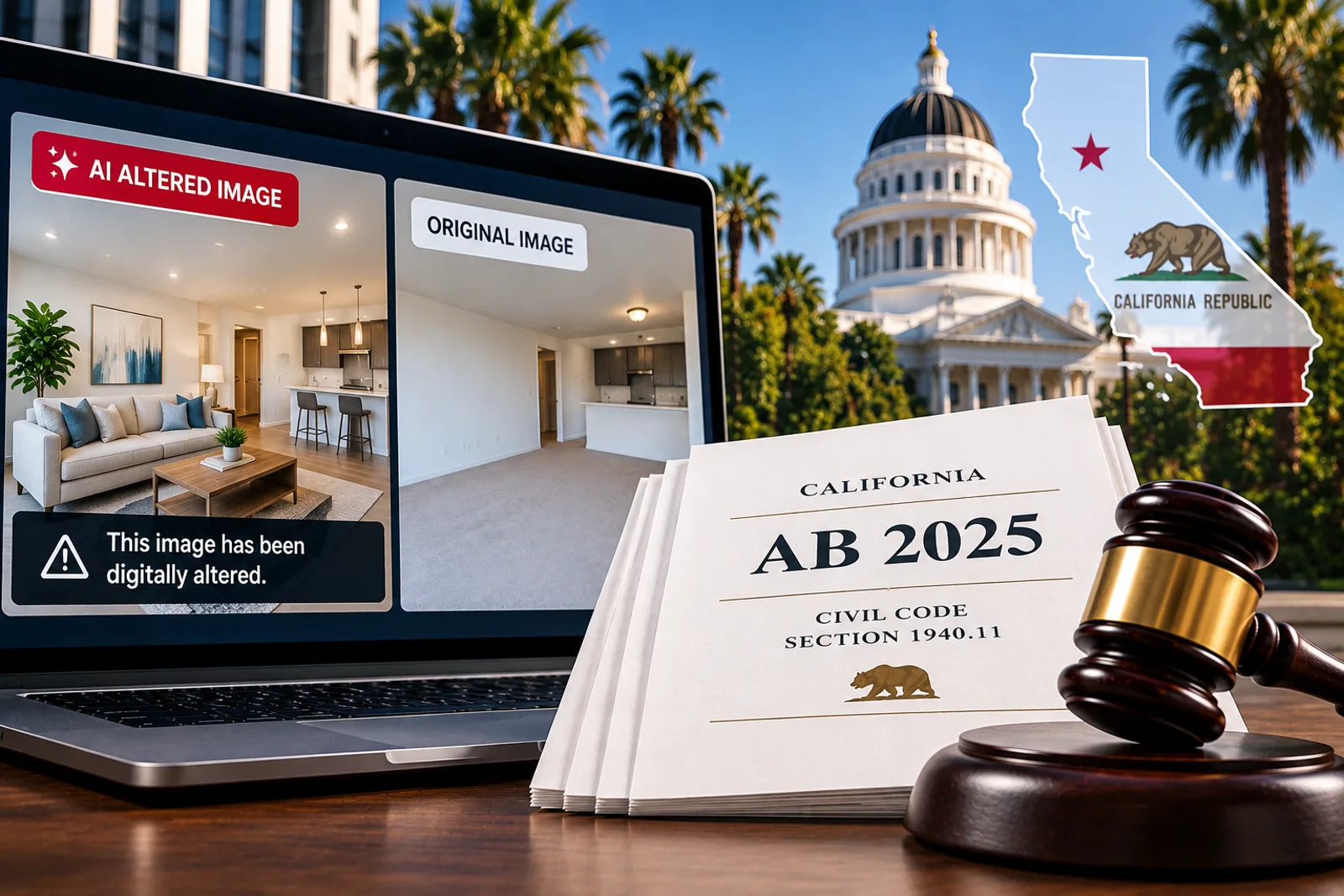
California enacted AB 2025 on September 27, 2026, creating new disclosure rules for AI-generated and digitally altered images used to advertise rental property. Beginning January 1, 2027, covered altered images generally must be clearly disclosed, and when an altered image was created from an actual photograph, the original image generally must also be made available. The law does not ban virtual staging or ordinary photo enhancement.
What Does AB 2025 Cover?
AB 2025 is Chapter 572, Statutes of 2026. It adds section 1940.11 to the California Civil Code and takes effect January 1, 2027, under the ordinary effective-date rule for regular-session statutes.123
The law applies to a “person” who includes a digitally altered image in advertising or promotional material for the rental of real property. It is not limited to landlords, licensed real-estate brokers, property managers, or real-estate agents; anyone who places a covered image in a rental advertisement falls within its terms.1
For people licensed under California’s Real Estate Law, a violation of section 1940.11 is also deemed a violation of that licensing law. For landlords reviewing their marketing practices more generally, see our landlord representation and unlawful detainer practice.1
What Counts as a “Digitally Altered Image”?
Section 1940.11 defines a “digitally altered image” in two broad categories:1
- an image fully generated through artificial-intelligence software; or
- an existing image modified using artificial-intelligence or photo-editing software to add, remove, or change substantive elements.
The statute gives examples of substantive elements, including furniture, fixtures, appliances, flooring, walls, paint color, landscaping, façades, floor plans, streetlights, utility poles, window views, and neighboring properties. Virtually adding a sofa, removing a utility pole, or replacing a view of a parking lot with a view of trees would all fall on the covered side of the line.
Routine adjustments are treated differently. Changes to lighting, sharpening, white balance, color correction, angle, straightening, cropping, and exposure are not covered digitally altered images when they do not change the representation of the real property. In plain English, making a dim room look properly exposed is ordinary photography; making the room look like it has different finishes is an alteration.1
What Must a Rental Advertisement Disclose?
If a covered digitally altered image appears in rental advertising or promotional material, the advertisement must include a disclosure that the image has been altered. The disclosure must be reasonably conspicuous and located on or adjacent to the altered image.1
The statute requires a clear disclosure that the image has been altered, but it does not prescribe one universal sentence that every advertiser must use. A short label placed directly on or beside the image, such as “Digitally altered image” (an example, not statutory wording), is the kind of placement the law contemplates.
When Must the Original Image Be Provided?
When a digitally altered image was created from an original captured image, the advertisement generally must also include the original, unaltered image. An advertiser may comply by including the original image in the posting, or by providing a link, URL, or QR code to a publicly accessible website that clearly identifies the original image.1
If a link, URL, or QR code is used, the alteration disclosure must indicate that the unaltered image can be accessed through it.
There is an important limit. If the image, architectural rendering, or artistic rendering was never originally created using a capture device, there is no underlying original photograph to provide. A fully AI-generated rendering still requires an alteration disclosure, but the statute does not require the advertiser to produce an original photograph that never existed.1
What Should California Landlords and Property Managers Do?
AB 2025 does not prohibit AI staging or photo-editing software. It regulates disclosure. A sensible compliance workflow may include the following steps:
- retain original listing photographs;
- keep altered and original versions together;
- identify whether marketing vendors or property managers have modified images;
- ensure required disclosures remain attached to altered images;
- verify that original images remain accessible when a listing is syndicated to third-party platforms; and
- distinguish ordinary photographic correction from edits that materially change the property’s appearance.
These file-retention and workflow suggestions are practical risk-management recommendations, not separate statutory requirements imposed by AB 2025.
The statute also expressly preserves existing California law concerning false or misleading advertising. Compliance with AB 2025 does not eliminate other potential issues under California law if a rental advertisement is otherwise false or misleading. AB 2025 fits within California’s broader AI oversight efforts, but its obligations are specific to rental advertising.1
AB 2025 does not prohibit California landlords from using AI or virtual staging in rental marketing. Beginning January 1, 2027, however, covered alterations must be disclosed, and advertisers generally must make the original image available when an altered image was created from a real photograph. The practical distinction is between ordinary photo enhancement and changes that materially alter how the property is presented. For related California landlord developments, see our article on AB 2042 and the 2027 service-of-process rules.
Mahrouyan Law does not represent any landlord, tenant, brokerage, or listing platform in connection with this statute, and this article is not a comment on any particular advertiser’s compliance.
Footnotes
Mahrouyan Law handles these matters directly. Read more about how the firm approaches landlord representation & unlawful detainer in California, or discuss your own situation with the firm.

Omeed Mahrouyan is the founder of Mahrouyan Law, P.C., a California firm handling business and commercial litigation, property and cargo damage claims, personal injury, landlord representation, startup transactions, and practical intellectual property matters. Clients work directly with him on strategy, drafting, and case decisions.
More about Omeed Mahrouyan →