
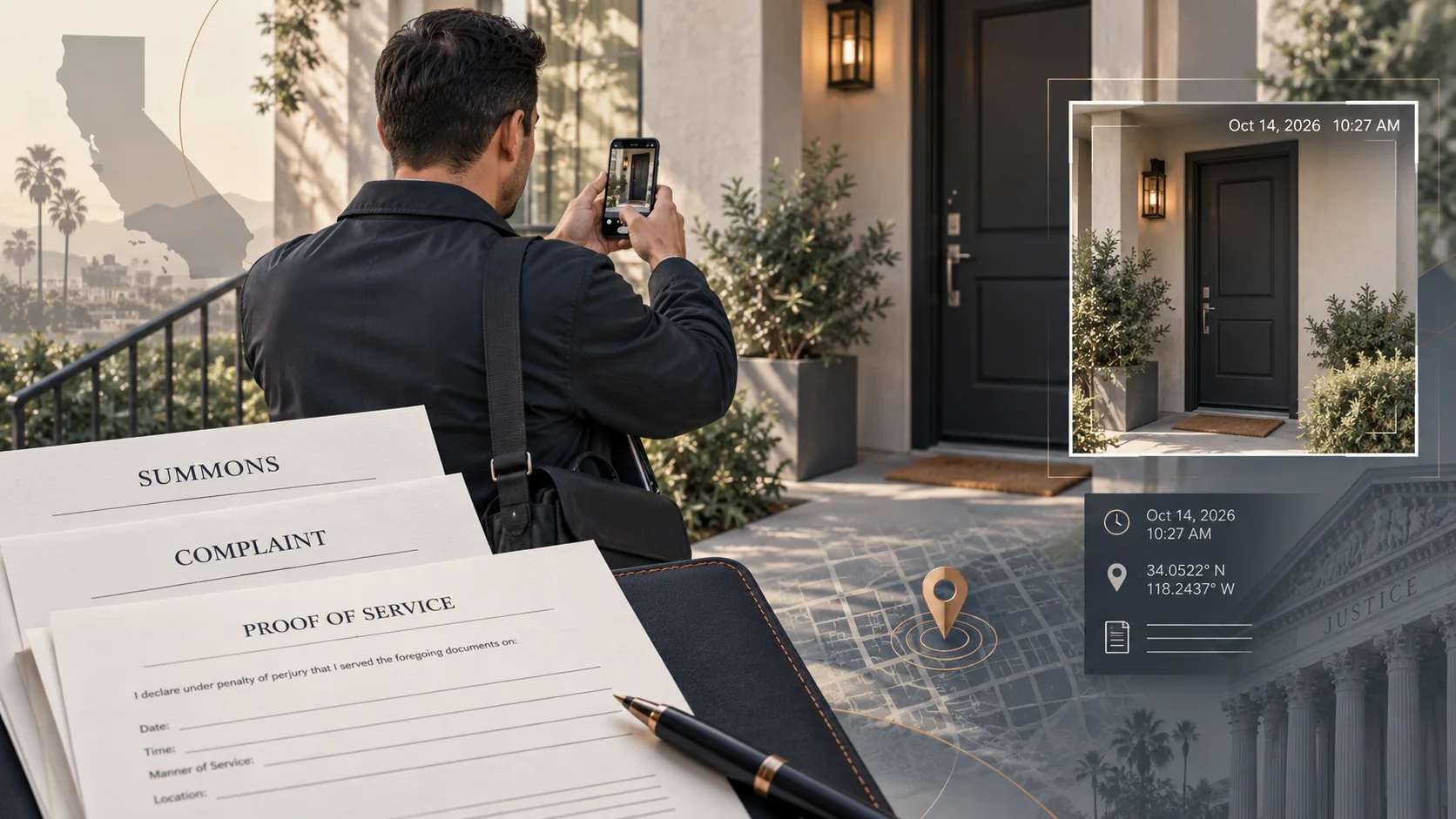
AB 2042 clarifies how California's 2027 service-of-process and default-judgment framework will apply, while AB 747 remains the law that created the new photo and GPS proof requirements.
- January 1, 2027
- Operative framework
- AB 747
- Created photo/GPS proof rules
- AB 2042
- Clarifies defaults and disputes
- Preponderance standard
- When service is rebutted
California's 2027 Service-of-Process Framework Is Coming Into Focus
California has enacted AB 2042, a 2026 bill that clarifies parts of the service-of-process and default-judgment framework scheduled to take effect on January 1, 2027.3
For landlords, property owners, business plaintiffs, and defendants, the practical issue is not merely paperwork. Service of process is the step that gives a defendant formal notice of a lawsuit and gives the court authority to move forward. If service is defective, a later default or default judgment can become vulnerable.
The key distinction is important: AB 2042 did not create California's new photographic and GPS proof-of-service requirements. Those reforms were enacted in 2025 through AB 747, the Service of Process Accountability, Reform and Equity Act, known as the SPARE Act. AB 2042 clarifies related rules governing defaults, challenged service, and when the new framework applies.1
What AB 747 Created
AB 747 made the major service-of-process changes. Beginning January 1, 2027, proof of service for specified methods of serving a summons and complaint must include more detailed information. The statute addresses personal service, substituted service, and service by posting in unlawful-detainer actions.
In covered situations, the proof of service must include at least one photograph of the site of the effected or attempted service, if the photograph can be obtained without compromising the process server's safety. It must also include a readable stamp and GPS coordinates showing the date, time, and location of service. If no GPS or cellular signal is available, the process server must provide a detailed statement explaining that circumstance.
AB 747 also defines reasonable diligence for certain service attempts and adds specific unlawful-detainer pleading rules concerning the service of a termination notice. Those notice allegations are separate from later service of the summons and complaint after a lawsuit is filed.
What AB 2042 Clarifies
AB 2042 is more targeted. It amends Civil Code section 1788.61 and Code of Civil Procedure sections 417.10 and 473.2. The bill's Legislative Counsel digest describes the changes to section 417.10 as nonsubstantive, which reinforces that AB 2042 should not be credited as the bill that created the original photo and GPS proof-of-service framework.
The most practical clarification appears in the default-judgment setting. AB 2042 clarifies that the new section 473.2 framework applies to service attempted or completed on or after January 1, 2027. It also preserves the treatment of earlier proofs of service under prior law.
The bill separately clarifies relief rules in certain debt-buyer cases where the defendant lacked actual notice. That part may matter in consumer-debt litigation, but the broader civil-practice significance for many readers is the relationship between documented service, disputed service, and later defaults.
Why This Matters in Unlawful-Detainer Cases
Unlawful-detainer cases move quickly, and service problems can have major consequences. A landlord may need a valid default if the tenant does not respond. A tenant or occupant may challenge a default by arguing that the summons and complaint were not lawfully served.
The 2027 framework specifically reaches service by posting when the summons is for an unlawful-detainer action involving real property. That makes process documentation especially important for landlords and property managers who rely on posted service after other service methods have not succeeded.
This does not mean a missing photograph automatically defeats service in every case, or that every default will be set aside whenever documentation is incomplete. The statute contains qualifications, including safety and signal limitations, and courts will still evaluate the evidence and applicable procedure.
Termination Notices Are Not the Same as the Summons and Complaint
Landlord-tenant readers should keep one distinction clear. Serving a termination notice is not the same event as serving the summons and complaint in the later court case.
A termination notice—such as a notice to pay rent or quit, perform covenant or quit, cure or quit, or terminate tenancy—typically comes before the lawsuit. The summons and complaint are served after the unlawful-detainer action is filed. The SPARE Act framework addresses proof requirements for service of the summons and complaint and separately adds pleading detail concerning the earlier termination notice.
Conflating those steps can create confusion. The notice may affect whether the unlawful-detainer complaint is viable. Service of the summons and complaint affects whether the court can proceed against the defendant in that case.
What Happens When Service Is Challenged?
Under the 2027 section 473.2 framework, a party who was not served in accordance with the governing service rules may seek to set aside or vacate a default or default judgment and obtain leave to defend or move for dismissal.
AB 2042 clarifies the burden-shifting rule. Once sufficient evidence is offered to rebut the process server's return, the party seeking the default or default judgment must prove by a preponderance of the evidence that service of the summons and complaint was lawful.2
In plain English, the signed proof of service still matters. But if the opposing party produces enough contrary evidence, the party relying on service may need to prove that service complied with the law. Photographs, GPS data, time stamps, declarations, attempted-service notes, and consistency between the proof and other records may all become important.
Practical Evidence to Preserve
For landlords and property owners, vendors, lenders, business plaintiffs, and defendants, the lesson is documentation. Preserve the proof of service, photographs, GPS-stamped records, attempted-service logs, declarations, communications with the process server, and any court orders authorizing alternative service.
For defendants, contemporaneous evidence can also matter. Travel records, work records, photographs, messages, address evidence, surveillance footage, lease documents, or other records may help evaluate whether service occurred as claimed.
Mahrouyan Law assists with selected Landlord Representation & Unlawful Detainer matters and business and commercial litigation where service, defaults, evidence, and procedural strategy affect the dispute.
The Broader Lesson
AB 2042 should be understood as a clarification bill, not as the source of every 2027 service-of-process change. AB 747 created the SPARE Act's major photo, GPS, and documentation reforms. AB 2042 then refined how parts of that framework interact with default judgments and challenged service.
That distinction matters for legal accuracy and for practical planning. A party seeking default should expect service records to be scrutinized more closely under the 2027 framework. A party challenging service should be prepared to offer evidence, not merely suspicion. And both sides should remember that the goal is not technical gamesmanship—it is reliable notice before a court proceeds toward judgment.
Footnotes
- AB 747 (2025–2026), Chapter 563, Service of Process Accountability, Reform and Equity Act ↩
- AB 2042 (2025–2026), Chapter 379, Civil actions: setting aside default or default judgment ↩
- AB 2042 bill status, chaptered by Secretary of State as Chapter 379, Statutes of 2026, after approval by the Governor on September 20, 2026 ↩
Sources & Authorities
- AB 2042 (2025–2026), Chapter 379 — Civil actions: setting aside default or default judgment — Official chaptered bill text amending Civil Code § 1788.61 and Code of Civil Procedure §§ 417.10 and 473.2.
- AB 2042 bill status — Chaptered September 20, 2026 — Official California Legislative Information status page identifying Chapter 379, Statutes of 2026.
- AB 747 (2025–2026), Chapter 563 — Service of Process Accountability, Reform and Equity Act — Official bill page for the 2025 SPARE Act that enacted the core January 1, 2027 photo and GPS proof-of-service framework.
- Office of Governor Gavin Newsom, September 20, 2026 legislative update — Official signing context; statutory text controls.
Mahrouyan Law handles these matters directly. Read more about how the firm approaches landlord representation & unlawful detainer in California, or discuss your own situation with the firm.
Discuss Your Matter
Mahrouyan Law handles selected California landlord-tenant, unlawful-detainer, default-judgment, and business litigation matters. Service and default disputes can turn on timing, documentation, the specific service method used, and the evidence available to both sides.

Omeed Mahrouyan is the founder of Mahrouyan Law, P.C., a California firm handling business and commercial litigation, property and cargo damage claims, personal injury, landlord representation, startup transactions, and practical intellectual property matters. Clients work directly with him on strategy, drafting, and case decisions.
More about Omeed Mahrouyan →