
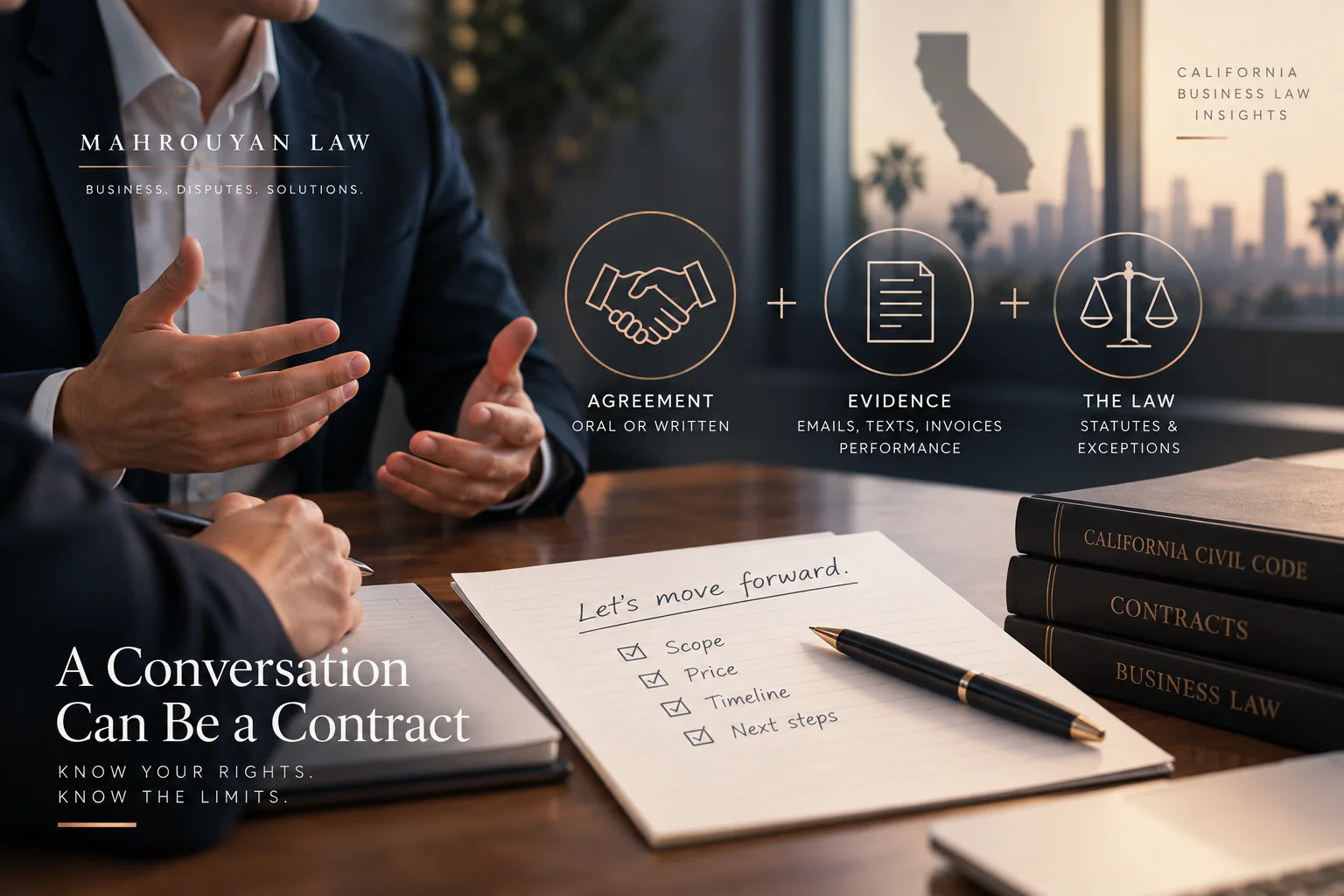
California recognizes many oral contracts, but enforceability often turns on what was agreed, what can be proven, and whether the law required the deal to be in writing.
- Was there a sufficiently definite deal?
- Agreement
- What documents and conduct prove it?
- Evidence
- Was this type of contract required to be written?
- The law
California Recognizes Many Verbal Contracts
A business contract does not automatically become unenforceable because the parties never signed a formal document.
California Civil Code section 1622 states the general rule: contracts may be oral unless another law specifically requires the agreement to be in writing.
That can matter in ordinary business relationships.
A contractor may start work after a phone call. A consultant may agree on a project during a meeting and later send an invoice. Two businesses may agree on price, scope, and timing before anyone prepares a formal contract.
The absence of a signed agreement therefore does not end the analysis.
The more important questions are whether the parties actually reached an agreement, what its material terms were, whether they intended to be bound, whether either side performed, and whether a statute requires this type of agreement to be written.
What Must You Prove?
An oral agreement still has to satisfy the ordinary requirements of California contract law.
Civil Code section 1550 identifies four basic requirements: parties capable of contracting, consent, a lawful object, and sufficient consideration.2
In a real business dispute, the questions are usually more practical: What did each side agree to do? How much was to be paid? When was performance due? Did the parties act as though a deal had been reached? Did one side perform while the other accepted the benefit?
A court does not need an elegant twenty-page contract to determine that an agreement existed.
But the agreement must be sufficiently definite to determine what the parties promised and whether someone failed to perform.
That is why oral-contract disputes often become evidence disputes.
What Evidence Can Prove a Verbal Agreement?
When there is no single signed contract, the surrounding record becomes especially important.
Relevant evidence can include emails, text messages, proposals, invoices, payment records, purchase orders, calendar entries, contract drafts, accounting records, witness testimony, delivery records, and the parties’ actual course of performance.
Consider a simple example.
A business owner orally agrees to pay a consultant $10,000 for a defined project. The consultant later sends an email summarizing the scope, completes the project, issues a $10,000 invoice, and receives a response saying payment will be made the following week.
There may be no formal signed contract.
But those communications and the parties’ conduct may provide meaningful evidence of what they agreed to.
The opposite can also be true.
If the parties repeatedly said no one would be bound until a final written agreement was signed, the missing signature may become critical.
What If We Planned to Sign a Contract Later?
This issue arises frequently in vendor, consulting, founder, and commercial negotiations.
Sometimes the parties agree on the material terms and plan to prepare a formal document later.
California’s civil jury instructions recognize that a binding agreement can exist before the final writing is signed if the parties already agreed to the terms and intended to be bound.3
But if the parties intended that no contract would exist until execution of the final document, the result can be different.
That is why phrases such as “subject to execution,” “nonbinding,” or “no agreement exists until signed” can matter.
So can the parties’ conduct after the discussion.
When Does California Require a Written Agreement?
California’s general rule permitting oral contracts has important exceptions.
Civil Code section 1624—the Statute of Frauds—requires specified agreements to be memorialized in a signed writing.4
Important examples include agreements that, by their terms, cannot be performed within one year; certain promises to answer for another person’s debt; agreements for the sale of real property; leases longer than one year; certain real-estate brokerage agreements; and specified commercial lending commitments exceeding $100,000.
The precise statutory language and exceptions matter.
A business owner should therefore not assume that every handshake agreement is enforceable merely because California generally permits oral contracts.
Sales of Goods Have a Separate Rule
Businesses buying or selling goods also need to consider California Commercial Code section 2201.
Subject to statutory exceptions, a contract for the sale of goods priced at $500 or more generally requires a signed record sufficient to indicate that a sale contract was made.5
The statute contains exceptions, including circumstances involving specially manufactured goods, admissions in court, and goods that have been received and accepted or paid for and accepted.
A services contract and a sale-of-goods contract can therefore present different enforceability questions even when both began with an oral conversation.
Can Emails or Electronic Signatures Count?
Electronic records can be legally significant.
California Civil Code section 1633.7 provides that a record or signature cannot be denied legal effect simply because it is electronic. It also provides that, where a law requires a writing or signature, an electronic record or electronic signature can satisfy that requirement in transactions governed by California’s Uniform Electronic Transactions Act.6
That does not mean every email or text automatically creates an enforceable agreement.
The communications still must establish the required agreement, the parties must have agreed to conduct the transaction electronically, and transaction-specific rules may apply.
But businesses should not assume there is “nothing in writing” merely because nobody signed a piece of paper with ink.
How Long Do You Have to Sue?
The limitations period can differ materially depending on whether the claim is founded on a written instrument.
California Code of Civil Procedure section 339 generally provides a two-year period for an action on a contract, obligation, or liability not founded on a written instrument.7
Section 337 generally provides four years for an action founded on a written contract or other written instrument.8
The exact deadline can still depend on when the claim accrued and on the nature of the obligation.
The practical point is simple: An oral-contract dispute may carry a shorter filing deadline than a written-contract dispute.
Waiting too long can therefore create unnecessary risk.
What Can You Recover?
California Civil Code section 3300 generally measures contract damages by the loss proximately caused by the breach or the loss that would ordinarily result from it.9
Depending on the facts, a business might seek an unpaid contract amount or other provable losses caused by the breach.
But an enforceable contract does not automatically make every claimed loss recoverable.
Issues such as causation, foreseeability, certainty, mitigation, contractual limitations, and the particular remedy requested may matter.
Attorney’s fees are a separate issue.
California generally follows the rule that parties pay their own attorney’s fees unless a statute or agreement provides otherwise. Where a written contract contains an enforceable attorney-fee provision, Civil Code section 1717 can make that provision reciprocal in an action on the contract; it does not create a fee right where none was agreed.10
In an oral-contract case, however, proving that the parties actually agreed to an attorney-fee term may itself become disputed.
What Should You Do When the Agreement Is Disputed?
The first step usually should not be sending an angry text or email.
Preserve the record.
Collect emails, texts, invoices, proposals, payment history, purchase orders, drafts, notes, accounting records, delivery records, and relevant calendar entries.
Then define the alleged agreement precisely: Who made it? When? What was each side required to do? What price was agreed? What performance occurred? What was not performed? What financial loss followed?
It is also important to determine whether the transaction falls within a statute requiring a writing; another signed agreement affects the alleged oral deal; an arbitration, notice, or dispute-resolution provision applies; or a filing deadline is approaching.
That factual analysis often determines whether negotiation, a demand letter, arbitration, or litigation makes commercial sense. A separate guide explains how much business litigation may cost when evaluating whether to pursue a dispute.
A Verbal Agreement Is Not the Same as No Agreement
California does not require every business agreement to be contained in one signed document.
But verbal agreements create a different litigation problem.
The parties may disagree not only about whether someone breached the agreement, but about what the agreement was in the first place.
That makes contemporaneous evidence especially important in business contract disputes.
The same lesson matters when preparing customer and vendor contracts: clear written terms can reduce later disagreement about what the parties promised.
When the amount at stake is meaningful, the better question is not simply: “Was the agreement verbal?”
It is: Can you prove a sufficiently definite agreement, does California law permit that agreement to be oral, and can you prove the breach and resulting loss?
Those questions usually matter much more.
Footnotes
- Cal. Civ. Code § 1622 ↩
- Cal. Civ. Code § 1550 ↩
- Judicial Council of California Civil Jury Instructions, CACI No. 306, Unformalized Agreement (2026 ed.) ↩
- Cal. Civ. Code § 1624 ↩
- Cal. Com. Code § 2201 ↩
- Cal. Civ. Code § 1633.7 ↩
- Cal. Code Civ. Proc. § 339 ↩
- Cal. Code Civ. Proc. § 337 ↩
- Cal. Civ. Code § 3300 ↩
- Cal. Code Civ. Proc. § 1021; Cal. Civ. Code § 1717 ↩
Sources & Authorities
- Cal. Civ. Code § 1622 — California’s general rule for oral contracts.
- Cal. Civ. Code § 1550 — The essential requirements of a contract.
- Judicial Council of California Civil Jury Instructions, CACI No. 306, Unformalized Agreement (2026 ed.) — Addresses whether parties intended to be bound before completing a contemplated formal writing.
- Cal. Civ. Code § 1624 — California’s principal Statute of Frauds provision.
- Cal. Com. Code § 2201 — Writing rule and exceptions for sales of goods priced at $500 or more.
- Cal. Civ. Code § 1633.7 — Legal effect of electronic records and signatures.
- Cal. Code Civ. Proc. § 339 — Limitations provision for obligations not founded on a written instrument.
- Cal. Code Civ. Proc. § 337 — Limitations provision for obligations founded on a written instrument.
- Cal. Civ. Code § 3300 — General measure of damages for breach of contract.
- Cal. Code Civ. Proc. § 1021 — California’s general attorney-fee rule.
- Cal. Civ. Code § 1717 — Reciprocity for qualifying contractual attorney-fee provisions.
Mahrouyan Law handles these matters directly. Read more about how the firm approaches small business & commercial litigation in California, or discuss your own situation with the firm.
Discuss Your Matter
Mahrouyan Law represents businesses, founders, vendors, contractors, and service providers in selected California contract and commercial disputes. When an agreement is oral, partly written, or disputed, an early issue is often determining what can actually be proven and what remedies may be available.

Omeed Mahrouyan is the founder of Mahrouyan Law, P.C., a California firm handling business and commercial litigation, property and cargo damage claims, personal injury, landlord representation, startup transactions, and practical intellectual property matters. Clients work directly with him on strategy, drafting, and case decisions.
More about Omeed Mahrouyan →