
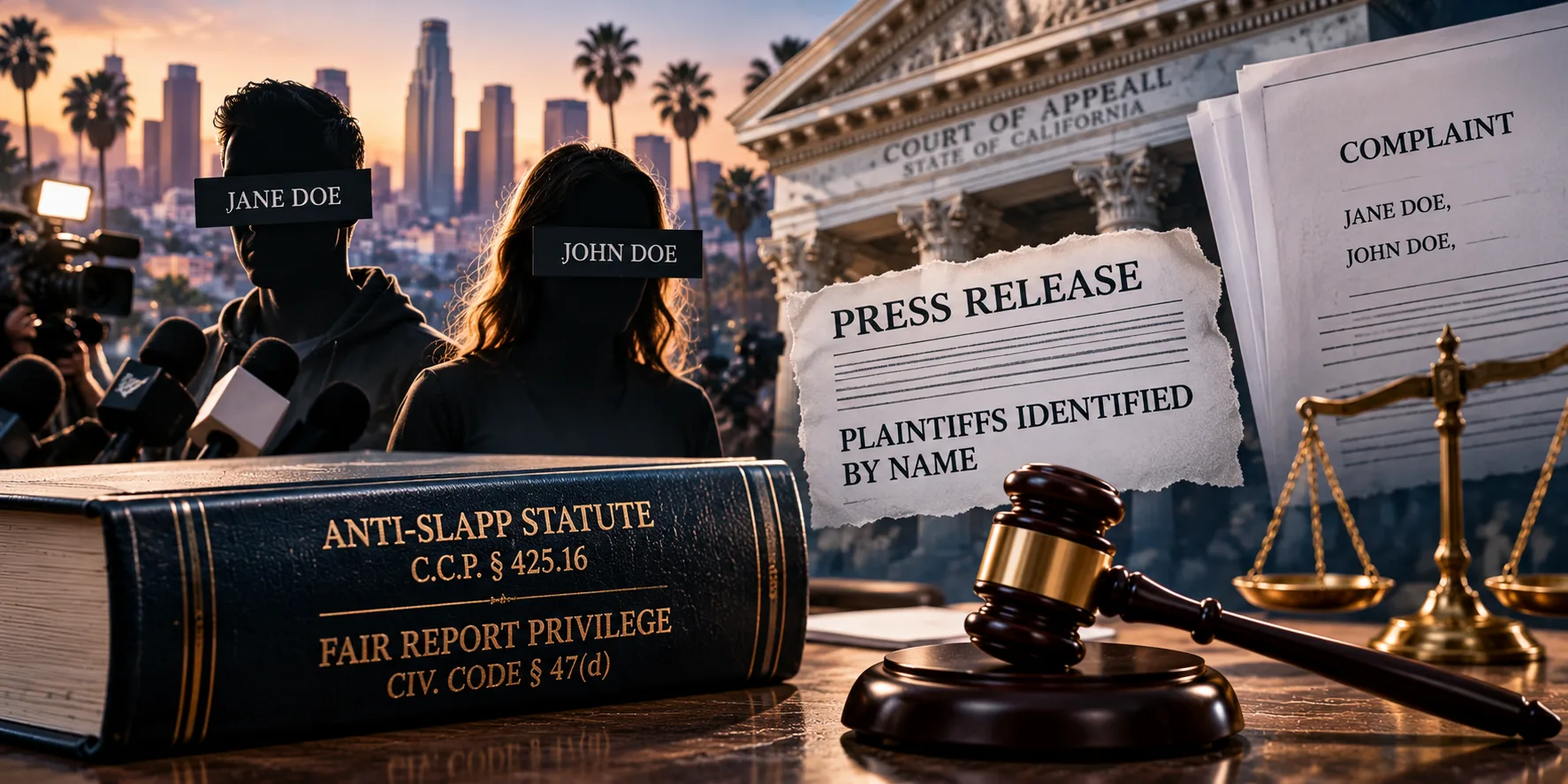
A published California appellate decision explains why filing a lawsuit under a pseudonym does not automatically guarantee anonymity and how anti-SLAPP and the fair report privilege can protect litigation-related public statements.
A newly published California appellate decision addresses an increasingly practical question: does filing a lawsuit as “Jane Doe” automatically prevent the opposing party from publicly identifying the plaintiff?
In Luna v. Top Dawg Entertainment LLC, the California Court of Appeal held that it did not under the circumstances presented. The Second District Court of Appeal reversed an order denying an anti-SLAPP motion against a doxing claim arising from a press release that publicly identified two plaintiffs who had filed suit under pseudonyms.
The decision is narrow. It does not mean defendants may always identify pseudonymous plaintiffs, and it did not decide the merits of the plaintiffs’ underlying allegations.
What Happened in Luna v. Top Dawg Entertainment?
Two plaintiffs filed a Los Angeles County lawsuit in December 2024 against Top Dawg Entertainment LLC and several individuals, alleging sexual misconduct and related claims. The defendants disputed the allegations.
The plaintiffs filed the lawsuit using pseudonyms but did not initially ask the trial court for an order permitting them to proceed anonymously. Plaintiffs’ counsel later issued a public statement discussing the lawsuit while continuing to use the pseudonyms.
Top Dawg Entertainment responded with its own press release disputing the allegations and identifying the plaintiffs by their actual names. The plaintiffs then amended their complaint to assert a civil doxing claim under California Civil Code section 1708.89 based on the disclosure.
The defendants moved to strike that claim under California’s anti-SLAPP statute, Code of Civil Procedure section 425.16. The trial court denied the motion. On October 8, 2026, the Court of Appeal reversed and directed the trial court to grant the anti-SLAPP motion and strike the doxing cause of action.
Filing Under a Pseudonym Does Not Automatically Create Anonymity
The appellate court began by addressing the procedure for proceeding anonymously in California civil litigation. The court explained that public access to civil proceedings generally includes access to the identities of the parties.
Absent a specific statutory authorization, a plaintiff does not have an absolute right to proceed anonymously simply by placing a pseudonym on the complaint. Instead, the court explained, a litigant seeking anonymity ordinarily must conditionally file under a pseudonym and ask the trial court for permission to continue that way. The trial court then considers whether an overriding interest justifies limiting the public’s access to the litigant’s identity.
That distinction mattered in Luna because the plaintiffs had not sought judicial authorization to proceed anonymously before the challenged disclosure occurred.
The Press Release Was Protected Activity Under California’s Anti-SLAPP Law
California’s anti-SLAPP statute provides a procedure for striking qualifying claims arising from protected speech or petitioning activity when the plaintiff cannot make the required showing at the second stage.
The Court of Appeal concluded that the defendants’ press release qualified as protected activity. It was a public statement responding directly to pending litigation and allegations that the court found involved matters of public interest. That satisfied the first stage of the anti-SLAPP analysis.
The remaining question was whether the plaintiffs could demonstrate the required probability of prevailing on their doxing claim.
The Fair Report Privilege Defeated the Doxing Claim
The court concluded they could not because the challenged disclosure was protected by California’s fair report privilege. Civil Code section 47(d) protects qualifying fair and true reports concerning judicial proceedings.
The court emphasized that the relevant question was whether identifying the individuals as the plaintiffs in the lawsuit accurately described the proceeding. It did. Although the plaintiffs had used pseudonyms in the complaint, they were in fact the individuals who brought the action, and no motion seeking judicial protection of their identities was pending when the press release was issued.
The court treated that timing as important. Accordingly, the Court of Appeal concluded that disclosure of the plaintiffs’ identities was privileged under the circumstances presented.
What the Court Did Not Decide
The opinion should not be read as creating blanket permission to identify every litigant who files under a pseudonym. The court specifically distinguished the circumstances before it from a situation in which a request for anonymity or sealing protection is pending. Other circumstances may also involve:
- an existing protective order;
- statutory confidentiality;
- sealed records;
- privacy protections;
- contractual confidentiality obligations; or
- other restrictions on disclosure.
The Court of Appeal also did not decide whether the conduct otherwise satisfied the statutory definition of doxing under Civil Code section 1708.89. Nor did it decide the defendants’ alternative argument that the First Amendment independently barred application of the doxing statute.
And importantly, the appellate ruling did not resolve the merits of the plaintiffs’ underlying misconduct allegations.
The Fair Report Privilege Does Not Protect Every Litigation-Related Statement
Businesses should also avoid reading Luna too broadly. The court focused on the particular statement challenged by the doxing claim: the identification of the actual plaintiffs.
The decision does not establish that every accusation, characterization, or statement contained in a litigation-related press release is automatically privileged. Whether the fair report privilege applies depends on the statement at issue and its relationship to the underlying judicial proceeding.
What This Means for California Businesses and Litigants
The decision illustrates two practical lessons. First, a litigant who wants to proceed anonymously should not assume that placing “Jane Doe” or another pseudonym on the complaint automatically creates a legal right to anonymity. Judicial protection may need to be requested promptly.
Second, businesses responding publicly to litigation should still exercise caution. Before issuing a press release or public response concerning an active lawsuit, counsel should consider:
- whether the statement accurately reflects the proceeding;
- whether a sealing or anonymity request is pending;
- whether any protective order applies;
- whether statutory confidentiality rules apply; and
- whether statements go beyond describing the proceeding and create separate legal exposure.
A public response to litigation can itself become the subject of additional litigation.
The Bottom Line
Luna v. Top Dawg Entertainment confirms that filing a California civil lawsuit under a pseudonym does not, by itself, necessarily establish a legal right to remain anonymous. Under the particular circumstances before the court, the defendants’ response to the lawsuit constituted protected activity, and the disclosure of the plaintiffs’ identities was protected by the fair report privilege.
The holding is nevertheless limited. The result could be materially different where a court has authorized anonymity, a request for such protection is pending, or another confidentiality rule restricts disclosure.
Mahrouyan Law, P.C. represents businesses and individuals in selected California business and commercial litigation and civil disputes, including matters involving litigation strategy and business-related claims.
Frequently Asked Questions
Can I file a lawsuit anonymously in California?
Sometimes, but using a pseudonym on a complaint does not necessarily create an automatic right to anonymity. Absent specific statutory authorization, a litigant seeking to proceed anonymously generally must ask the court for permission, and the court balances the asserted privacy interest against the public’s right of access.
Did Luna hold that defendants may always identify anonymous plaintiffs?
No. The court emphasized the circumstances before it, including that the plaintiffs had not sought judicial authorization to proceed anonymously before the challenged disclosure. Different rules may apply where a motion, protective order, sealing order, or statutory confidentiality provision exists.
What is an anti-SLAPP motion?
California Code of Civil Procedure section 425.16 provides a procedure for challenging certain claims arising from protected speech or petitioning activity. If the defendant establishes that the claim arises from protected activity, the plaintiff must make the required showing that the claim has sufficient legal and factual merit to proceed.
What is California’s fair report privilege?
Civil Code section 47(d) protects qualifying fair and true reports concerning judicial proceedings. Its application depends on the particular statement and circumstances.
Did the appellate court decide the underlying misconduct allegations?
No. The appeal addressed the doxing cause of action and the defendants’ anti-SLAPP motion. It did not determine the merits of the plaintiffs’ underlying substantive allegations.
Sources & Authorities
- Luna v. Top Dawg Entertainment LLC (Oct. 8, 2026, B347645) — Cal. Ct. App., 2d Dist., Div. 2 (certified for publication)
- Luna v. Top Dawg Entertainment LLC — full opinion (Justia mirror)
- Cal. Code Civ. Proc. § 425.16 (anti-SLAPP statute)
- Cal. Civ. Code § 47(d) (fair report privilege)
- Cal. Civ. Code § 1708.89 (civil doxing)
- California Judicial Branch — Published and Citable Opinions
Mahrouyan Law handles these matters directly. Read more about how the firm approaches small business & commercial litigation in California, or discuss your own situation with the firm.

Omeed Mahrouyan is the founder of Mahrouyan Law, P.C., a California firm handling business and commercial litigation, property and cargo damage claims, personal injury, landlord representation, startup transactions, and practical intellectual property matters. Clients work directly with him on strategy, drafting, and case decisions.
More about Omeed Mahrouyan →