
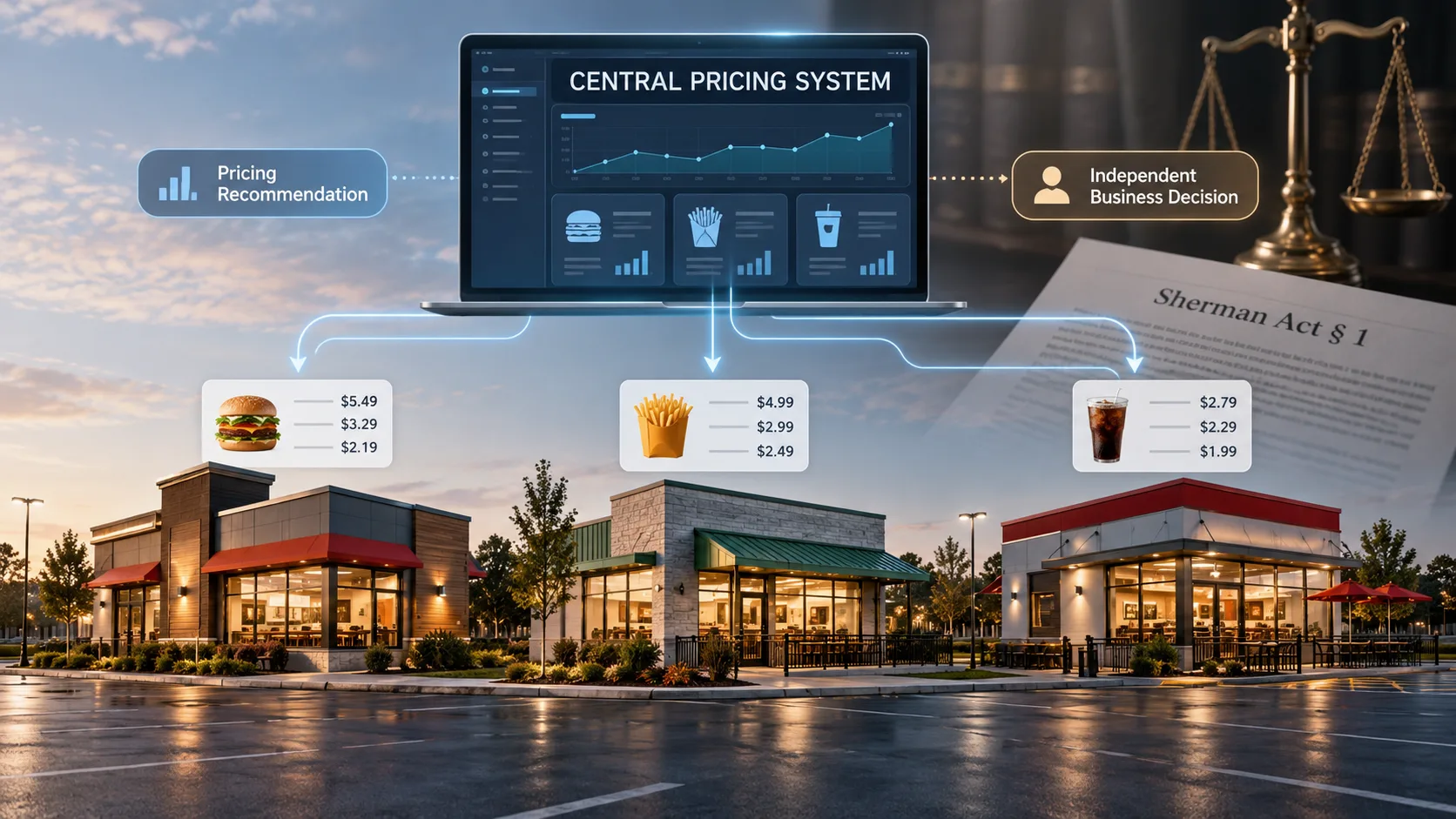
A new federal lawsuit alleges McDonald’s used centralized pricing technology to coordinate menu prices among franchise restaurants. The case raises questions about franchisee independence, shared data, and Sherman Act liability.
A newly filed federal class action accuses McDonald’s of using centralized pricing technology to coordinate menu prices among independently owned franchise restaurants. The allegations are unproven, and McDonald’s denies that its technology sets or coordinates prices.
But the lawsuit raises a broader question for franchise systems and other businesses using centralized analytics: when does a franchisor’s pricing recommendation become unlawful coordination among independently owned businesses?
What the Lawsuit Alleges
On October 2, 2026, Illinois consumer Michael Thomas filed Thomas v. McDonald’s USA, LLC, No. 1:26-cv-12149, in the U.S. District Court for the Northern District of Illinois. The defendants are McDonald’s USA, LLC and McDonald’s Corporation.
The complaint asserts two principal theories under Section 1 of the Sherman Act:
- an alleged price-fixing agreement; and
- an allegedly unlawful exchange of competitively sensitive information.
The complaint also asserts claims under Illinois law. These are allegations in a newly filed complaint. No court has determined that McDonald’s or its franchisees violated antitrust law.
The Central Pricing-System Allegations
According to the complaint, McDonald’s has operated a centralized machine-learning pricing system that uses transaction, sales, and pricing information from company-operated and franchised restaurants. The plaintiff alleges that the system uses pooled information to generate restaurant-specific menu-price recommendations.
The complaint further alleges that independently owned franchise locations contribute nonpublic business data to the system and receive recommendations influenced by information from other restaurants. The plaintiff characterizes that arrangement as unlawful coordination among businesses that otherwise would make independent pricing decisions.
Whether the system actually operates in the manner alleged—and whether any such arrangement constitutes an unlawful agreement—remain disputed.
McDonald’s Says Franchisees Set Their Own Prices
McDonald’s publicly disputes the premise that its technology fixes or coordinates menu prices. In an October 1 statement, the company said:
- its pricing tool provides restaurant-specific recommendations;
- the technology does not set or change prices;
- the tool does not use dynamic or individualized customer pricing; and
- individual franchisees decide what prices to charge and whether to follow the recommendations.
McDonald’s has also stated that approximately 95% of its U.S. restaurants are independently owned and operated. That ownership structure is central to the lawsuit.
Why the Franchise Model Makes This Case Different
Most algorithmic-pricing lawsuits involve separate companies accused of sharing information through a common pricing platform. For a related but structurally different dispute, see Mahrouyan Law’s analysis of the RealPage rent-pricing litigation. The McDonald’s case presents a different structure: the allegedly participating businesses operate under the same franchise brand.
Franchise systems necessarily involve substantial coordination. A franchisor may impose or recommend standards concerning branding, products, operations, advertising, quality, technology, and other aspects of the customer experience. At the same time, independently owned franchisees may remain separate businesses with responsibility for certain commercial decisions.
According to Reuters, one of the central questions in the case will be how independently McDonald’s franchisees actually compete with one another on price, and whether the challenged conduct should be characterized as horizontal coordination among competing restaurants, vertical coordination between franchisor and franchisees, or some combination of the two. That legal characterization may materially affect the antitrust analysis.
Pricing Recommendations Are Not Automatically Price-Fixing
The use of software, algorithms, or artificial intelligence does not itself establish an antitrust violation. Businesses commonly use data and analytics to inform pricing decisions.
The relevant legal question under Sherman Act section 1 is whether there is an actionable agreement or restraint of trade. A system that gives independently acting businesses optional recommendations may raise very different issues from one that allegedly facilitates an agreement about what prices competitors should charge. The existence of a centralized pricing tool alone does not establish unlawful price-fixing.
Shared Data Can Raise Separate Antitrust Questions
The complaint also challenges the alleged exchange of competitively sensitive information. Businesses may have legitimate reasons to provide operational and financial data to a franchisor. But antitrust concerns can arise when competing businesses allegedly exchange current, nonpublic pricing or sales information and use it to reduce independent decision-making.
The legal significance depends on the actual information exchanged, how it is used, the relationships among the participants, the presence or absence of an agreement, and the competitive effects. Because the lawsuit was only recently filed, those factual questions have not been resolved.
Allegedly Higher Prices Do Not Prove Price-Fixing
The plaintiff alleges that consumers paid prices above competitive levels. That allegation does not itself establish an antitrust violation. Higher menu prices, similar pricing among restaurants, or use of the same analytical software do not alone prove an agreement to fix prices.
A plaintiff still must establish the elements of the asserted claims, including actionable concerted conduct and the required connection between that conduct and the alleged injury.
What This Means for Franchise Systems
Franchisors and franchisees using centralized pricing technology should consider whether their systems and documents clearly address:
- what data the franchisor collects;
- whether information from one franchisee informs recommendations to another;
- whether recommendations are genuinely optional;
- how compliance or noncompliance is monitored;
- whether pricing affects renewal, expansion, or other franchise decisions;
- who retains final pricing authority; and
- how pricing tools are described in franchise agreements and operating materials.
Clear documentation does not itself resolve antitrust questions, but ambiguity about independent decision-making can create litigation risk—particularly in technology-enabled commercial arrangements.
AI Is Not the Legal Issue by Itself
The case is sometimes described as an “AI price-fixing” lawsuit. That shorthand can be misleading. The central legal issue is not whether McDonald’s uses artificial intelligence; it is whether the alleged arrangement constitutes an unlawful agreement or information exchange under existing antitrust law.
The Case Is Just Beginning
The lawsuit seeks certification of a proposed nationwide consumer class and an Illinois subclass, along with monetary and injunctive relief. As of publication, no class has been certified, no settlement has been approved, and no court has found McDonald’s liable for price-fixing or any other antitrust violation. The allegations will need to be tested through the litigation process.
The Bottom Line
Thomas v. McDonald’s USA presents a distinctive question at the intersection of franchise law, antitrust law, and centralized pricing technology. Franchise systems require coordination, but independently owned businesses may still retain responsibility for certain competitive decisions.
The key issue will not simply be whether an algorithm generated pricing recommendations. It will be whether the evidence establishes an unlawful agreement or information exchange that displaced genuinely independent pricing decisions.
Mahrouyan Law, P.C. represents businesses and parties to franchise agreements in selected California franchise and commercial disputes and advises businesses concerning contractual relationships, governance, and operational risk.
Frequently Asked Questions
Is McDonald’s accused of using AI to fix menu prices?
Yes, but only as an allegation at this stage. The complaint alleges that centralized pricing technology facilitated coordination among McDonald’s and independently owned franchise restaurants. McDonald’s denies that its tools set, coordinate, or fix prices.
Does McDonald’s set franchisee menu prices?
McDonald’s says it does not. The company states that its technology provides restaurant-specific pricing recommendations and that franchisees independently decide what prices to charge and whether to use those recommendations. The plaintiff disputes the independence of that process.
Are pricing recommendations illegal under antitrust law?
Not automatically. The legal analysis depends on whether there is an unlawful agreement or restraint of trade, how information is shared, whether businesses retain independent decision-making authority, and the competitive effects of the arrangement.
Why does the franchise structure matter?
Franchisees may be independently owned businesses while also operating within a common system that requires coordination on branding, products, operations, and other matters. The lawsuit raises the question of where legitimate franchise-system coordination ends and potentially unlawful pricing coordination begins.
Has a class been certified?
No. The lawsuit seeks certification of a proposed nationwide class and an Illinois subclass, but no class-certification order has been identified as of publication.
Has McDonald’s been found liable?
No. The case is at the complaint stage. No court has found McDonald’s liable for price-fixing or any other antitrust violation.
Sources & Authorities
- Thomas v. McDonald’s USA, LLC et al., No. 1:26-cv-12149 (N.D. Ill., filed Oct. 2, 2026) — docket
- Thomas v. McDonald’s USA, LLC et al., Class Action Complaint (filed Oct. 2, 2026)
- McDonald’s, “Separating Fact from Fiction: AI Does Not Set Prices at McDonald’s” (Oct. 1, 2026)
- Reuters, “AI Pricing Lawsuit Against McDonald’s Raises New Antitrust Questions” (Oct. 8, 2026) (reproduced by GV Wire)
- Associated Press, “McDonald’s sued over AI tool that recommends prices to US franchisees” (Oct. 6, 2026)
- 15 U.S.C. § 1 (Sherman Act § 1)
Mahrouyan Law handles these matters directly. Read more about how the firm approaches small business & commercial litigation in California, or discuss your own situation with the firm.

Omeed Mahrouyan is the founder of Mahrouyan Law, P.C., a California firm handling business and commercial litigation, property and cargo damage claims, personal injury, landlord representation, startup transactions, and practical intellectual property matters. Clients work directly with him on strategy, drafting, and case decisions.
More about Omeed Mahrouyan →