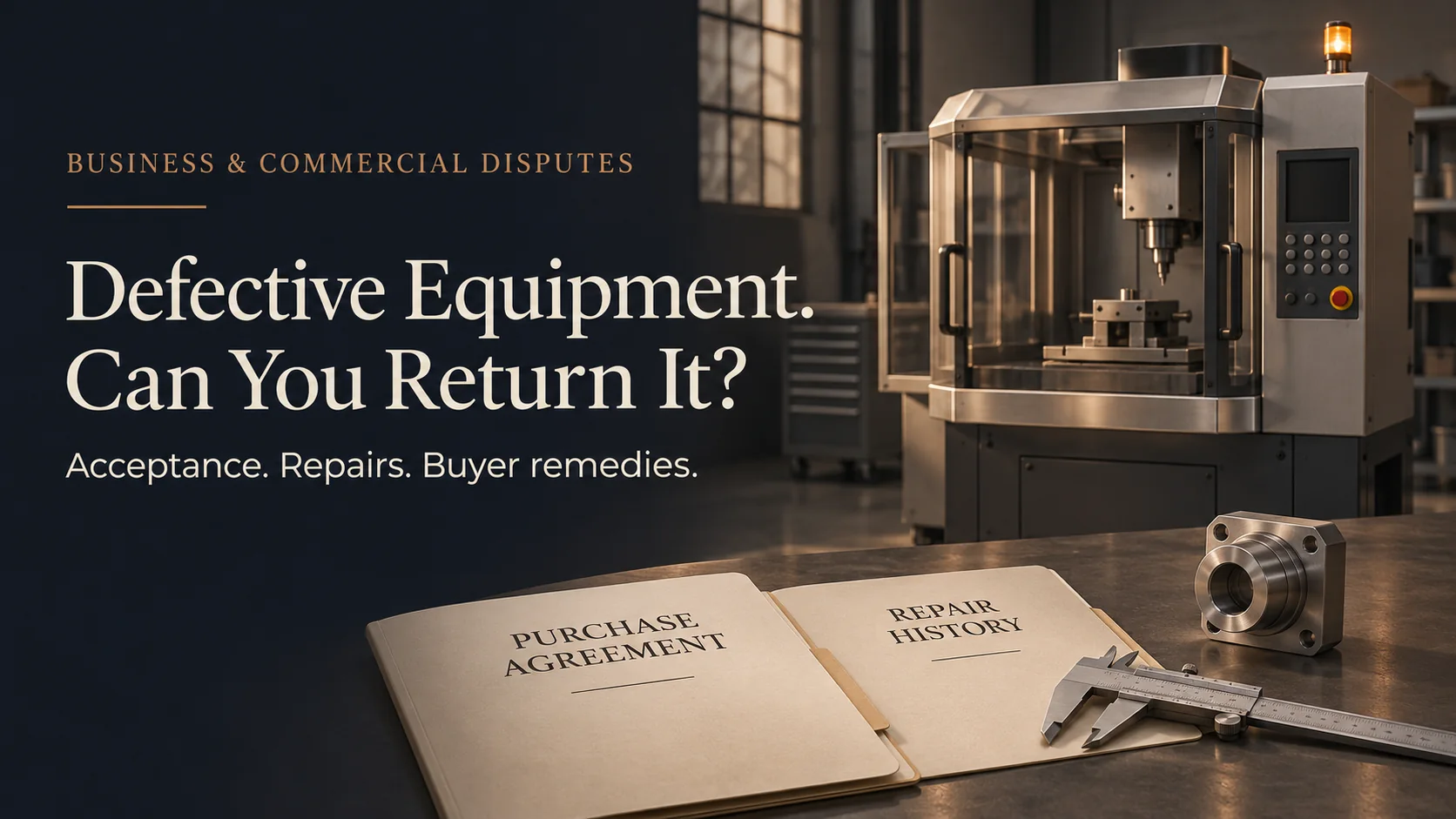
Accepting equipment does not necessarily end a business buyer’s remedies, but returning it after acceptance depends on specific statutory requirements.
Sometimes. Accepting equipment does not necessarily eliminate a business buyer’s remedies. California Commercial Code § 2608 permits revocation of acceptance when a qualifying nonconformity substantially impairs the goods’ value to the buyer and the statute’s additional requirements are satisfied. A malfunction or an unsuccessful repair does not, by itself, establish a right to return the equipment. 1
Acceptance, Rejection, and Revocation Are Different
Physical delivery and legal acceptance do not necessarily happen at the same moment. Under Commercial Code § 2606, acceptance can arise from specified statements or conduct, including a failure to make an effective rejection after a reasonable opportunity to inspect. 2
Once goods are accepted, ordinary rejection is no longer available. Under Commercial Code § 2607, however, acceptance does not of itself impair the buyer’s other remedies for nonconformity, and qualifying revocation may remain. 3
These rules govern sales of goods. Commercial Code § 2102 applies the sales division to transactions in goods and, to a stated extent, to hybrid transactions that combine goods with other elements. 4 True leases, service contracts, and financing arrangements may be governed by different rules.
What Must the Buyer Establish to Revoke Acceptance?
Section 2608 sets several requirements:
- The nonconformity substantially impairs the value of the lot or commercial unit to that buyer.
- The buyer accepted on the reasonable assumption that the problem would be cured, and it was not seasonably cured; or accepted without discovering the problem because discovery before acceptance was difficult or the seller’s assurances reasonably induced acceptance.
- Revocation occurs within a reasonable time after the buyer discovers, or should have discovered, the grounds for it.
- Revocation occurs before any substantial change in the goods’ condition that is not caused by their own defects.
- The buyer notifies the seller. Revocation is not effective until that notice is given.
The statute uses reasonableness standards. It does not set a universal 30-day return period or a fixed number of required repair attempts.
Why Repair History and Clear Notice Matter
Two kinds of notice are involved. Section 2607 requires a buyer who has accepted goods to notify the seller of a breach within a reasonable time after discovering it, or after it should have been discovered, or be barred from any remedy. Communicating revocation under § 2608 is a separate step. A repair request does not necessarily tell the seller that the buyer is revoking acceptance.
Document defects, seller assurances, repair attempts, performance failures, and communications as they occur. Section 2608 does not prescribe a particular written form, but written notice is prudent evidence of what was communicated and when.
Continued use, modifications, and preservation of the equipment require case-specific analysis. Continued use does not automatically defeat revocation, and unlimited continued use is not necessarily permissible.
A Seller Dispute May Not Cancel the Financing Agreement
U.S. Roofing, Inc. v. Credit Alliance Corp. (1991) 228 Cal.App.3d 1431 involved a defective crane acquired through lease financing. The Court of Appeal upheld the supplier’s liability for breach of warranty while ordering a new trial on damages. It reached a different result for the financing lessor, reversing the judgments against it and directing judgment in the lessor’s favor on its claim under the lease. 5
The case illustrates why supplier obligations, financing terms, and warranty disclaimers require separate analysis. A dispute with the seller does not automatically suspend a separate payment obligation—and whether a particular financing obligation is enforceable depends on the agreement and the circumstances.
What Remedies and Contractual Limitations Matter?
Justified revocation: Commercial Code § 2711 permits the buyer to cancel and recover so much of the price as has been paid, together with other applicable remedies. 6
Keeping accepted goods: Commercial Code § 2714 addresses damages for nonconformity and breach of warranty when the buyer has accepted the goods and given notice. 7
Additional losses: Commercial Code § 2715 governs qualifying incidental and consequential damages. Lost profits are not automatic; they depend on the statutory requirements and proof. 8
Contractual restrictions: Commercial Code § 2719 addresses agreed remedy limitations, limited remedies that fail of their essential purpose, and exclusions of consequential damages. 9 A failed repair remedy does not automatically invalidate every damages exclusion.
A & M Produce Co. v. FMC Corp. (1982) 135 Cal.App.3d 473 is a fact-specific example: the court affirmed a judgment for a farming company after the trial court found a form contract’s warranty disclaimer and damages limitation unconscionable. 10 It does not invalidate all commercial disclaimers. Our article on business contract termination and breach discusses related questions.
A Practical Evidence Checklist
Gather and preserve:
- Purchase and financing agreements, warranties, and product specifications.
- Sales representations and related communications.
- Delivery and inspection records.
- Repair history and photographs of defects.
- Notices sent to the seller and any responses.
- Supported records of resulting losses.
Prompt notice of breach or revocation is different from the deadline to sue. Commercial Code § 2725 generally requires an action for breach of a sales contract to be commenced within four years after the cause of action accrues; the original agreement may reduce that period to not less than one year. A warranty claim ordinarily accrues on tender of delivery, subject to the statute’s exception for warranties that explicitly extend to future performance and to applicable tolling principles. 11
Sources
- 1.
- 2.
- 3.
- 4.
- 5.
- 6.
- 7.
- 8.
- 9.
- 10.
- 11.
Discuss Your Matter
If your business is in a dispute over defective equipment, contact Mahrouyan Law to discuss the circumstances and appropriate next steps. Learn more about our Small Business & Commercial Litigation practice. Available remedies depend on the agreements, the evidence, and applicable law.

Omeed Mahrouyan is the founder of Mahrouyan Law, P.C., a California firm handling business and commercial litigation, property and cargo damage claims, personal injury, landlord representation, startup transactions, and practical intellectual property matters. Clients work directly with him on strategy, drafting, and case decisions.
More about Omeed Mahrouyan →