
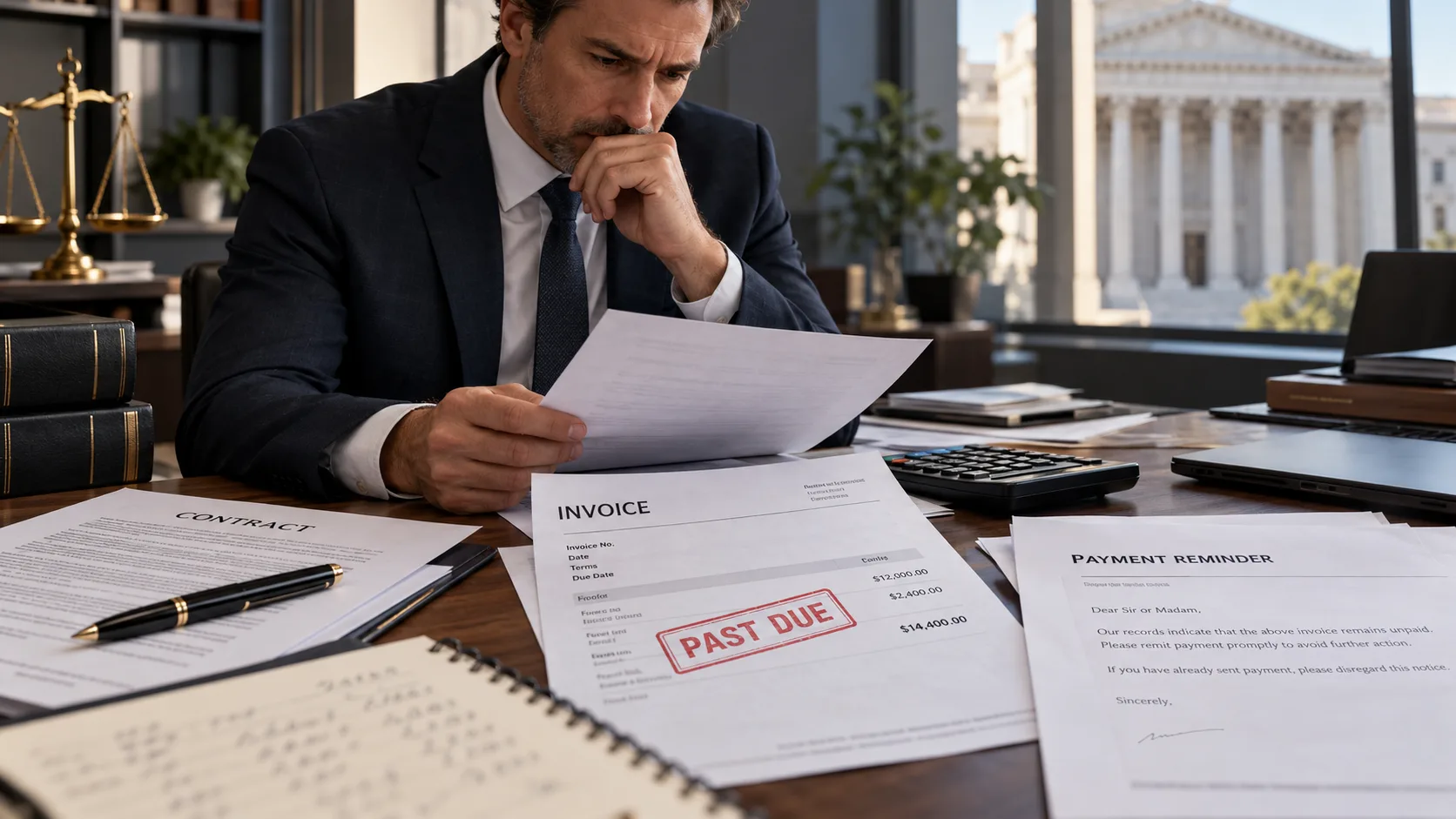
What an unpaid invoice proves, which California claims may apply, deadlines, interest and fees, and why collectibility matters.
When a business customer refuses to pay an invoice, California law provides several potential remedies, including breach of contract and certain common-count claims.
But an invoice alone does not establish an enforceable debt.
The relevant questions are straightforward: What did the customer agree to pay? Did your business perform? What amount remains due? And is the claim worth pursuing?
Is an Unpaid Invoice Enforceable?
An invoice generally documents a claimed payment obligation. It does not necessarily establish the underlying agreement.
To prevail on a breach-of-contract claim, a plaintiff generally must establish a contract, its own performance or excuse for nonperformance, the defendant's breach, and resulting damages caused by that breach. (Richman v. Hartley (2014) 224 Cal.App.4th 1182, 1186; CACI No. 303.)
A signed contract is useful but not always necessary. California recognizes many oral and implied agreements, subject to statutory writing requirements. For more on that issue, see enforcing a verbal business agreement.
For an unpaid commercial invoice, the key evidence usually concerns the agreed price, payment terms, performance, and outstanding balance.
What Evidence Should a Business Preserve?
A well-documented payment dispute may include:
- contracts, proposals, and purchase orders;
- statements of work and change orders;
- invoices and account statements;
- emails and written payment acknowledgments;
- delivery confirmations or proof of completed services;
- payment history, credits, and adjustments; and
- communications disputing the work or amount owed.
The objective is to establish what the parties agreed, what was provided, when payment became due, and whether the customer has a legitimate defense.
If the customer alleges defective, incomplete, or late performance, that issue must be evaluated rather than dismissed merely because an invoice remains unpaid.
What Legal Claims May Be Available?
California recognizes several potential claims for unpaid commercial debts. The appropriate theory depends on the transaction and available evidence.
Breach of contract. Where a customer agreed to pay and failed to do so after the business performed its obligations, nonpayment may constitute a breach. The contract may also contain notice requirements, arbitration provisions, interest terms, or attorney-fee provisions that affect enforcement. (CACI No. 303.)
Open book account. An open-book-account claim requires qualifying records of financial transactions maintained in the ordinary course of business. Code of Civil Procedure section 337a defines a book account and addresses the required recordkeeping characteristics. CACI No. 372 identifies the essential elements of the claim. A qualifying account may contain one or more entries, but merely issuing an invoice or maintaining private accounting records does not automatically establish an open book account.
Account stated. An account stated generally requires a prior debtor-creditor relationship, an agreement on the amount owed, and an express or implied promise to pay that amount. (CACI No. 373.) Agreement may be inferred from the parties' conduct in appropriate circumstances. But sending a statement and receiving no response does not invariably establish assent, particularly where the underlying debt is disputed. In Maggio, Inc. v. Neal (1987) 196 Cal.App.3d 745, 751–753, the Court of Appeal rejected account-based theories where the required relationship and agreement were not adequately established.
Goods or services rendered. A business may also have a common-count claim for the reasonable value of goods delivered or services performed at the customer's request. The recoverable amount must be supported by evidence and does not automatically equal whatever appears on the invoice. (CACI No. 371.)
These theories are not interchangeable, and pleading additional claims does not relieve the business of proving the underlying obligation.
Should You Send a Demand Letter?
Often, yes. A written demand can identify the agreement, outstanding balance, payment deadline, and supporting documentation. It should account for previous payments or credits and address any known dispute.
The letter should also be consistent with applicable contractual notice and dispute-resolution requirements.
A demand may resolve the matter without litigation or clarify the customer's actual defense. California's small-claims procedure generally requires requesting payment before filing, subject to applicable exceptions.
Can You Recover Interest and Attorney's Fees?
Potentially, but neither is automatic.
Interest. Civil Code section 3287(a) addresses prejudgment interest where damages are certain or capable of calculation and the right to recover vested on an identifiable date. Under Civil Code section 3289(b), a qualifying contract entered into after January 1, 1986, that does not stipulate a lawful interest rate generally bears interest at 10% annually after breach, subject to the statute's scope and applicable exceptions.
This does not mean an invoice automatically earns 10% interest from its issuance date. The governing contract, breach date, and interest-entitlement rules matter.
Attorney's fees. California generally requires a contractual or statutory basis for fee recovery. Civil Code section 1717 governs qualifying contractual attorney-fee provisions and generally makes those provisions reciprocal.
A business should not assume its customer must reimburse legal fees simply because the customer failed to pay.
How Long Do You Have to File a Lawsuit?
The applicable limitations period depends on the obligation and claim. Under California law:
- Written contracts: generally four years. (Code Civ. Proc., § 337(a).)
- Contracts not founded on a writing: generally two years. (Code Civ. Proc., § 339(1).)
- Qualifying book accounts and accounts stated based on written accounts: generally four years, subject to statutory requirements. (Code Civ. Proc., § 337(b).)
- Contracts for the sale of goods: separate limitations rules may apply, including Commercial Code section 2725.
Accrual, the transaction's legal character, and potential tolling issues can alter the analysis.
A business cannot assume that sending additional invoices or account statements automatically restarts the filing deadline. See Leighton v. Forster (2017) 8 Cal.App.5th 467.
Should You File in Small Claims Court, Superior Court, or Arbitration?
The appropriate forum depends on the amount owed, the claimant's legal status, the contract, and the issues in dispute.
California small-claims courts have different jurisdictional limits for individuals and business entities. Attorney representation at small-claims hearings is generally restricted.
Larger or more complex disputes may proceed in superior court, while an enforceable arbitration agreement may require arbitration.
Before filing, consider the amount at stake, likely defenses, attorney-fee exposure, the cost of business litigation, and the financial condition of the customer.
Winning a Judgment Does Not Guarantee Payment
A judgment establishes an enforceable obligation, but collection is a separate process.
Depending on the debtor's circumstances and applicable exemptions, enforcement may involve a debtor examination, writ of execution, bank levy, or other authorized procedure. California courts do not automatically collect a judgment for the prevailing party.
A claim against an operating business with identifiable assets may present different recovery prospects from one against an insolvent or inactive entity.
Collectibility should be assessed before substantial litigation expenses are incurred.
What Should You Do First?
Before escalating an unpaid invoice:
- confirm the correct customer or contracting entity;
- reconcile the outstanding balance and preserve supporting records;
- review contractual payment, notice, interest, and dispute-resolution terms;
- evaluate any legitimate objections to performance; and
- assess limitations periods and the customer's ability to pay.
A demand letter, negotiated payment arrangement, arbitration, or lawsuit may be appropriate depending on the circumstances.
The objective is recovery—not merely obtaining a judgment.
Mahrouyan Law, P.C. represents California businesses in selected commercial contract and business disputes, including nonpayment and collection matters.
Frequently Asked Questions
Can I sue a business customer without a signed contract?
Yes, potentially. California recognizes many oral and implied agreements, although some transactions must satisfy statutory writing requirements. The agreement, performance, breach, and resulting damages still must be proven.
Does sending an invoice create an account stated?
Not automatically. An account stated requires an existing debt and agreement on the balance. Assent may sometimes be inferred from conduct, but an invoice alone does not establish the claim.
Can I charge interest on an unpaid invoice?
Potentially. The agreement and applicable California statutes determine whether interest is recoverable, at what rate, and from what date. Unilaterally adding a late fee does not necessarily make it enforceable.
Can I recover my attorney's fees?
Only where an enforceable contract provision or applicable statute authorizes recovery, subject to the governing rules.
What if the customer has gone out of business?
A claim may still exist, but the customer's legal status, assets, insolvency, and available enforcement remedies affect whether payment can realistically be collected.
Sources & Authorities
- CACI No. 303 — Breach of Contract (Judicial Council of California Civil Jury Instructions)
- CACI No. 371 — Goods and Services Rendered
- CACI No. 372 — Open Book Account
- CACI No. 373 — Account Stated
- Cal. Code Civ. Proc. § 337 — four-year limitations periods
- Cal. Code Civ. Proc. § 337a — book account
- Cal. Code Civ. Proc. § 339 — two-year limitations period
- Cal. Civil Code § 3287 — prejudgment interest
- Cal. Civil Code § 3289 — contractual interest after breach
- Cal. Civil Code § 1717 — contractual attorney's fees
- Cal. Commercial Code § 2725 — sales-of-goods limitations period
- Richman v. Hartley (2014) 224 Cal.App.4th 1182, 1186 — cited in CACI No. 303 for the elements of breach of contract
- Maggio, Inc. v. Neal (1987) 196 Cal.App.3d 745, 751–753
- Leighton v. Forster (2017) 8 Cal.App.5th 467
- California Courts Self-Help — Small Claims or Limited Civil
- California Courts Self-Help — How to Collect a Judgment
Mahrouyan Law handles these matters directly. Read more about how the firm approaches small business & commercial litigation in California, or discuss your own situation with the firm.
Unpaid Commercial Invoice?
Contact Mahrouyan Law, P.C. to discuss the agreement, the balance owed, and the available options.

Omeed Mahrouyan is the founder of Mahrouyan Law, P.C., a California firm handling business and commercial litigation, property and cargo damage claims, personal injury, landlord representation, startup transactions, and practical intellectual property matters. Clients work directly with him on strategy, drafting, and case decisions.
More about Omeed Mahrouyan →