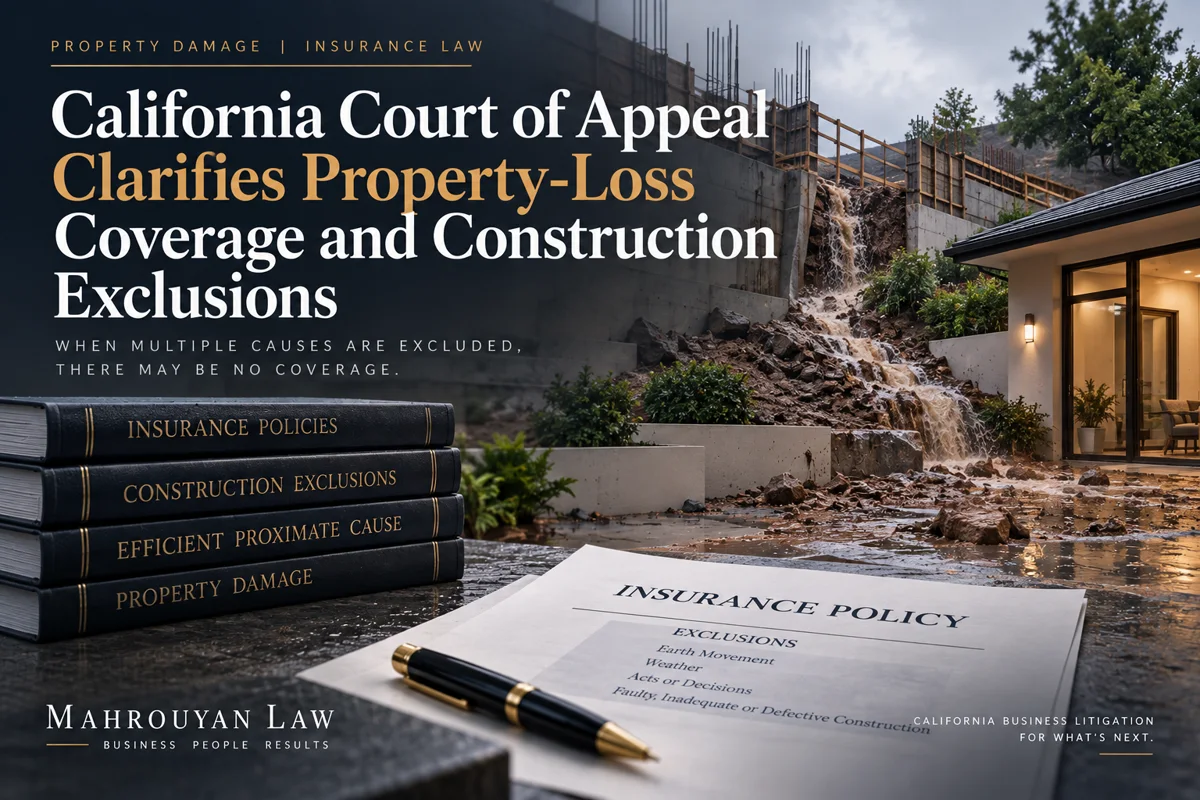
A published California decision explains how efficient proximate cause and construction exclusions apply when neighboring construction, rain, runoff, and mud combine in a property loss.
- Sherman Oaks residence
- Property
- Construction + rain + runoff + mud
- Events
- Coverage excluded on this record
- Insurance Result
- Not decided
- Third-Party Liability
What Happened?
The homeowners owned a single-family residence in Sherman Oaks at the bottom of a ravine below a steep hillside. On the upslope neighboring property, Melt Construction was building a residence and a retaining wall under City-approved plans.
After a neighbor complained about the wall's appearance, the City asked the contractor to pause while possible design changes were considered. The City did not issue a formal stop order. When work paused, approximately 15 feet of the retaining wall remained unfinished; caisson holes had been drilled and rebar placed, but that section of wall had not been built.
During a December 2019 rainstorm, runoff traveled along the wall, formed a gully at its unfinished end, overwhelmed drainage, and carried water, mud, and debris into the insured home. The residence became uninhabitable. The homeowners submitted a claim to First American, which ultimately denied coverage based on several policy exclusions. The trial court entered summary judgment for the insurer, and the Court of Appeal affirmed in Linsao v. First American Property & Casualty Insurance Co., No. B340746, filed August 27, 2026 and certified for publication September 23, 2026.
What Is the ‘Efficient Proximate Cause’?
When several events contribute to one loss, California does not simply ask which event happened first or last. Insurance Code section 530 focuses on proximate cause: an insurer may be liable when an insured peril is the proximate cause even if another peril was remote, but not when the insured peril was only remote.2
Garvey v. State Farm Fire & Casualty Co. (1989) 48 Cal.3d 395, 403–404 explains that the efficient proximate cause is the predominant or most important cause in the applicable causal chain. An excluded event does not automatically eliminate coverage if a covered peril was the efficient proximate cause.3
Linsao therefore is not a rule that multiple causes mean no coverage. Policy language, the supported causes, and which cause predominated still matter.
Why Did the Insurer Prevail in Linsao?
First American argued that every possible efficient proximate cause supported by the summary-judgment record was excluded: the rainstorm, earth movement or mud, the neighboring construction, and the events surrounding the interruption of retaining-wall construction.
The homeowners argued that uncertainty about which event predominated should require a trial. The Court of Appeal disagreed. A real dispute between a potentially covered efficient cause and an excluded one may require a factfinder. But uncertainty does not create coverage where every legally viable possible efficient cause is excluded.
The court relied on Brodkin v. State Farm Fire & Casualty Co. (1989) 217 Cal.App.3d 210, 217 for the narrower point that summary judgment may be proper when all alleged efficient causes fall within policy exclusions, even if the parties dispute which one predominated.4
Why Didn't the Neighbor's Complaint Change the Result?
The homeowners argued that the neighbor's complaint led the City to request that work pause and could therefore be the efficient cause. The court rejected that theory.
A remote event does not become the efficient proximate cause merely because later events might not have occurred without it. The complaint could not independently have caused the physical damage. Treating every link in the history as a separate peril would turn remote but-for events into predominant causes, contrary to California's framework.
Why Did the Unfinished Wall Count as ‘Inadequate Construction’?
The homeowners argued that inadequate construction should require proof of negligent or faulty construction. The court disagreed under this policy's wording. It applied the ordinary meaning of inadequate: insufficient or incapable of performing the intended function.
Wilson v. Farmers Insurance Exchange (2002) 102 Cal.App.4th 1171, 1174 similarly treated materially unfinished construction as potentially within an inadequate-construction exclusion. In Linsao, about 15 feet remained unfinished, with only caisson holes and rebar in place.5
The holding is policy- and fact-specific. It does not mean every construction-related loss is excluded, that incomplete construction always defeats coverage, or that inadequate construction always has the same effect under every policy.
Did the Court Find the Contractor Negligent?
No. The appellate case decided whether the homeowners' own property-insurance policy covered the loss. It did not adjudicate whether the neighboring contractor, City, developer, or another participant was negligent or legally responsible.
The homeowners separately sued the City, the contractor, and other parties associated with the neighboring work. Linsao did not decide that separate action. A first-party policy exclusion does not itself resolve a negligence, contract, indemnity, or property-damage claim against someone alleged to have caused the loss.
That distinction is important in construction- and contractor-caused property damage: insurance coverage asks what the owner's policy promises, while third-party liability asks whether another person or entity is legally responsible for causing the damage.
What About the Insurer's Earlier Statements That Coverage Existed?
The homeowners relied on evidence that insurance personnel allegedly said the loss would be covered. The court recognized that factual questions could exist about what was said and whether the homeowners relied on it.
But it applied the general rule that estoppel ordinarily cannot create policy coverage for a risk the contract did not cover. The court distinguished decisions involving liability insurers that assumed the defense of third-party lawsuits and caused insureds to surrender other means of protecting themselves.
The holding should not be reduced to ‘an insurer can always change its mind without consequence.’ It addresses the particular estoppel and coverage theories presented on this record.
What Evidence Matters After Construction-Related Property Damage?
Preserve photographs and video from before and after the loss; construction, grading, drainage, and retaining-wall plans; permits; contractor communications; weather records; engineering and geotechnical reports; inspection records; repair estimates; insurance correspondence; expert evaluations; and loss-of-use documentation.
For potential third-party claims, contracts, subcontractor roles, site-control evidence, and records showing who directed the relevant work may also matter. Early preservation can help separate what the policy covers from who may have caused the physical loss.
The Practical Lesson
Construction-related storm damage can create two potential recovery paths. First: what does the property owner's own policy cover? Second: did another party cause the damage and face separate liability? Those questions should be evaluated independently.
Linsao resolved the first question on the record and policy before the court. It did not eliminate every possible avenue of third-party recovery. Property owners and businesses may need to analyze both the coverage language and the evidence supporting business and commercial litigation against an allegedly responsible participant.
A related Mahrouyan Law Insight, California Court Clarifies Shipper Liability After Overheight Cargo Strikes Bridge, explains another setting in which one participant's duties did not automatically eliminate a third party's potential responsibility.
Footnotes
- Linsao v. First American Property & Casualty Insurance Co., No. B340746 (Cal. Ct. App., 2d Dist., Div. 1, Aug. 27, 2026), certified for publication Sept. 23, 2026. ↩
- Cal. Ins. Code § 530. ↩
- Garvey v. State Farm Fire & Casualty Co. (1989) 48 Cal.3d 395, 403–404. ↩
- Brodkin v. State Farm Fire & Casualty Co. (1989) 217 Cal.App.3d 210, 217. ↩
- Wilson v. Farmers Insurance Exchange (2002) 102 Cal.App.4th 1171, 1174. ↩
Sources & Authorities
- Linsao v. First American Property & Casualty Insurance Co., No. B340746 (Cal. Ct. App., 2d Dist., Div. 1, Aug. 27, 2026), certified for publication Sept. 23, 2026 — Published opinion and attached publication order.
- Cal. Ins. Code § 530 — California's statutory proximate-cause rule for insured and remote perils.
- Cal. Ins. Code § 532 — Read together with California's efficient-proximate-cause decisions.
- Garvey v. State Farm Fire & Casualty Co. (1989) 48 Cal.3d 395
- Brodkin v. State Farm Fire & Casualty Co. (1989) 217 Cal.App.3d 210
- Wilson v. Farmers Insurance Exchange (2002) 102 Cal.App.4th 1171
Mahrouyan Law handles these matters directly. Read more about how the firm approaches commercial property, equipment & cargo damage in California, or discuss your own situation with the firm.
Discuss Your Matter
Mahrouyan Law handles selected California property-damage matters involving construction and contractor-caused damage, commercial property, loss of use, expert evidence, and related insurance issues where relevant. When several events may have contributed to a loss, separating insurance coverage from potential third-party liability can be an important early step.

Omeed Mahrouyan is the founder of Mahrouyan Law, P.C., a California firm handling business and commercial litigation, property and cargo damage claims, personal injury, landlord representation, startup transactions, and practical intellectual property matters. Clients work directly with him on strategy, drafting, and case decisions.
More about Omeed Mahrouyan →