
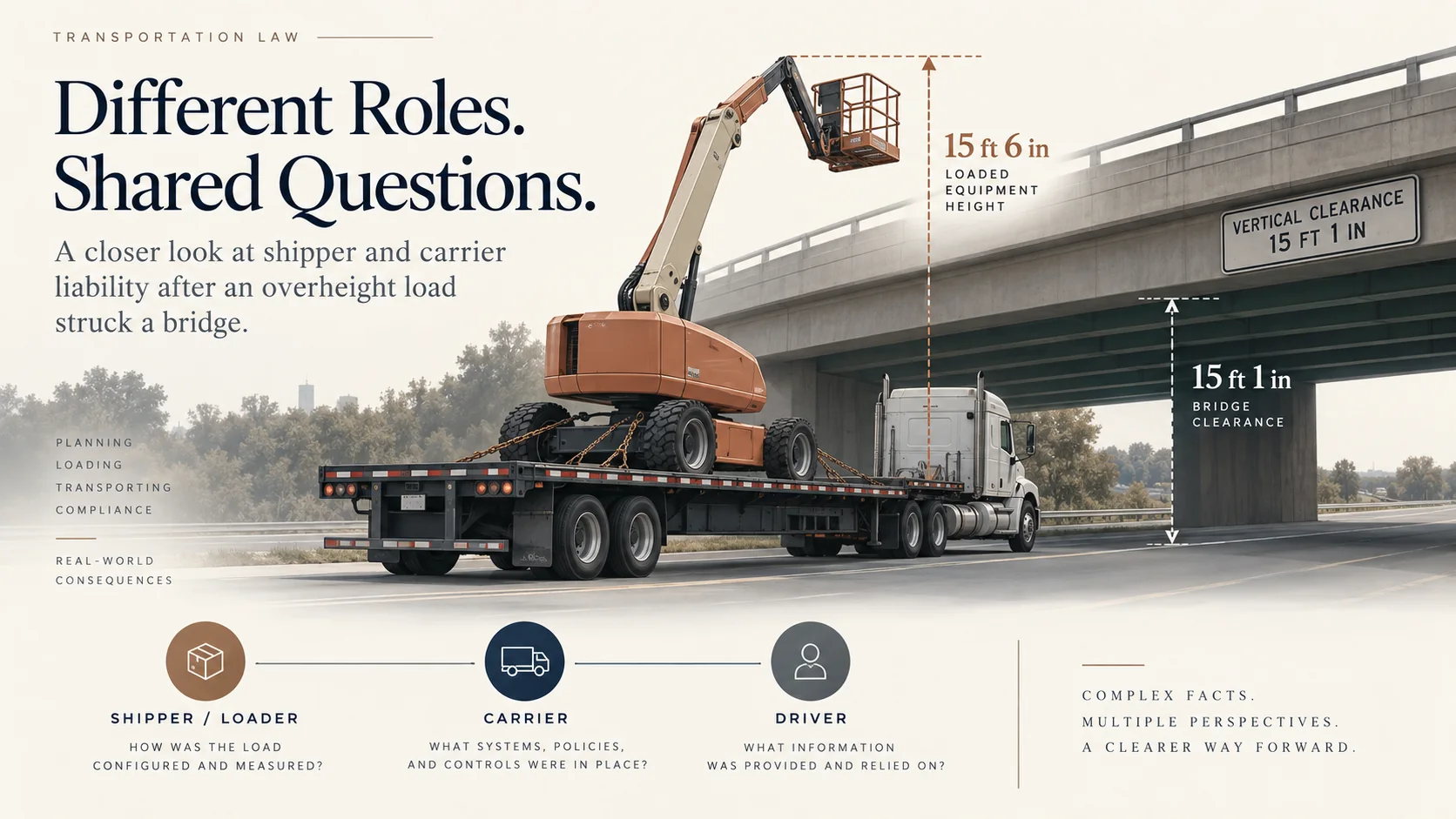
A carrier has its own loading and inspection duties—but those duties do not automatically eliminate a shipper's potential responsibility for its own loading conduct.
- 15 ft. 6 in.
- Load Height
- 15 ft. 1 in.
- Bridge Clearance
- Summary judgment for shipper
- Trial Court
- Reversed
- Court of Appeal
What Happened?
In June 2020, a driver for California Interstate Express arrived at a Herc Rentals yard to transport a JLG 800A articulated 80-foot boom lift to a buyer.
Two Herc employees loaded the boom lift onto the driver's flatbed trailer. The lift was undocked, meaning its arm remained extended. After the loading was complete, the driver secured the equipment with straps and chains.
The driver knew he was responsible for checking the load's dimensions, but he did not measure its height before leaving. According to the opinion, the loaded lift stood approximately 15 feet, 6 inches above the roadway. The bridge clearance was approximately 15 feet, 1 inch.
The top of the boom lift struck the overcrossing and caused structural damage. Caltrans ultimately sued the carrier, the driver, and Herc.
Why Did Herc Initially Win?
Herc moved for summary judgment, arguing that the carrier and driver—not the shipper—had the controlling legal responsibility to inspect and safely transport the load.
The trial court agreed. It relied in part on federal motor-carrier regulations, California vehicle law, and the shipper-carrier doctrine associated with United States v. Savage Truck Line, Inc.
Under the traditional Savage rule, a carrier generally bears primary responsibility for safe loading, while a shipper that performs the loading may remain responsible for defects that are hidden or latent.
The Court of Appeal concluded that this rule did not justify dismissing Caltrans's third-party negligence claim against Herc.
What Did the Court of Appeal Decide?
The Court of Appeal reversed the judgment based on the order granting summary judgment for Herc.
Its most important published holding was narrow: a carrier's loading responsibilities do not categorically immunize a shipper from a negligence claim brought by an injured third party.
Savage historically addressed allocation between a shipper and carrier. Caltrans was a third party, not a participant in that commercial relationship. The court also explained that California's comparative-fault system permits responsibility to be allocated among multiple actors based on their respective conduct.
California Civil Code section 1714 states the state's general duty-of-care rule. The published opinion concluded that the carrier regulations did not create an exception that automatically insulated a shipper from responsibility for its own conduct.4
The decision therefore allows the claim against Herc to continue. It does not resolve whether Herc breached a duty, caused the damage, or bears any ultimate share of fault.
The Carrier Still Had Its Own Duties
The court did not excuse the carrier or driver. Federal regulation 49 C.F.R. section 392.9 provides that a driver may not operate a commercial motor vehicle unless its cargo is properly distributed and adequately secured, and it requires a driver to assure that condition before driving.2
California Vehicle Code section 35250 generally limits a vehicle and its load to 14 feet in height. It also states that a vehicle or load exceeding 13 feet, 6 inches may be operated only on highways deemed safe by the vehicle owner.3
Those rules imposed duties on the carrier and driver. But the court held that those duties did not themselves establish that a shipper could owe no independent duty for its own loading conduct.
Why the Savage Rule Did Not End the Case
The published opinion treated the commercial relationship between shipper and carrier as different from a negligence claim by someone outside that relationship.
No California state court had applied Savage to categorically defeat a third party's negligence claim against a shipper. The court concluded that the rule could not be used to shield a shipper from such a claim merely because the carrier also had loading and inspection duties.
That does not abolish Savage for every purpose. Contractual, indemnity, or allocation disputes between a shipper and carrier can present different questions from a third party's direct negligence claim.
Did the Court Find Herc Negligent?
No. Reversing summary judgment is not a final finding of negligence or liability.
The decision did not determine whether Herc breached a legal duty, whether its conduct caused the bridge damage, how fault should be allocated, or what damages may ultimately be recoverable.
The case returned to the trial court for further proceedings. The opinion also stated that the appellate court was not deciding the precise standard of care governing Herc's conduct, leaving that issue for the trial court on remand.
Why Publication Status Matters
The opinion was certified for publication except Part E of the Discussion.
The precedential analysis in this article therefore relies on the published portions addressing the Savage rule, California comparative-fault principles, federal motor-carrier regulations, and Vehicle Code section 35250.
Part E contains the court's detailed Rowland duty analysis. Because that part was excluded from publication, this article does not present it as published precedent. The reversal and the case's return to the trial court remain part of the procedural history.
What Evidence Matters After a Loading or Transportation Loss?
A transportation-loss investigation may depend on photographs of the equipment before transport and of the loaded trailer; equipment configuration; load-height measurements; bills of lading; pickup and delivery documents; driver inspection records; loading procedures; dispatch communications; GPS and route information; permits; equipment manuals; and post-loss communications.
Contracts between the shipper and carrier, indemnity provisions, and insurance information can also matter. Those agreements may affect risk allocation between commercial participants even when a third party's negligence claim presents a separate question.
Even a few inches can be decisive. The opinion states that the loaded boom lift stood approximately five inches higher than the bridge clearance.
Mahrouyan Law handles selected commercial property, equipment, and cargo damage matters involving transportation losses and related evidence-preservation issues.
The Broader Lesson
The decision does not mean a shipper is always responsible, and it does not make a carrier's duties disappear.
Its practical lesson is that different participants may have different duties at the same time. California comparative-fault principles may then determine how responsibility is allocated based on the evidence.
For shippers, carriers, loaders, equipment owners, and insurers, early preservation of loading records, photographs, measurements, contracts, and communications can be especially important.
Questions about responsibility, contractual allocation, and recovery may also require business and commercial litigation analysis beyond the immediate transportation regulations.
Footnotes
Sources & Authorities
- State of California ex rel. Department of Transportation v. Herc Rentals, Inc., No. A174303 (Cal. Ct. App., 1st Dist., Div. 5, Sept. 14, 2026) — Official published-opinion page; the opinion is certified for publication except Part E of the Discussion.
- 49 C.F.R. § 392.9 — Inspection of cargo, cargo securement devices and systems — Official eCFR text governing carrier and driver cargo inspection and securement duties.
- California Vehicle Code § 35250 — Official California Legislative Information text concerning vehicle and load height.
- California Civil Code § 1714 — Official California Legislative Information text stating California's general duty-of-care rule.
Mahrouyan Law handles these matters directly. Read more about how the firm approaches commercial property, equipment & cargo damage in California, or discuss your own situation with the firm.
Discuss Your Matter
Mahrouyan Law handles selected California commercial property, equipment, cargo, and transportation-damage matters. These disputes can involve shippers, carriers, loaders, equipment owners, insurers, and other commercial participants, making early evidence preservation and responsibility analysis important.

Omeed Mahrouyan is the founder of Mahrouyan Law, P.C., a California firm handling business and commercial litigation, property and cargo damage claims, personal injury, landlord representation, startup transactions, and practical intellectual property matters. Clients work directly with him on strategy, drafting, and case decisions.
More about Omeed Mahrouyan →