
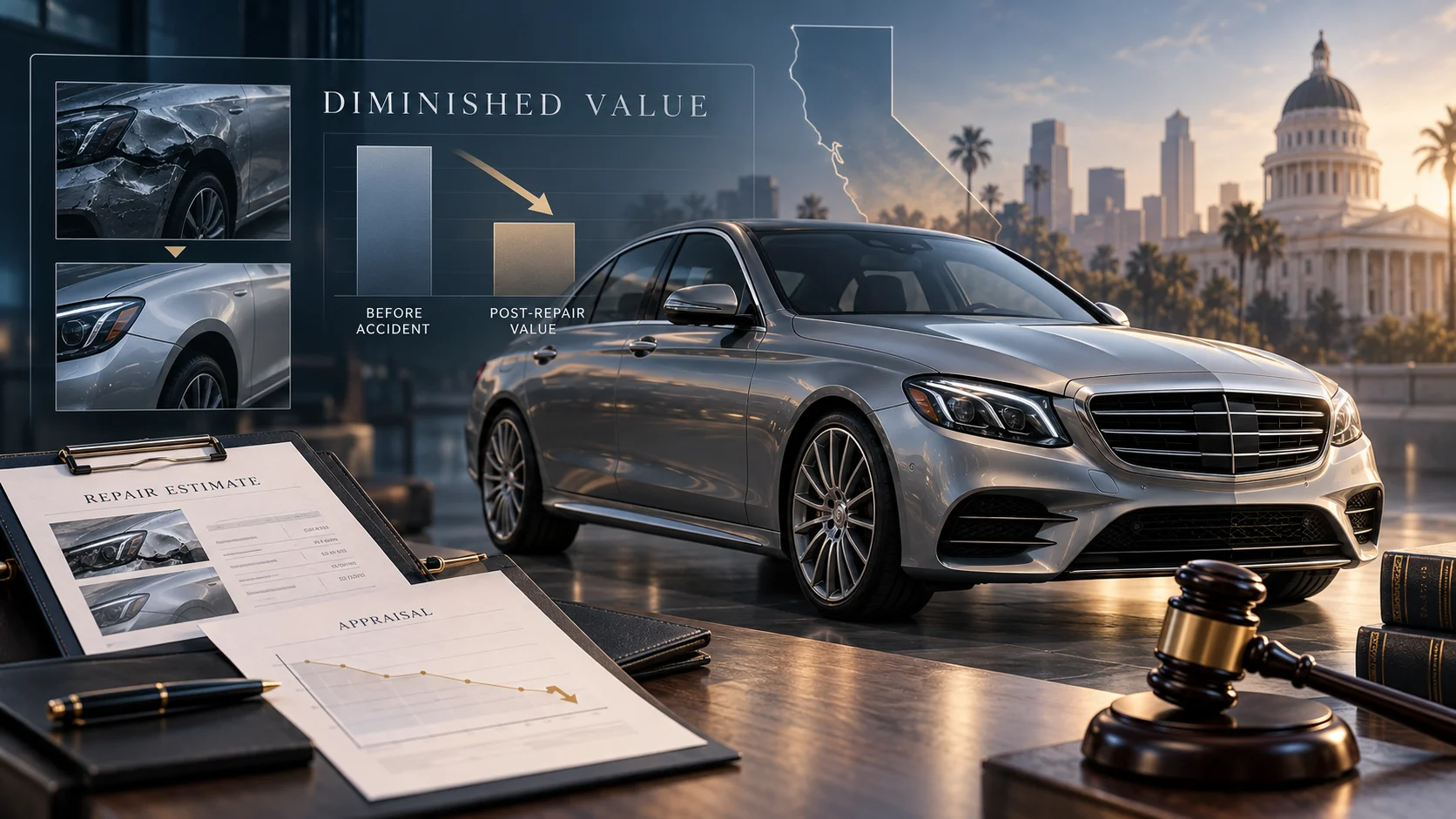
A repaired vehicle may still be worth less after a crash. Learn when California law may allow recovery for diminished value and how these claims are proven.
A car can be repaired correctly and still be worth less than it was before an accident. That remaining loss is commonly called diminished value.
California law can recognize that loss in an appropriate third-party property-damage claim. If reasonable repairs do not fully restore a vehicle’s pre-accident market value, the owner may potentially recover both reasonable repair costs and the remaining depreciation—subject to rules preventing double recovery.
But diminished value is not automatic, and a claim against your own insurance company raises a different question.
What Is Diminished Value?
Diminished value is the difference between what a vehicle was worth before an accident and what it is worth after appropriate repairs, when the accident and repair history still reduce its market value.
California’s general tort-damages statute, Civil Code section 3333, provides compensation for detriment proximately caused by a wrongful act. In Merchant Shippers Association v. Kellogg Express & Draying Co. (1946) 28 Cal.2d 594, 600, the California Supreme Court explained that when damaged property cannot be completely restored to its former value, damages may include the reasonable cost of repair plus the remaining depreciation after repair. CACI No. 3903J, Damage to Personal Property (Economic Damage), reflects the same principle.
In practical terms, if repairs fully restore the vehicle’s market value, there may be no additional diminished-value damages. If credible evidence shows the properly repaired vehicle remains worth less, the residual loss may be recoverable from the responsible party.
Is Diminished Value Automatic After an Accident?
No. An accident appearing on a vehicle-history report does not by itself establish a particular amount of damages. The owner must prove an actual reduction in fair market value.
California law does not establish a universal diminished-value percentage, multiplier, or “17c formula.” The question is what a willing buyer would have paid immediately before the accident compared with what a willing buyer would pay after repairs, knowing the vehicle’s relevant condition and history.
A newer luxury vehicle with significant structural repairs may present a very different valuation question than an older vehicle with minor cosmetic damage. The evidence—not a predetermined formula—controls.
How Is a Diminished-Value Claim Proven?
The central comparison is what the vehicle was worth immediately before the collision versus what the repaired vehicle is worth afterward. A repair bill proves what the repairs cost; diminished value asks whether a separate market loss remains. Useful evidence may include:
- purchase, ownership, mileage, and maintenance records;
- pre-accident photographs and any prior accident or repair history;
- vehicle options, specifications, and comparable market data;
- initial and supplemental repair estimates, teardown photographs, and structural measurements;
- final repair invoices; and
- a qualified post-repair appraisal when appropriate.
Can I Recover Repair Costs and Diminished Value?
Potentially. When repairs can be made but the property remains worth less afterward, damages may include the reasonable repair cost plus the remaining reduction in value.
But California does not permit overlapping double recovery. CACI No. 3903J instructs that the combined recovery under this measure generally may not exceed the property’s value immediately before the harm. The purpose is compensation for actual economic loss—not a windfall.
What About a Claim Against My Own Insurance Company?
This is a critical distinction. A claim against the driver or other party responsible for damaging your vehicle is generally governed by tort-damages principles. A claim against your own automobile insurer depends primarily on the language of your policy.
In Carson v. Mercury Insurance Co. (2012) 210 Cal.App.4th 409, the Court of Appeal enforced policy language addressing diminution in value and rejected the insured’s argument that the insurer still had to compensate for post-repair stigma depreciation. Baldwin v. AAA Northern California, Nevada & Utah Insurance Exchange (2016) 1 Cal.App.5th 545 likewise upheld policy language permitting repair while excluding compensation for remaining loss in resale value.
Those decisions turned on the policy language before the court. Whether your own carrier owes diminished value depends on your actual policy—not a universal rule in either direction.
What if the At-Fault Driver’s Insurer Is Handling the Claim?
The underlying claim is still against the person or entity legally responsible for the damage, even when that party’s liability insurer investigates and negotiates it. The scope of your third-party tort damages is not defined by the at-fault driver’s policy in the way a first-party claim is governed by your own insurance contract.
An insurer’s offer does not by itself determine the value of the claim. The relevant questions remain liability and proof of the vehicle’s actual residual loss.
Be Careful Before Signing a Property-Damage Release
Evaluate diminished value before finalizing a property-damage settlement. In Carson, the insured had released her property-damage claim against the responsible driver without pursuing a separate diminution claim—an illustration of why a release’s scope deserves careful review before signing.
Depending on its language, a release may affect repair supplements, diminished value, loss of use, and other vehicle-related property claims. Do not assume that accepting a payment labeled “property damage” preserves additional claims; the actual release language controls.
Can I Also Recover Loss of Use?
Potentially, but it is a separate item. Diminished value concerns what the vehicle is worth; loss of use concerns being deprived of the vehicle for a compensable period while it is repaired or replaced.
In Reynolds v. Bank of America National Trust & Savings Association (1959) 53 Cal.2d 49, the California Supreme Court recognized loss-of-use damages for a commercial vehicle during the period reasonably necessary to obtain a replacement. Metz v. Soares (2006) 142 Cal.App.4th 1250 illustrates that theoretical rental value does not necessarily establish damages where the claimant was not actually deprived of use.
For fleet vehicles, work trucks, trailers, and other income-producing property, loss of use can be a significant separate component—see, for example, our discussion of a California shipper-liability decision involving overheight cargo. Bodily-injury damages are a separate subject; see How Much Is My Personal Injury Case Worth in California?
How Long Do I Have to Bring a Claim?
Code of Civil Procedure section 338(c)(1) generally provides a three-year limitations period for an action for injury to goods or chattels, including vehicle property damage.
That is not a reason to wait. Vehicles are sold, repair photographs disappear, and releases get signed. Other claims arising from the accident may carry different deadlines, and disputes with your own insurer may involve contractual notice, appraisal, or suit-limitation provisions.
What Should I Preserve?
Before selling or trading the vehicle, preserve:
- the complete repair estimate and all supplements;
- before-and-after and teardown photographs;
- structural measurements and final invoices;
- vehicle-history reports and purchase and maintenance records;
- insurer correspondence; and
- any diminished-value appraisal.
The Bottom Line
California law can compensate a provable residual market loss after repairs, but whether that loss exists and who must pay it depend on liability, evidence, and—in first-party insurance claims—the governing policy language. A practical first step is to ask who is responsible, what reliable evidence shows about value before and after repair, and whether the property claim has already been released.
Mahrouyan Law, P.C. represents businesses, vehicle and equipment owners, and injured individuals in selected California commercial property, equipment, and vehicle-damage claims and collision matters.
Frequently Asked Questions
Can I recover diminished value after a California car accident?
Potentially. If reasonable repairs do not fully restore the vehicle’s pre-accident market value, California law may allow recovery of the remaining depreciation from the responsible party when properly proven.
Does every accident create a diminished-value claim?
No. The owner must establish an actual post-repair reduction in fair market value. California does not provide an automatic percentage or universal diminished-value formula.
Can I recover repair costs and diminished value?
Potentially, when repairs do not completely restore the property’s market value. California law also limits overlapping or double recovery.
Does my own insurance company have to pay diminished value?
Not necessarily. First-party coverage depends on the insurance policy. California courts have enforced policy language limiting or excluding separate compensation for post-repair diminution in value.
How long do I have to bring a California vehicle property-damage claim?
Code of Civil Procedure section 338(c)(1) generally provides three years for injury to personal property, but other claims and insurance-policy requirements may have different deadlines.
Sources & Authorities
- Merchant Shippers Assn. v. Kellogg Express & Draying Co. (1946) 28 Cal.2d 594
- Judicial Council of California Civil Jury Instructions (2026 ed.), CACI No. 3903J, Damage to Personal Property (Economic Damage)
- Cal. Civil Code § 3333
- Carson v. Mercury Ins. Co. (2012) 210 Cal.App.4th 409
- Baldwin v. AAA Northern California, Nevada & Utah Ins. Exchange (2016) 1 Cal.App.5th 545
- Cal. Code Civ. Proc. § 338(c)(1)
- Reynolds v. Bank of America Nat. Trust & Sav. Assn. (1959) 53 Cal.2d 49
- Metz v. Soares (2006) 142 Cal.App.4th 1250
Mahrouyan Law handles these matters directly. Read more about how the firm approaches commercial property, equipment & cargo damage in California, or discuss your own situation with the firm.
Does the Repair Bill Capture the Full Loss?
If a repair bill does not appear to capture the full economic loss to your vehicle, contact Mahrouyan Law, P.C. to discuss the circumstances and available options.

Omeed Mahrouyan is the founder of Mahrouyan Law, P.C., a California firm handling business and commercial litigation, property and cargo damage claims, personal injury, landlord representation, startup transactions, and practical intellectual property matters. Clients work directly with him on strategy, drafting, and case decisions.
More about Omeed Mahrouyan →