
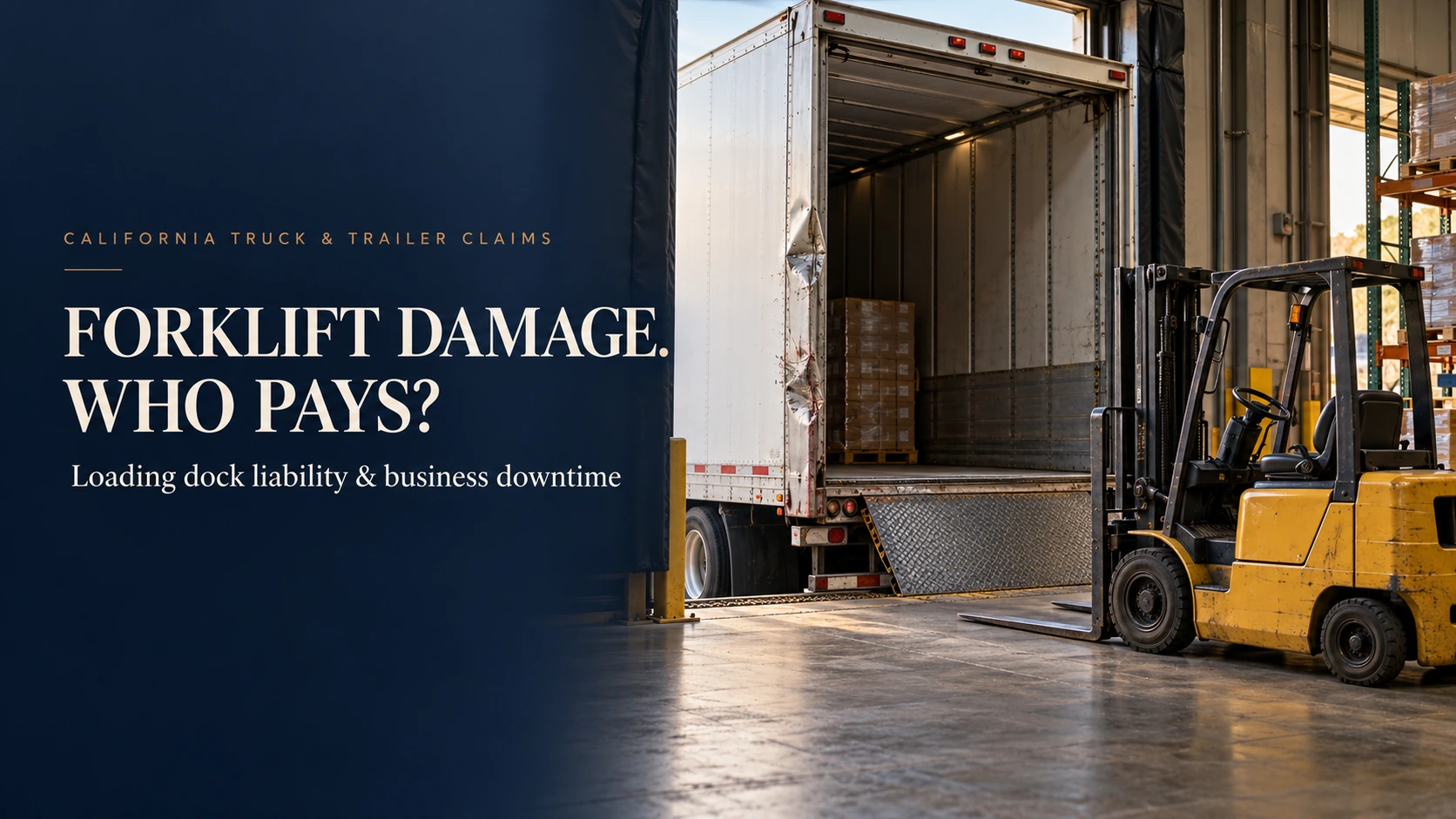
A warehouse or loading contractor may be responsible for negligent forklift operations. Liability and repair or downtime losses require separate proof.
A damaged trailer can interrupt operations long after it leaves the dock. The first question is who caused the damage and on what legal basis—not simply who owns the warehouse. Contracts, employment relationships, and the condition of the trailer can affect that analysis.
Who May Be Responsible?
Civil Code section 1714 provides California’s general ordinary-care framework. CACI No. 400 requires proof of negligence, harm, and causation; evaluating negligence involves the applicable duty and its breach. Damage discovered at a warehouse does not automatically prove negligent loading. 12
An employer may be responsible for an employee’s negligence within the scope of employment. Identify the actual operator, employer, and entity directing the loading operation. The warehouse owner did not necessarily employ everyone working there, and a loading contractor’s role requires its own analysis. CACI Nos. 3701 and 3720 address employment responsibility and scope. 3
What if the Driver Contributed?
Proven contributing negligence may reduce recovery under California’s comparative-fault rules. Trailer positioning or loading communications may matter, but an accusation alone does not establish fault. CACI Nos. 405–406 address the plaintiff’s negligence and allocation among responsible persons; fault must be supported by evidence. 4
What Evidence Matters?
Preserve a clear record of the incident and the trailer’s earlier condition:
- Photographs of the damage, dock, forklift, and trailer positioning.
- Surveillance footage and incident reports.
- Operator, employer, and witness identities.
- Pre-trip inspections, maintenance records, and earlier photographs.
- Dock-restraint information and loading communications.
- Repair estimates, repair timeline, substitute-equipment availability, and business records.
Promptly request preservation of relevant footage and records. A request does not guarantee preservation or access. Keep your own records and document who received the request.
California’s loading-dock and industrial-truck regulations, title 8, sections 3336 and 3650, can inform the investigation. Their applicability and relevance require analysis: a regulatory violation does not automatically establish civil liability, and not every workplace rule supports a property-damage claim. 5
Can Recovery Include More Than Repairs?
Physical damage: CACI No. 3903J generally measures reasonable repair costs or reduction in value, whichever is less. If repairable property remains worth less after repairs, the instruction permits reasonable repair costs plus residual diminished value, capped at the property’s value immediately before the harm. Repair costs and the full pre-repair diminution cannot simply be added together. 6
Loss of use: CACI No. 3903M measures the reasonable rental value of similar equipment for the time reasonably necessary to repair or replace the damaged property. Comparable rental rates and a supported repair timeline matter; every day out of service is not automatically compensable. 7
Lost profits: CACI No. 3903N requires proof that profits would have been earned but for the defendant’s conduct, with reasonable certainty and a reasonable basis for calculation. The measure is net profit, not gross revenue. Every canceled load is not necessarily recoverable. Our business-interruption and lost-profits article explains these proof issues. 8
Reasonable mitigation matters, including substitute-equipment availability and practical steps to limit downtime. Do not claim duplicative compensation for the same loss under both loss-of-use and lost-profit labels. 9
What Else Needs Review?
For leased trailers, identify ownership, possessory rights, repair obligations, and who actually sustained each loss. Insurance coverage is separate from liability and depends on policy terms. Contracts may also contain notice requirements and allocations of responsibility. Preserve the agreements and review them before assuming who must pay.
Sources
- 1.
- 2.
- 3.
- 4.
- 5.
- 6.
- 7.
- 8.
- 9.
Discuss a Trailer-Damage Dispute
For an evaluation of a loading-dock equipment-damage dispute, you may contact Mahrouyan Law. Learn more about our Commercial Property, Equipment & Cargo Damage practice. Recovery depends on the evidence and applicable law.

Omeed Mahrouyan is the founder of Mahrouyan Law, P.C., a California firm handling business and commercial litigation, property and cargo damage claims, personal injury, landlord representation, startup transactions, and practical intellectual property matters. Clients work directly with him on strategy, drafting, and case decisions.
More about Omeed Mahrouyan →