
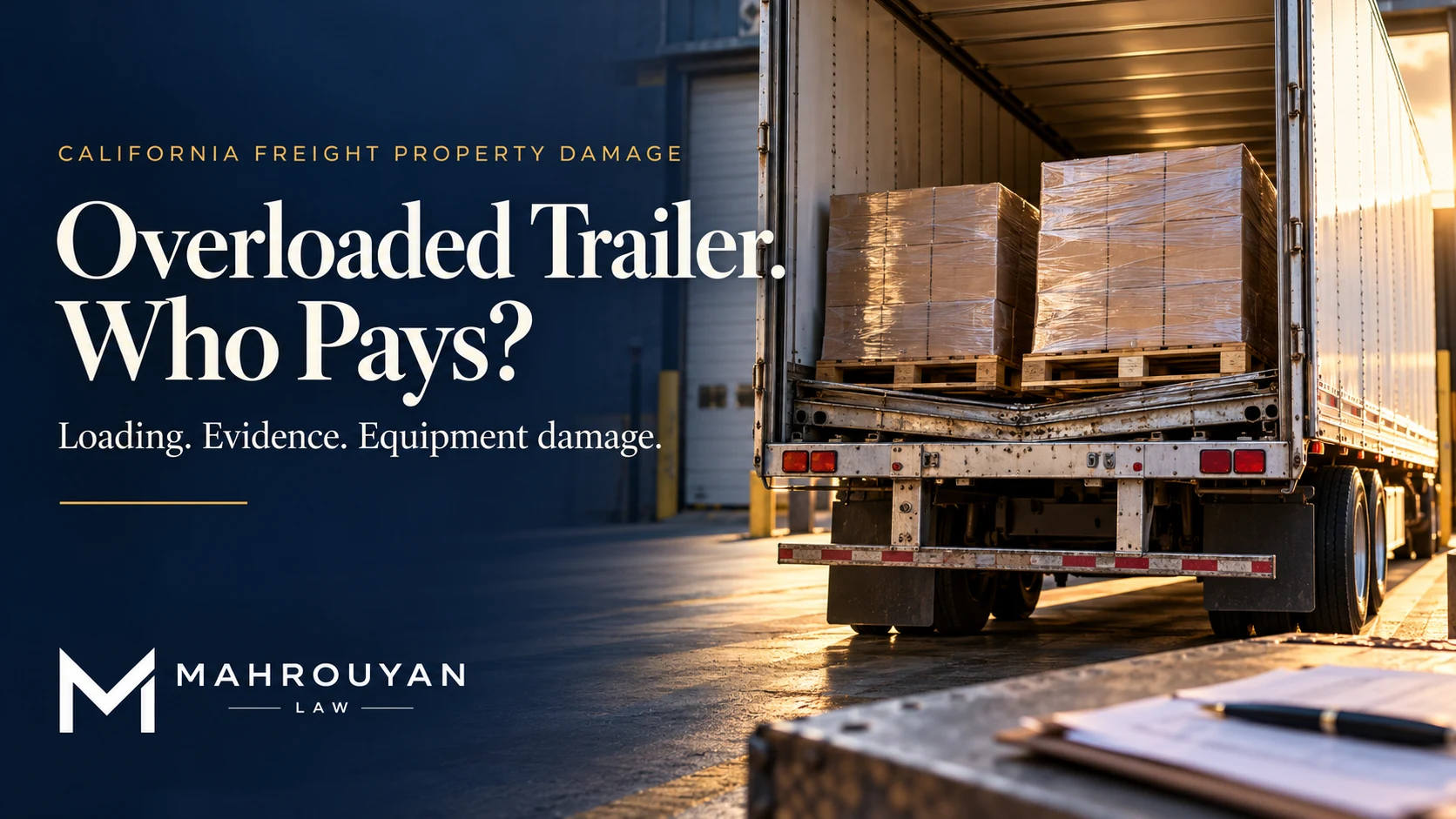
Loading a trailer does not by itself establish liability. Responsibility turns on duty, conduct, causation, the carrier's role, and the governing agreements and law.
A shipper or loading party may be responsible for trailer damage if an applicable duty, negligent conduct, causation, and damages are established.1 Responsibility also depends on the carrier's conduct, whether the loading problem was discoverable, governing agreements, and applicable law. Loading the trailer does not, by itself, establish liability.
For trucking companies, owner-operators, fleet owners, and equipment owners, the practical question is what caused the physical damage—and what evidence connects that damage to the responsible party.
Who Loaded the Freight—and What Could the Carrier Discover?
In United States v. Savage Truck Line, Inc., the Fourth Circuit distinguished apparent loading defects, which a carrier could discover through ordinary observation, from concealed defects when the shipper undertook loading. Its discussion allocates responsibility differently for those situations.2 This is Fourth Circuit authority whose application requires analysis—not a categorical California rule.
In State of California ex rel. Department of Transportation v. Herc Rentals, Inc., the California Court of Appeal reversed summary judgment for a shipper in a bridge-damage case. The carrier's duties did not categorically eliminate the shipper's potential duty to an injured third party.3 The ruling did not establish final liability or resolve every carrier-versus-shipper equipment claim.
Our related Herc Rentals overheight-cargo Insight explains that distinction. Who loaded, directed, inspected, or accepted the shipment remains important.
Driver Inspections and Sealed Trailers
For covered operations, 49 C.F.R. section 392.9(a) addresses proper cargo distribution and securement; subsection (b) imposes driver inspection duties, subject to exceptions.4 Compliance and the driver's opportunity to identify a problem may matter to responsibility.
Subsection (b)(4) excepts a sealed vehicle when the driver has been ordered not to open it for inspection, or loading that makes cargo inspection impracticable. The exception concerns subsection (b), not a blanket exemption from subsection (a).4 A seal alone does not establish shipper liability or answer whether the loading caused the damage.
Connect the Loading to the Damage
Address immediate safety concerns first. Preserve evidence as safely practicable before unloading or repairs change the condition. Useful records include:
- Bills of lading, manifests, scale tickets, and actual shipment weights.
- Photographs or video of loading, cargo placement, and damaged components.
- Pre-trip inspections, maintenance history, and equipment specifications.
- Loading instructions, dispatch communications, and relevant contracts.
- Repair estimates, downtime records, and qualified technical analysis where needed.
Total weight, axle loading, equipment capacity, and concentrated floor loading are distinct issues to investigate. A permissible total shipment weight does not necessarily answer whether weight was concentrated beyond a component's capacity. Conversely, a bowed floor does not establish that this particular shipment caused it. Prior damage, wear, equipment condition, and alternative causes may require technical evaluation.
Contracts, Cargo Claims, and Brokers
Bills of lading, rate confirmations, broker-carrier agreements, and equipment-use agreements may address different responsibilities. A shipper load and count notation is relevant evidence—not an automatic liability determination. Review the actual language and the parties' roles.
The Carmack Amendment addresses loss or injury to goods received for transportation.5 Damage to the carrier's own transportation equipment is a different issue. Do not assume every container or trailer falls outside Carmack: its role and the transaction matter, including whether the item itself was received for transportation.
A broker's arrangement of transportation alone does not establish responsibility for loading damage. Montgomery v. Caribe Transport II, LLC addressed the federal safety exception in a negligent-hiring claim arising from a highway collision. It did not establish broker liability for overloading or decide the merits of negligence.6
What Losses May Be Recoverable?
CACI No. 3903J generally measures physical property damage by the lesser of reasonable repair cost or reduction in value; it does not promise new-equipment replacement cost. Where repair costs plus residual diminished value are appropriate, the instruction's applicable qualifications and cap—the property's pre-damage value—remain important.7
CACI No. 3903M measures loss of use by the reasonable rental value of comparable equipment for the period reasonably necessary to repair or replace it.8 Document the equipment's availability, the repair timeline, and comparable rental information.
Lost profits require causation and reasonable certainty under CACI No. 3903N, accounting for relevant expenses.9 Gross revenue is not automatically lost profit. Avoid overlapping compensation for the same loss, including duplication between downtime-related recovery and lost-profit calculations.
Review the Claim Promptly
Review contractual notice requirements and applicable filing deadlines promptly; no single deadline fits every claim. To discuss a commercial equipment-damage dispute, contact Mahrouyan Law, P.C., or read about our property-damage practice.
This article provides general information and is not legal advice. Liability and available remedies depend on the facts, contracts, and applicable law. Contacting Mahrouyan Law, P.C. does not by itself create an attorney-client relationship.
Sources
- 1.
- 2.
- 3.
Supports: Published portions only; Part E of the Discussion is unpublished.
↩ Return to text - 4.
- 5.
- 6.
- 7.
- 8.
- 9.
Mahrouyan Law handles these matters directly. Read more about how the firm approaches commercial property, equipment & cargo damage in California, or discuss your own situation with the firm.
Property or Equipment Damage From a Loaded Shipment?
Mahrouyan Law evaluates commercial property, equipment, and cargo damage claims for California trucking companies, owner-operators, fleet owners, and equipment owners. Read more about the firm's property, equipment & cargo damage practice, or discuss your shipment and the available evidence with the firm.

Omeed Mahrouyan is the founder of Mahrouyan Law, P.C., a California firm handling business and commercial litigation, property and cargo damage claims, personal injury, landlord representation, startup transactions, and practical intellectual property matters. Clients work directly with him on strategy, drafting, and case decisions.
More about Omeed Mahrouyan →