A 2026 California appellate decision holds that certain promissory notes payable at a definite time carry a six-year limitations period and explains when partial payments may restart the clock.
A newly published California appellate decision clarifies an important statute-of-limitations issue for unpaid promissory notes.
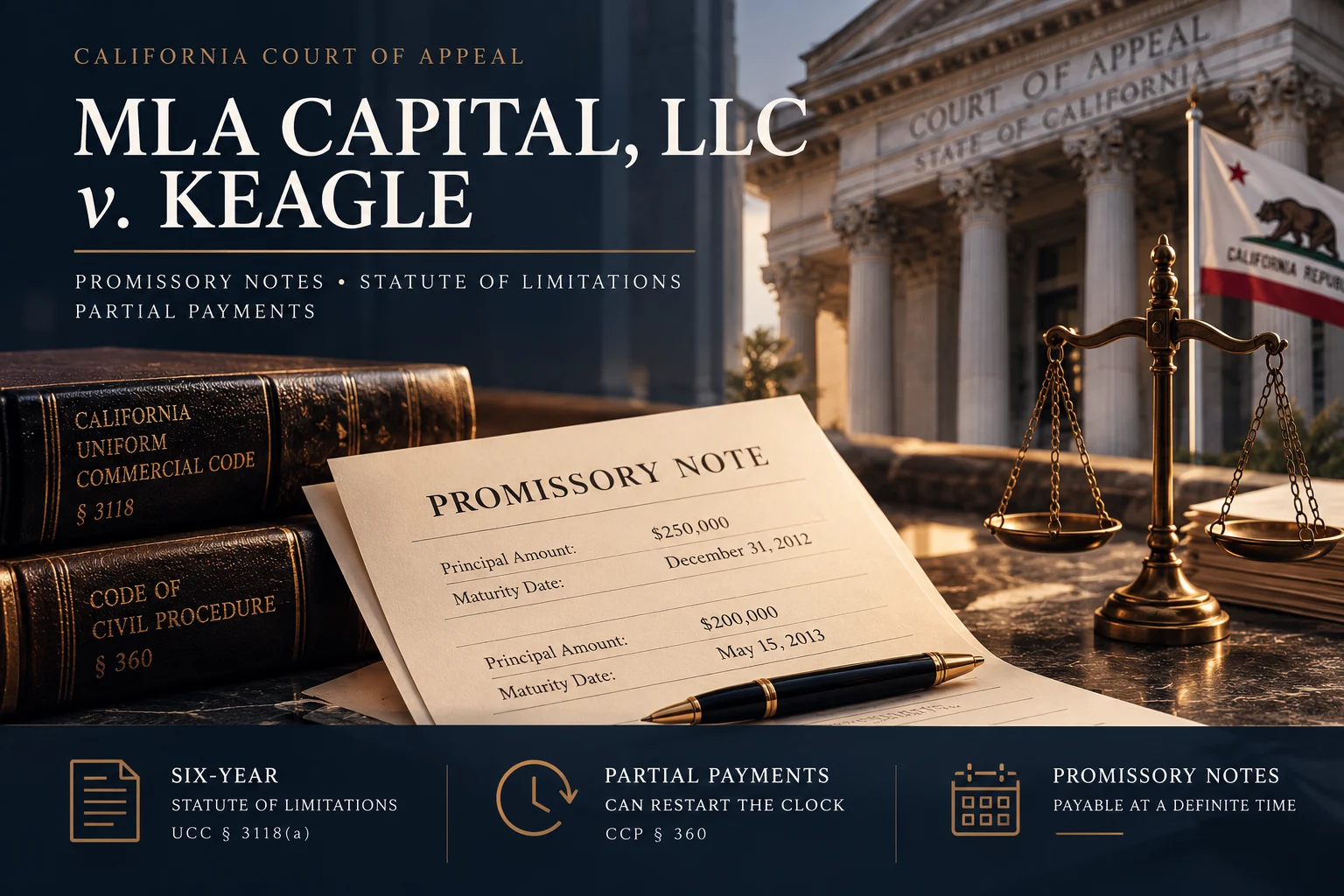
In MLA Capital, LLC v. Keagle, No. D086592 (Cal. Ct. App. Sept. 28, 2026), the Fourth District Court of Appeal held that an action to enforce a qualifying promissory note payable at a definite time is governed by the six-year limitations period in California Commercial Code § 3118(a)—rather than the general four-year period ordinarily applicable to written contracts under California Code of Civil Procedure § 337.
The court also held that California’s partial-payment rule under California Code of Civil Procedure § 360 can apply to claims governed by section 3118. But the decision does not mean that every written loan gets six years or that any later payment automatically revives an old debt.
The Loans at Issue
The case involved two promissory notes.
Linda Keagle and her late husband executed a $250,000 note in 2007, with the remaining balance due December 31, 2012. They executed a second $200,000 note in 2008, due May 15, 2013. The loans were used to finance a restaurant venture in Corona.
The lenders sued in February 2022—well after both original maturity dates. The trial court granted summary judgment for Keagle, concluding that the claims were untimely.
The Court of Appeal reversed.
A Six-Year Period for Notes Payable at a Definite Time
California Code of Civil Procedure section 337 generally provides a four-year limitations period for actions based on written contracts. (For agreements that were never put in writing, see Can I Enforce a Verbal Business Agreement in California?)
But Commercial Code section 3118(a) contains a more specific rule for certain negotiable instruments. It provides that an action to enforce a party’s obligation to pay a note payable at a definite time must generally be brought within six years after the stated due date, or within six years after an accelerated due date when acceleration applies.
The Court of Appeal concluded that section 3118 controlled because it is both more specific and more recently enacted than the general written-contract statute. Accordingly, the claims to enforce the promissory notes in MLA Capital were governed by the six-year period.
The court also applied that same limitations period to the plaintiffs’ related common-count claims because the substance of those claims remained enforcement of the underlying promissory notes.
Can a Partial Payment Restart the Clock?
Potentially. Code of Civil Procedure section 360 provides that a qualifying payment of principal or interest on a promissory note can stop the existing limitations period and begin a new one. The Court of Appeal held that this rule applies to claims governed by Commercial Code section 3118.
In MLA Capital, the lenders began receiving monthly checks from C&C Organization in August 2018. The payments continued until March 2020. Evidence in the record suggested that the checks may have been intended as payments on the outstanding loans and may have been authorized by Keagle.
That timing mattered because the payments began before the applicable six-year periods had expired.
If the payments ultimately qualify under section 360, they could have stopped the existing limitations period and started a new six-year period. The appellate court observed that, based on the final checks sent in March 2020, the new period would extend through March 2026—making the February 2022 lawsuit timely.
The Court Did Not Decide That the Payments Were Authorized
This distinction is important. The Court of Appeal did not hold that Keagle actually authorized the payments or that the lenders had conclusively established their claims.
Instead, it found sufficient evidence to create a triable issue of material fact over whether C&C Organization made the payments on Keagle’s behalf. That factual dispute was enough to defeat summary judgment.
Whether the payments were actually authorized remains a factual question for further proceedings.
A Payment Cannot Automatically Revive an Already Time-Barred Claim
Section 360 also contains an important limitation. A partial payment can restart a limitations period when the payment occurs while the claim is still legally enforceable. But the statute expressly provides that a payment does not, by itself, revive a cause of action that was already barred.
Timing therefore remains critical. A lender evaluating an older promissory note should determine not only whether payments were made, but also:
- the note’s maturity or accelerated due date;
- whether the instrument falls within Commercial Code section 3118;
- when each payment was made;
- whether the payment was for principal or interest on the particular note;
- whether the debtor made or authorized the payment; and
- whether the original limitations period had already expired before the payment occurred.
What MLA Capital Means for California Lenders and Borrowers
The decision is significant because the familiar rule that California provides four years to sue on a written contract does not necessarily control every written loan dispute.
For a qualifying promissory note payable at a definite time, section 3118(a) may provide a six-year deadline measured from the note’s due date. And a qualifying partial payment made before that period expires may start a new limitations period under section 360.
The analysis, however, is highly dependent on the particular instrument, payment history, maturity date, acceleration provisions, and evidence concerning who made or authorized later payments.
Parties dealing with an older unpaid loan should therefore evaluate the limitations issue early rather than assuming that the ordinary four-year written-contract rule resolves the question.
California Business and Promissory Note Disputes
Mahrouyan Law, P.C. represents businesses and individuals in contract, payment, and commercial disputes, including matters involving unpaid obligations and pre-litigation collection issues, as part of its small business and commercial litigation practice.
Where an older loan or promissory note is involved, determining the applicable statute of limitations can be one of the first—and most consequential—questions in evaluating whether a claim remains enforceable.
Frequently Asked Questions
Is the statute of limitations for every California promissory note six years?
No. MLA Capital concerned promissory notes payable at a definite time governed by California Commercial Code section 3118. Different instruments and factual circumstances may be subject to different limitation periods.
Can a partial payment restart the statute of limitations on a California promissory note?
Potentially. Under Code of Civil Procedure section 360, a qualifying payment of principal or interest made before the claim becomes time-barred can stop the existing limitations period and start a new period. The payment must be attributable to the debtor or an authorized agent.
Can a payment revive a promissory-note claim after the statute of limitations has already expired?
Not by itself. Section 360 expressly provides that a payment does not, by itself, revive a cause of action that was already barred.
Sources & Authorities
Mahrouyan Law handles these matters directly. Read more about how the firm approaches small business & commercial litigation in California, or discuss your own situation with the firm.
Dealing With an Unpaid Loan or Promissory Note?
If you are dealing with an unpaid business loan, promissory note, or other commercial payment dispute, contact Mahrouyan Law, P.C. to discuss your options.

Omeed Mahrouyan is the founder of Mahrouyan Law, P.C., a California firm handling business and commercial litigation, property and cargo damage claims, personal injury, landlord representation, startup transactions, and practical intellectual property matters. Clients work directly with him on strategy, drafting, and case decisions.
More about Omeed Mahrouyan →