
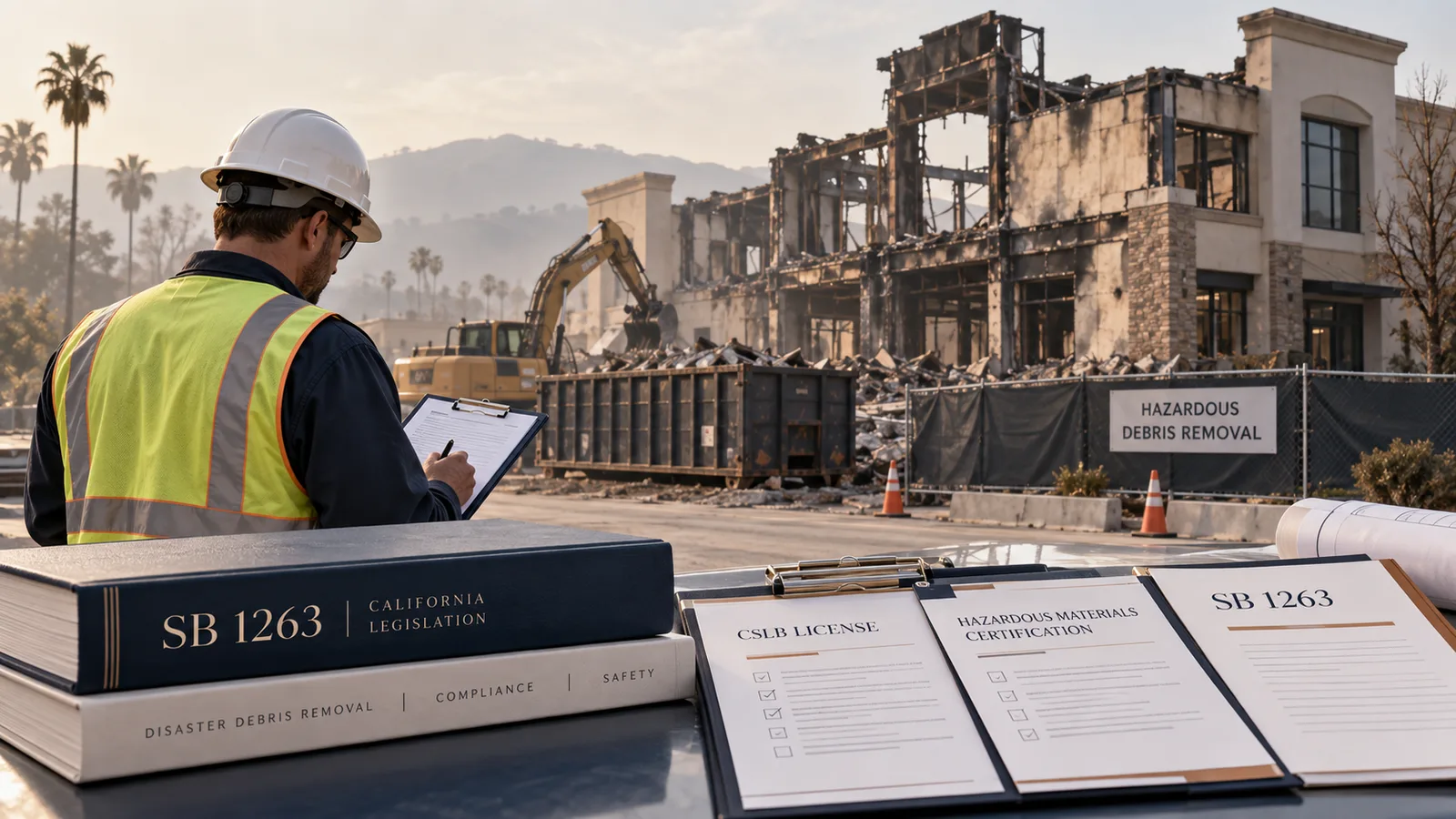
After a wildfire or other declared disaster, SB 1263 adds a new question to the cleanup checklist: whether the contractor removing hazardous debris is legally qualified to do the work.
- September 27, 2026
- Signed
- Bus. & Prof. Code § 7058.9
- New Section
- Permitted hazardous debris work
- Scope
- A, B, C-12, C-21, C-49*
- Classifications
Why This Matters After a Disaster
After a wildfire, flood, or other major disaster, property owners often want cleanup to begin immediately. But contaminated debris may involve licensing, permitting, worker-safety, insurance, evidence-preservation, and disposal issues.
SB 1263 adds another item to that checklist: whether the contractor performing certain hazardous-material debris removal is legally qualified to perform the work. The bill does not regulate every form of cleanup. It targets a defined category of permitted work.
When Does SB 1263 Apply?
SB 1263 adds section 7058.9 to the Business and Professions Code. Beginning January 1, 2027, its restrictions will apply only when the relevant statutory conditions are present:2
- the work is debris removal that includes hazardous materials, including ‘muck out and ash out’;
- the property is residential or commercial;
- the property was damaged or destroyed by a natural disaster;
- the Governor has declared a state of emergency, or the President has declared an emergency or major disaster; and
- a permit is required for the hazardous-material debris-removal work.
SB 1263 does not apply to every form of post-disaster cleanup or ordinary debris removal. If one of these conditions is missing, section 7058.9 does not impose its restrictions on the work.
For purposes of the section, “residential property” and “commercial property” exclude property owned, operated, or leased by a state, federal, or local government, or by a utility.
Which Contractors Can Perform Covered Debris Removal?
Beginning January 1, 2027, covered work may be performed only by a contractor holding one of these classifications:
- A — General Engineering Contractor
- B — General Building Contractor
- C-12 — Earthwork and Paving
- C-21 — Building Moving/Demolition
- C-49 — Tree and Palm
The C-49 classification is narrower. Under the statute, a C-49 contractor's hazardous debris-removal authority is limited to tree service and removal only.
A Contractor Classification Alone Is Not Enough
Once section 7058.9 takes effect, a licensee performing covered work must also have passed an approved hazardous substance certification examination under Business and Professions Code section 7058.7, and must comply with the hazardous waste operations and emergency response (HAZWOPER) requirements of California Code of Regulations, title 8, section 5192.
This is not a separate “SB 1263 license.” It is a combination of an existing license classification, an existing certification examination, and existing worker-safety requirements.
The Rules Do Not Necessarily Last for the Entire Disaster Declaration
Under section 7058.9(c), the restrictions no longer apply after any needed hazardous-material debris removal is deemed completed or finalized by the local permitting agency, even if the emergency proclamation or disaster declaration is still in effect. Later rebuilding or ordinary cleanup is not automatically subject to the same rules.
What Should a Property Owner Verify Before Cleanup Begins?
A short, practical checklist:
- Contractor license: verify the contractor's active CSLB license and applicable classification.
- Scope of work: determine whether the work actually involves hazardous materials and whether SB 1263 applies.
- Permit: confirm whether the debris-removal work requires a permit.
- Hazardous-substance qualification: for covered work, verify the required hazardous-substance certification.
- Written contract: define the work scope, debris handling, disposal responsibility, price, schedule, insurance, and indemnity where appropriate.
- Documentation: photograph and document the damaged property before debris is removed.
- Evidence preservation: consider whether damaged materials, equipment, building components, samples, photographs, or reports should be preserved before disposal.
Why Documenting the Property Before Cleanup Can Matter
Cleanup can remove or alter evidence relevant to what caused the damage, whether construction or contractor work contributed, the extent of the loss, what repairs are necessary, whether damaged equipment can be restored, and whether another party may be responsible.
Not every item must be kept indefinitely. But where a significant insurance, contractor, construction, or third-party claim may exist, owners should consider documenting the condition before material evidence is discarded or altered. That can matter for commercial property damage claims and for insurance questions like those discussed in California Court Clarifies Insurance Coverage When Construction and Storm Damage Combine.
Smoke-related losses raise their own issues, covered in California Enacts New Wildfire Smoke-Damage Rules: What AB 1642 and AB 1795 Change. Where the cleanup contractor itself becomes the subject of a disagreement over scope, price, or performance, the dispute may become a contractor or service-provider dispute.
What SB 1263 Does Not Mean
The enacted text establishes contractor qualifications. It does not say that:
- every post-wildfire cleanup project is covered;
- every debris-removal contractor needs one unique SB 1263 license;
- a contractor violation automatically creates a private damages claim;
- a violation automatically establishes negligence;
- a violation automatically voids a contract;
- a violation automatically determines insurance coverage; or
- every cleanup after a declared disaster remains regulated for the entire duration of the declaration.
Those questions depend on other law, the contract, the policy, and the facts.
Signing and Status
Governor Gavin Newsom signed SB 1263 on September 27, 2026.1
As of publication on September 28, 2026, the California Legislature's online status page still displayed the measure as “Active Bill – Enrolled” and had not yet posted a chapter number.3
SB 1263 is a non-urgency measure. Under California’s general effective-date rule for statutes enacted during a regular legislative session, its new requirements take effect January 1, 2027.5
According to Senator Mike McGuire's office, the bill is intended to help ensure that hazardous post-disaster debris is handled by qualified contractors. That statement describes the author's stated purpose; the requirements themselves come from the enrolled text.4
Footnotes
- Office of Governor Gavin Newsom — Legislative update, September 27, 2026 (SB 1263 signed). ↩
- SB 1263 (2025–2026 Reg. Sess.), enrolled text, adding Bus. & Prof. Code § 7058.9. ↩
- California Legislature — SB 1263 bill status (viewed September 28, 2026). ↩
- Senator Mike McGuire — ‘Wildfire Survivor Disaster Rebuild Bill Plows Forward,’ June 23, 2026 (author’s stated purpose and June 2026 framing; final requirements come from the enrolled text). ↩
- California Legislature, SB 1263 Bill Status (identifying measure as non-urgency); California Secretary of State, Bill Chapters ↩
Sources & Authorities
- Governor of California — September 27, 2026 Legislative Update — Signing announcement.
- California Legislature — SB 1263 Enrolled Text — Adds Business and Professions Code section 7058.9.
- California Legislature — SB 1263 Bill Status — Official legislative status.
- California State Senate — Senator McGuire’s Wildfire Survivor Disaster Rebuild Bill Plows Forward — Author's office; used only for stated purpose.
- California Secretary of State — Bill Chapters — Official explanation of effective dates for California statutes.
Mahrouyan Law handles these matters directly. Read more about how the firm approaches commercial property, equipment & cargo damage in California, or discuss your own situation with the firm.
Discuss Your Matter
Mahrouyan Law represents California property owners and businesses in selected commercial property-damage, contractor, construction, and related business disputes. When significant damage occurs, early documentation can help clarify what happened, what the loss includes, and which parties may be responsible.

Omeed Mahrouyan is the founder of Mahrouyan Law, P.C., a California firm handling business and commercial litigation, property and cargo damage claims, personal injury, landlord representation, startup transactions, and practical intellectual property matters. Clients work directly with him on strategy, drafting, and case decisions.
More about Omeed Mahrouyan →