
The proposed GKN agreement includes a claims program of up to $100 million. Business-loss limits, conditional dates, and release terms deserve careful review.
The Orange County District Attorney announced a proposed $125 million agreement with GKN Aerospace Transparency Systems, Inc. and GKN Aerospace, Inc. on October 12, 2026, following the May Garden Grove chemical-tank emergency. The proposal includes a claims program of up to $100 million for eligible residents and businesses. 1
Check the official program updates before attempting to apply. 12
October 16 update: GKN insurance litigation and defense obligations.
What the Proposed Program Would Cover
GKN’s published materials identify lodging, meals, transportation, lost wages, and loss of use among the potential residential benefits, subject to eligibility and category-specific requirements. Eligible businesses could seek evacuation-related business-interruption compensation. Living or operating near the facility does not automatically establish eligibility. 2
The $125 million headline is the overall agreement amount—not the amount available for individual claims. The proposal also addresses governmental response costs, civil penalties, and safety oversight. 1
Business Losses: Profits, Not Gross Sales
The proposed program generally caps documented lost profits at $5,000 per eligible business for each day it would have operated but was evacuated during the applicable evacuation period. A specific exception covers qualifying multifamily owners’ documented tenant rent refunds or deductions. (Proposed Claims Program, § IV.E.) 3
Lost sales alone do not establish lost profits. Businesses should organize revenue and expense records supporting what they actually lost, rather than assume that every dollar of missed sales would be reimbursed.
The Proposed Dates Are Conditional
The draft lists October 19, 2026–April 19, 2027. If approval has not occurred before October 19, intake instead begins two weeks after approval and lasts six months. Intake may end earlier when $100 million in claims become approved payments. These are proposed program dates, not independently verified lawsuit deadlines. (Proposed Claims Program, § II.B.6.) 3
Review the Release Before Accepting
The proposal distinguishes submitting a claim from accepting an offer. It preserves claimants’ ability to reject offers and pursue legal rights until acceptance. Its payment provisions contemplate a broad incident-related release, and GKN may condition an offer on dismissal of pending litigation. (Proposed Claims Program, §§ II.B.1, IV.H–I, VI.) 3
California Civil Code section 1542 generally protects claims unknown or unsuspected when a general release is signed if knowledge of them would have materially affected the settlement. Review whether the offered agreement includes a waiver of that protection and what claims and parties it covers. 4
Before accepting, compare the payment with the documented losses and the rights being released. A program payment limit does not, by itself, determine the value or viability of a separate legal claim.
October 16, 2026 Update: GKN Insurance Litigation and the Duty to Defend
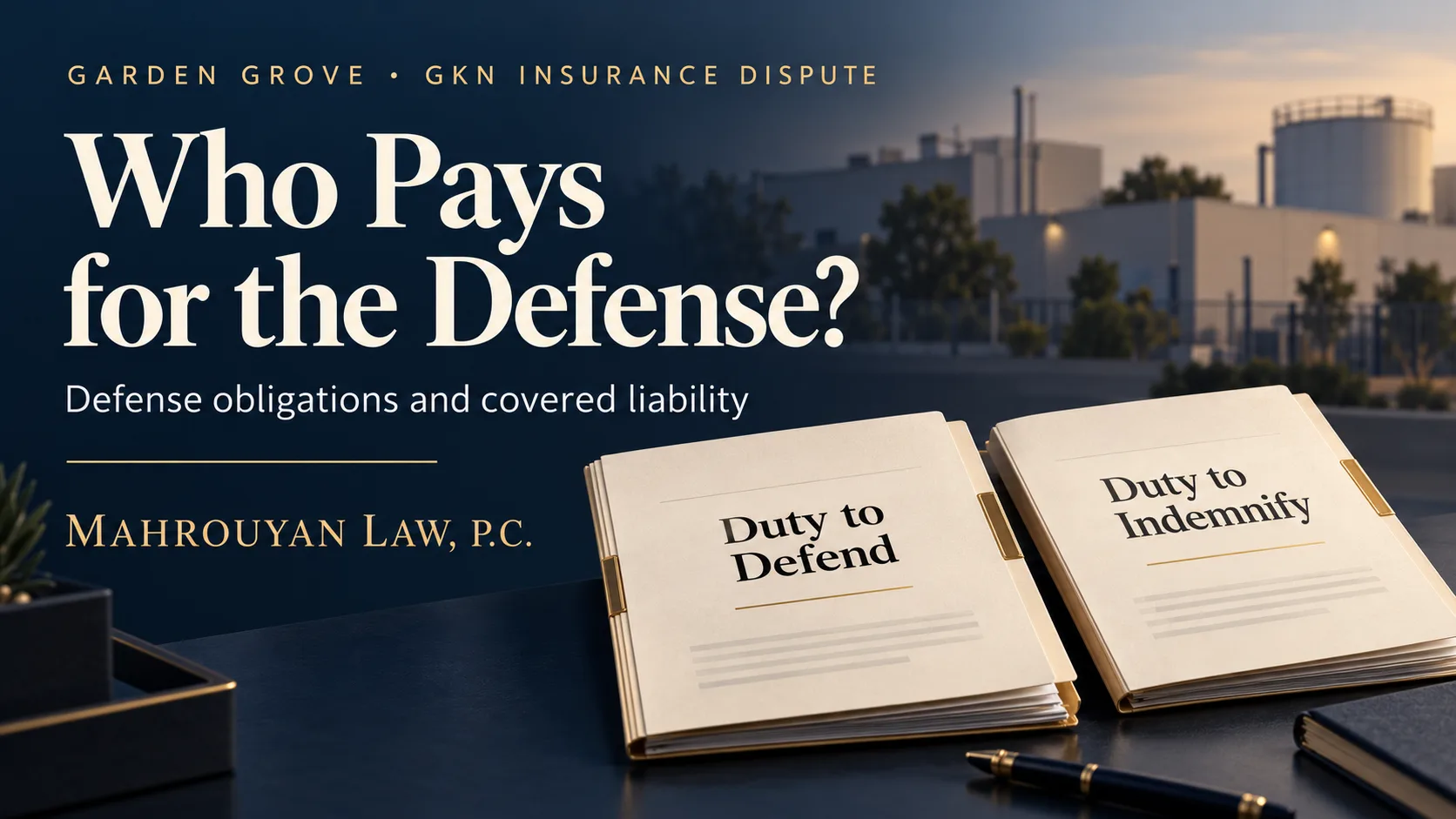
The Garden Grove incident has also generated separate litigation over insurance coverage.
ACE American Insurance Company filed a declaratory-judgment action against Melrose North America and GKN-related companies in the Eastern District of Texas on October 13, 2026, Case No. 4:26-cv-01483. 5 Bloomberg Law reported that ACE contends a pollution exclusion bars coverage for incident-related lawsuits. That is the insurer’s position, not a judicial determination. 6
GKN has also brought a separate action against ACE American and other insurers in the Central District of California, Case No. 8:26-cv-03033. According to Law360’s October 15 reporting, GKN alleges that its insurers are improperly refusing to defend it against lawsuits and a related civil investigation. 7
Paying for a defense is different from paying covered liability
Under California law, a liability insurer’s duty to defend generally concerns lawsuits presenting a potential for coverage. The duty to indemnify concerns payment of covered liability. A defense obligation can therefore exist even when the insurer ultimately owes no indemnity. 8
In Montrose Chemical Corp. v. Superior Court (1993) 6 Cal.4th 287, 295, 299–300, the California Supreme Court explained that the defense inquiry considers the policy, the underlying allegations, and relevant facts outside the complaint. An insurer can defeat a defense obligation by establishing that there is no potential for coverage. 8
These California principles provide general context. They do not establish which law governs the GKN policies or whether any insurer owes a defense here. Those questions require examination of the actual contracts, exclusions, claims, and applicable law.
What this means for affected residents and businesses
The insurance actions concern obligations between insurers and their insureds. Their filing does not itself establish whether residents or businesses have valid damages claims. The sources reviewed also do not establish that the coverage dispute has changed the proposed compensation program’s funding, eligibility, or timing.
Continue checking the official Garden Grove community-update website for program developments. 2
What Affected Businesses and Residents Can Do Now
Preserve receipts, financial records, evacuation-related correspondence, and prior reimbursement records. Confirm the applicable evacuation area and dates. Review the final approved procedures when available, and do not assume a program application extends any separate lawsuit deadline.
Mahrouyan Law, P.C. can assist with evaluating business losses, settlement terms, and potential civil claims as part of its property damage and business litigation practices. Contact the firm to discuss your circumstances.
Footnotes
- 1.
- 2.
- 3.
Proposed Claims Program, Exhibit A (proposed; not an entered judgment or final approved program)
Supports: See § II.B.6 (conditional intake period); § III (eligibility); § IV.E (business lost profits and multifamily-property exception); §§ II.B.1, IV.H–I (offers, releases, and payment); § VI (right to reject an offer and pursue legal rights until acceptance).
↩ Return to text - 4.
- 5.
- 6.
- 7.
Danielle Ferguson, “GKN Says Insurers Owe Defense In Overheated Tank Suits,” Law360 (Oct. 15, 2026); public court-activity listing for GKN Aerospace Transparency Systems, Inc., et al. v. ACE American Insurance Company, et al., No. 8:26-cv-03033 (C.D. Cal.), reproduced by CaseMagic. The activity listing is not the complete docket or complaint.
↩ Return to text - 8.
Mahrouyan Law handles these matters directly. Read more about how the firm approaches commercial property, equipment & cargo damage in California, or discuss your own situation with the firm.
Reviewing a Settlement Offer?
Contact Mahrouyan Law, P.C. to discuss business losses, settlement terms, and potential civil claims.

Omeed Mahrouyan is the founder of Mahrouyan Law, P.C., a California firm handling business and commercial litigation, property and cargo damage claims, personal injury, landlord representation, startup transactions, and practical intellectual property matters. Clients work directly with him on strategy, drafting, and case decisions.
More about Omeed Mahrouyan →