
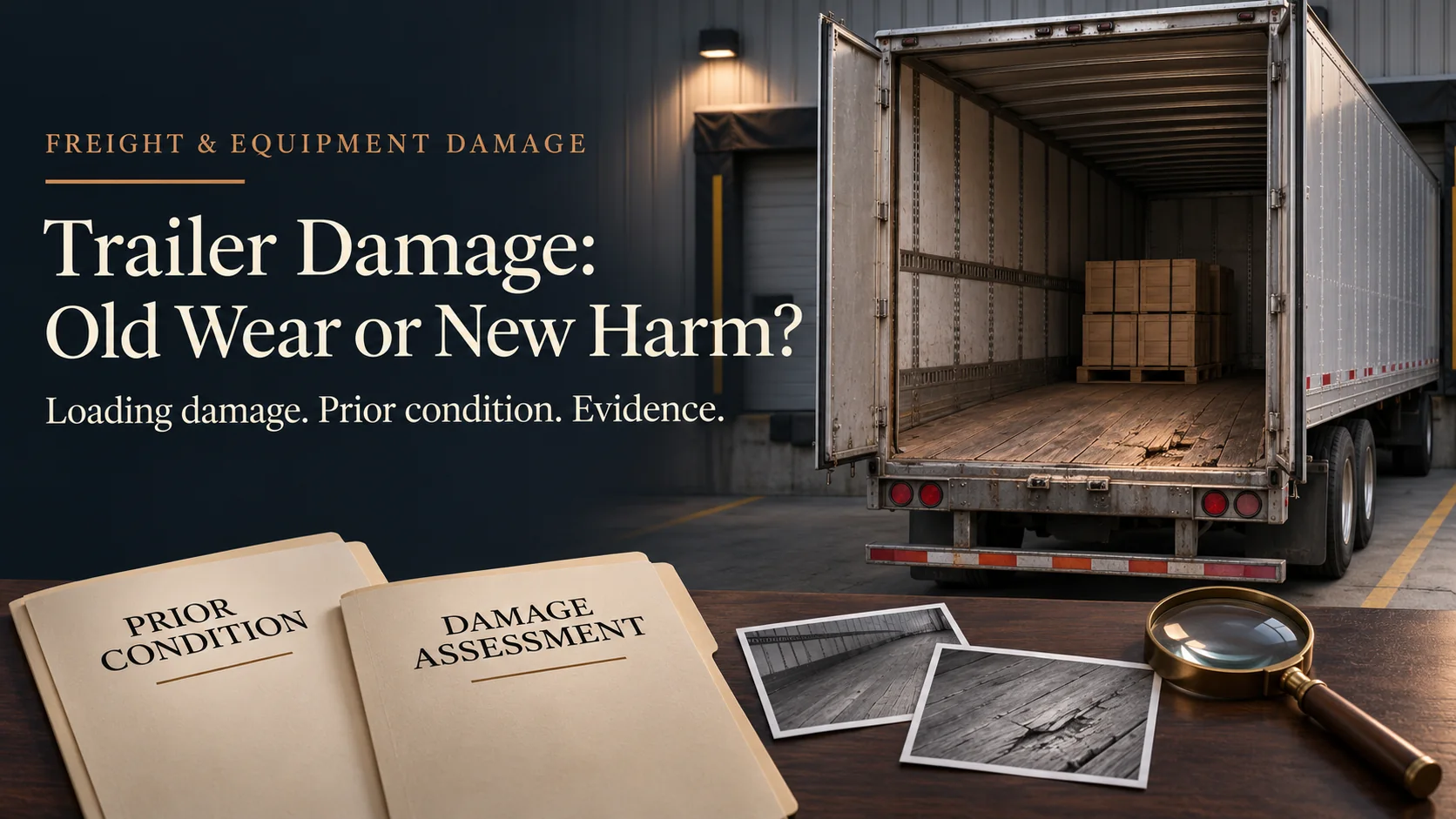
Prior wear does not automatically defeat a claim for loading damage. Causation, the owner’s own conduct, and the amount recoverable are separate questions.
Potentially, yes. Prior wear does not automatically defeat a claim for additional damage caused by negligent loading. A trucking company, owner-operator, fleet owner, or other equipment owner must still establish an applicable duty, a breach, and that the negligent conduct was a substantial factor in causing the claimed harm. Existing deterioration may affect causation and the equipment’s value. Negligent maintenance, if proven, may also support a comparative-fault defense.
Three questions should stay separate: what caused the damage, whether the owner was negligent, and how much loss is recoverable. This article applies general California principles. The authorities below are Judicial Council civil jury instructions (CACI)—not statutes—and court decisions that did not involve this precise trailer-wear scenario.
Can Old Wear and Negligent Loading Both Cause Damage?
Yes. Under CACI No. 430, a substantial factor is one that a reasonable person would consider to have contributed to the harm. It must be more than remote or trivial, but it need not be the only cause. 1
CACI No. 431 adds that negligence may combine with another factor to cause harm. A negligent party cannot avoid responsibility just because another person, condition, or event was also a substantial factor. 2 A trailer’s existing deterioration may be such a condition.
The reverse also matters. Discovering damage after loading does not by itself prove negligence or causation. Evidence that the same damage would have occurred without the loading conduct generally weighs against causation, subject to technical qualifications in the instruction’s directions for use.
Is an Older Trailer Necessarily Negligently Maintained?
No. Ordinary age, depreciation, and prior repairs are different from proven negligent inspection or maintenance.
Under CACI No. 405, a defendant asserting the claimant’s comparative negligence must prove that the claimant was negligent and that the negligence was a substantial factor in causing the harm. If the defendant does so, damages are reduced by the claimant’s percentage of responsibility. 3
Li v. Yellow Cab Co. (1975) 13 Cal.3d 804—general comparative-negligence authority, not a trailer-loading case—replaced the former all-or-nothing rule with liability assessed in proportion to fault. 4 Old equipment does not automatically warrant a fault percentage; the evidence must support one.
What Evidence Helps Distinguish Prior Wear From New Damage?
Useful records may include:
- Preloading photographs and inspection records.
- Maintenance history, prior repairs, and known defects.
- Loading records, cargo weights, placement, and equipment specifications.
- Photographs of damaged components and available surveillance.
- Repair estimates distinguishing existing deterioration from claimed new damage.
- A qualified repair specialist’s or engineer’s supported analysis of competing causes.
Compliance with highway weight limits alone does not resolve whether loading damaged a particular component. That question depends on the evidence, often including qualified technical analysis.
Where reasonably practicable, document the trailer’s condition before repairs begin, while prioritizing safety and reasonable steps to limit further loss. Our article on shipper overloading and trailer damage discusses related loading-liability questions.
Does Damage to an Old Trailer Entitle the Owner to a New One?
Not automatically. CACI No. 3903J generally measures harm to personal property by the reduction in its value or the reasonable cost of repair—ordinarily whichever is less when both are established. If the property can be repaired but will still be worth less afterward, the instruction permits reasonable repair costs plus the remaining loss in value, with the total not exceeding the property’s value immediately before the harm. 5
Hand Electronics, Inc. v. Snowline Joint Unified School District (1994) 21 Cal.App.4th 862 illustrates the limit. That case arose from a vehicle collision that damaged older manufacturing equipment—not from freight loading. The Court of Appeal affirmed an order granting a new trial, concluding the jury should not have been instructed on the cost of replacing the equipment with newer machinery. 6
That physical-damage measure is distinct from consequential losses, which are analyzed separately. CACI No. 3903M addresses loss of use: the reasonable cost to rent similar property for the time reasonably necessary to repair or replace it. 7 CACI No. 3903N addresses lost profits, which must be reasonably certain and are calculated net of the expenses the business would have had; gross missed revenue is not lost profit. 8 Both depend on causation and proof, and the same loss should not be recovered twice.
Whose Conduct and Agreement Matter?
The shipper, warehouse, actual loader, broker, carrier, and equipment owner may have different roles, duties, and contractual obligations. Identify who performed and directed the loading rather than treating those parties as interchangeable. Review the operative agreements and any applicable notice requirements, which may affect who bears a loss and what must be done to preserve a claim.
Sources
- 1.
- 2.
- 3.
- 4.
- 5.
- 6.
- 7.
- 8.
Discuss Your Matter
If a loading dispute has damaged your trailer or other operating equipment, contact Mahrouyan Law to discuss the circumstances and appropriate next steps. Learn more about our Commercial Property, Equipment & Cargo Damage practice. Recovery depends on the evidence and applicable law.

Omeed Mahrouyan is the founder of Mahrouyan Law, P.C., a California firm handling business and commercial litigation, property and cargo damage claims, personal injury, landlord representation, startup transactions, and practical intellectual property matters. Clients work directly with him on strategy, drafting, and case decisions.
More about Omeed Mahrouyan →