
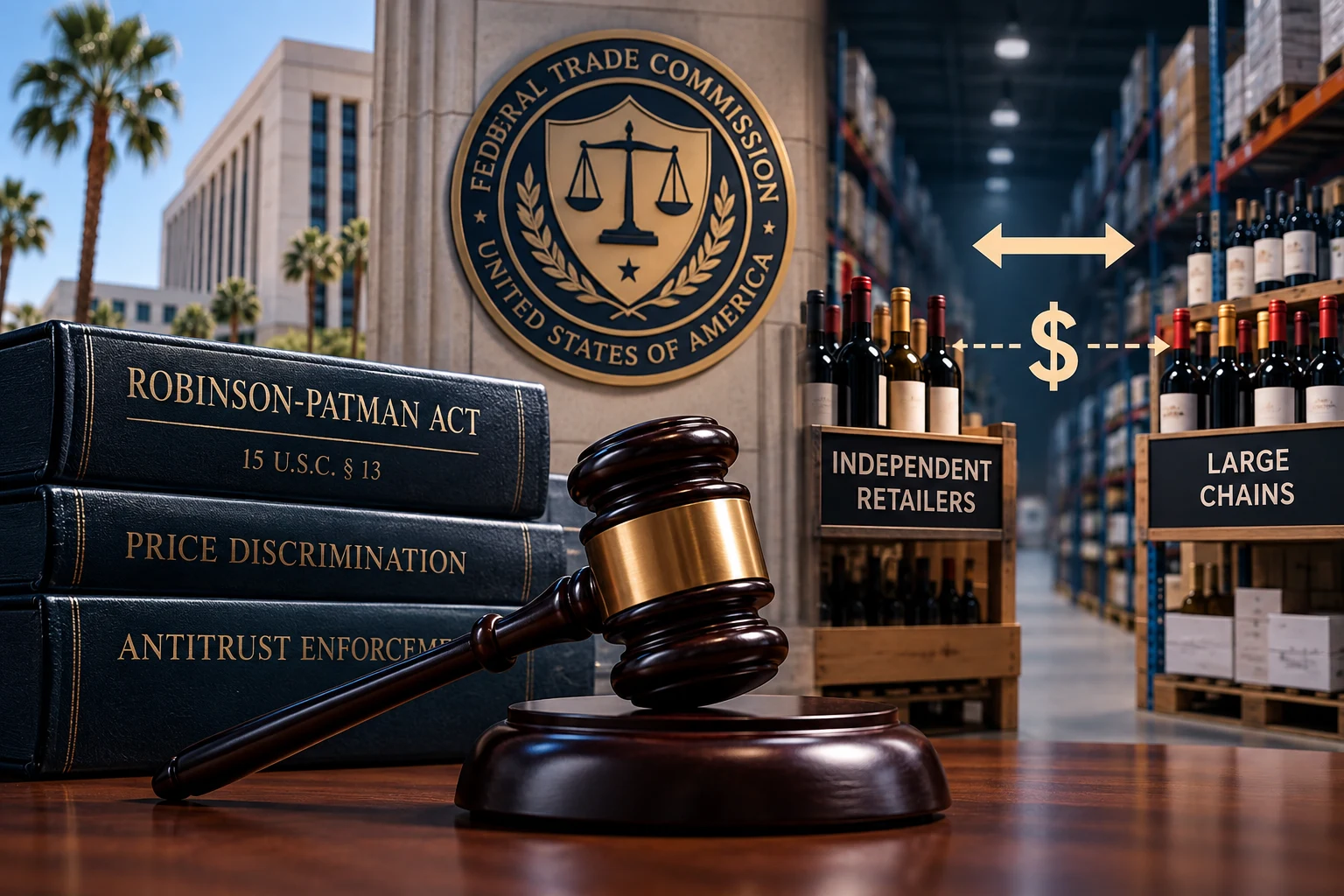
The FTC reached a proposed settlement with Southern Glazer’s over alleged price discrimination between large chains and independent retailers. Here is what California businesses should know.
The Federal Trade Commission has reached a proposed settlement in its price-discrimination lawsuit against Southern Glazer’s Wine & Spirits, which the FTC describes as the nation’s largest distributor of wine and spirits.
The case, pending in the Central District of California, alleged that Southern Glazer’s charged certain independent retailers higher effective prices than competing large chains for the same products. Southern Glazer’s has not admitted wrongdoing, and the proposed consent decree states that it is not an admission of liability.
The FTC describes the case as its first Robinson-Patman Act enforcement action in a generation, making the settlement significant for independent retailers, suppliers, distributors, and other businesses that compete with larger chains.
The practical question reaches beyond the alcohol industry: when does giving a large customer better pricing become unlawful price discrimination—and when is it simply a lawful commercial discount?
What the FTC Alleged
The FTC sued Southern Glazer’s in December 2024 under Section 2 of the Clayton Act, as amended by the Robinson-Patman Act, 15 U.S.C. § 13.
According to the complaint, Southern Glazer’s offered large national and regional chains discounts and rebates that were not available to competing independent retailers, so that some independent stores paid significantly more for identical bottles than nearby chain competitors. Those allegations were disputed and have not been adjudicated.
On October 2, 2026, the FTC filed a proposed stipulated consent decree resolving the litigation without trial or final adjudication of any issue of fact or law. As of publication, the decree remains subject to approval and entry by the district court.
What the Robinson-Patman Act Actually Prohibits
Different prices are not automatically unlawful. The Act generally addresses price discrimination between purchasers of commodities of like grade and quality where the effect may be to substantially lessen competition or injure competition, subject to statutory defenses—for example, price differences justified by differences in the seller’s costs, or a lower price offered in good faith to meet a competitor’s equally low price.
The analysis can depend on:
- whether the purchasers actually compete;
- whether the products are of like grade and quality;
- effective net prices after rebates and allowances;
- differences in distribution or selling costs;
- whether the pricing was used to meet competition; and
- whether the price difference may harm competition.
What the Proposed Southern Glazer’s Order Would Do
The proposed decree would last six years and would be overseen by an independent monitor. According to the FTC, it covers nearly all Southern Glazer’s wine and spirits sales to the five largest chain retailers in 26 states, including California.
It focuses on “paired transactions”: sales of the same product to a covered chain and to a nearby covered independent retailer within specified geographic and timing parameters. A covered retailer generally has 75 or fewer U.S. retail locations, subject to further conditions in the order.
The decree also looks beyond the invoice. Its definition of Net Price accounts for discounts, rebates, and other consideration affecting what a retailer actually pays—reflecting the point that two customers can see the same invoice price while receiving materially different effective pricing.
A $5,000 Threshold and Compensation Mechanism
Under the proposed order, a violation can arise when, among other conditions, price differences exceed a cost-based safe harbor and aggregated excess payments to a covered retailer exceed $5,000 over a 12-month period.
Southern Glazer’s could cure a qualifying violation by paying the affected retailer 1.5 times the aggregated excess payment. If it does not, and the FTC prevails in an enforcement action, the decree provides for payment of two times that amount.
These figures are negotiated provisions of this particular proposed consent decree governing Southern Glazer’s. They are not general statutory rules under the Robinson-Patman Act.
Why the Case Matters to Small Businesses
For an independent retailer, modest differences in wholesale pricing can become significant against a chain with far greater purchasing power. But the legal answer is not that suppliers must charge everyone the same price. The matter illustrates how price-discrimination analysis examines the actual economic terms competing customers receive and whether legitimate commercial circumstances support the differences.
Businesses reviewing these issues should preserve more than invoices, including:
- invoices and purchase histories;
- rebate, discount, and promotional-allowance programs;
- distributor communications and competitor pricing information;
- volume commitments and delivery or distribution terms; and
- documents explaining the commercial basis for different pricing.
A Southern California Federal Case
The case is FTC v. Southern Glazer’s Wine & Spirits, LLC, No. 8:24-cv-02684-FWS-ADS, pending before U.S. District Judge Fred W. Slaughter in the Central District of California; the “8:” case number designates the court’s Southern Division in Santa Ana. California is among the 26 states covered by the proposed order.
That makes the case particularly relevant to Southern California independent retailers, restaurants, franchise operators, distributors, and suppliers that rely heavily on wholesale pricing.
What Businesses Should Take From the Settlement
The settlement does not establish that large-volume discounts are illegal, or that a small retailer has a federal claim whenever a larger competitor receives a better price. It is evidence of renewed enforcement activity, though future priorities can change.
For suppliers and distributors, pricing programs, rebates, volume discounts, and customer-specific terms should be structured and documented carefully. For retailers and franchisees, significant and recurring pricing disparities may warrant closer examination of both the commercial agreement and the surrounding market facts.
California Business and Distribution Disputes
Mahrouyan Law, P.C. represents small and mid-sized businesses in commercial disputes involving contracts, vendors, franchise relationships, licensing, and distribution arrangements, including owner-operated businesses through its Costa Mesa business litigation practice.
The firm is not a dedicated antitrust boutique. But supplier pricing, distribution terms, rebates, and franchise procurement arrangements can overlap with broader business disputes.
Frequently Asked Questions
Did Southern Glazer’s admit violating the Robinson-Patman Act?
No. The proposed consent decree resolves the litigation without an admission of liability and without trial or final adjudication of the disputed facts or law.
Is it illegal for a supplier to charge two retailers different prices?
Not automatically. Robinson-Patman Act liability depends on multiple statutory requirements and factual circumstances, and cost-justification, meeting-competition, and other defenses may apply.
Are volume discounts illegal under the Robinson-Patman Act?
Not necessarily. Legitimate cost differences or other legally recognized circumstances may justify differential pricing. Whether a particular discount violates the Act requires a fact-specific analysis.
Does the $5,000 threshold apply to every Robinson-Patman case?
No. The $5,000 threshold is part of the proposed Southern Glazer’s consent decree. It is not a general statutory threshold under the Robinson-Patman Act.
Is the Southern Glazer’s settlement already a final court order?
As of publication, it is a proposed stipulated consent decree. The FTC states that stipulated orders have the force of law when approved and signed by the district court judge.
Sources & Authorities
- FTC, “FTC Secures Settlement that Protects Small Businesses from Illegal Price Discrimination” (Oct. 2, 2026)
- FTC v. Southern Glazer’s Wine & Spirits, LLC, No. 8:24-cv-02684-FWS-ADS (C.D. Cal.), Proposed Stipulated Consent Decree and Order (filed Oct. 2, 2026)
- FTC case page: Southern Glazer’s Wine and Spirits, LLC, FTC v., Matter No. 2110155
- 15 U.S.C. § 13 (Robinson-Patman Act)
Mahrouyan Law handles these matters directly. Read more about how the firm approaches small business & commercial litigation in California, or discuss your own situation with the firm.
Facing a Supplier or Distribution Dispute?
If your business is involved in a supplier, distribution, franchise, or commercial pricing dispute, contact Mahrouyan Law, P.C. to discuss the circumstances and available options.

Omeed Mahrouyan is the founder of Mahrouyan Law, P.C., a California firm handling business and commercial litigation, property and cargo damage claims, personal injury, landlord representation, startup transactions, and practical intellectual property matters. Clients work directly with him on strategy, drafting, and case decisions.
More about Omeed Mahrouyan →