
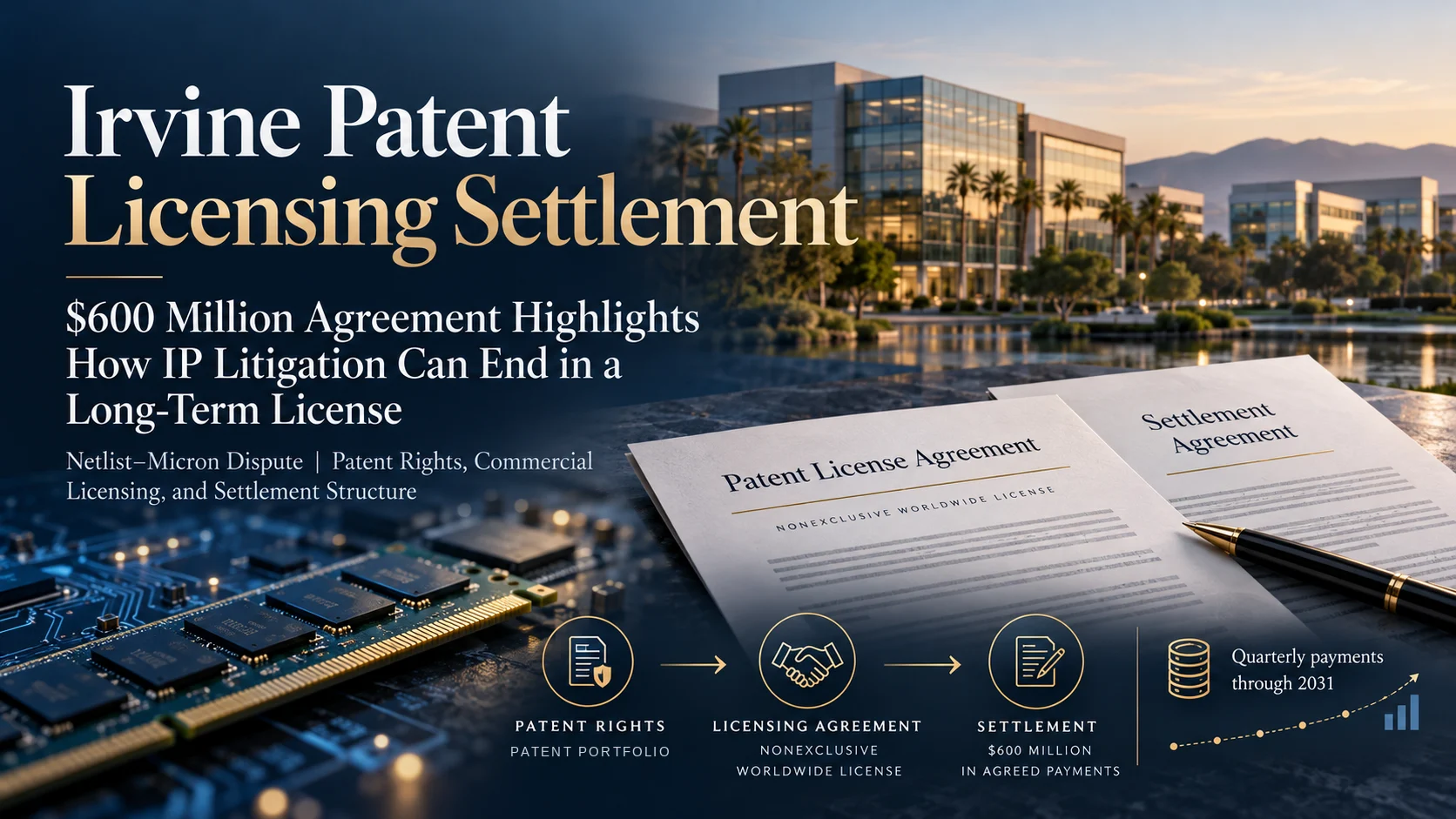
Netlist and Micron entered patent license and settlement agreements calling for $600 million in quarterly payments through 2031—a negotiated license, not a court award.
Irvine-based semiconductor technology company Netlist, Inc. announced on October 6, 2026, that it had reached a $600 million patent licensing and litigation settlement with Micron Technology, Inc.
The agreements, executed October 5, illustrate how intellectual-property litigation can culminate in a negotiated commercial relationship rather than simply a damages judgment.
According to Netlist's October 6 SEC filing, Micron agreed to make quarterly licensing payments over five years in exchange for defined rights to Netlist's patent portfolio.
What Does the $600 Million Agreement Provide?
Micron agreed to pay Netlist $30 million per quarter for 20 calendar quarters, beginning in the fourth calendar quarter of 2026 and ending in the third calendar quarter of 2031. The five-year license covers Netlist's entire worldwide patent portfolio and is:
- Worldwide: Covers Netlist's worldwide patent portfolio.
- Nonexclusive: Does not grant Micron exclusive rights.
- Nontransferable: Restricts transfer of the licensed rights.
- Nonsublicensable: Does not authorize Micron to grant sublicenses.
The parties also entered a settlement agreement that settles and mutually releases the pending legal proceedings between them identified in that agreement.
Separately, Micron purchased 10 million Netlist common shares for an aggregate $1 million under a securities purchase agreement, with a related lock-up agreement restricting transfer of the shares. This equity transaction is distinct from the $600 million licensing obligation.
(Source: Netlist, Inc., Current Report (Form 8-K), Item 1.01 (Oct. 6, 2026).)
How Does the Settlement Differ From a Patent Verdict?
In May 2024, a federal jury in the Eastern District of Texas awarded Netlist $445 million in patent-infringement damages against Micron. A judgment followed, but the dispute also involved post-trial motions, an appeal, and patent-validity proceedings that Netlist disclosed could affect collectability of the award.
The new $600 million agreement is fundamentally different: it establishes negotiated licensing payments, not an additional $600 million court-awarded damages judgment.
Nor should the agreement's total value be confused with funds already received. Payment obligations extend through 2031, and Netlist's filing identifies its ability to collect amounts owed under the license as a risk.
(Sources: Netlist's June 2026 Form 10-Q, Micron Litigation; October 2026 Form 8-K.)
What Can California Businesses Learn?
The settlement illustrates why intellectual-property disputes sometimes end through licensing rather than continued litigation. A negotiated agreement may establish future commercial rights while addressing specified existing disputes. For a contrasting example involving a patent damages judgment, see our article on the Apple–Masimo prejudgment-interest ruling.
For businesses negotiating intellectual-property licenses, important considerations include:
- Scope: Which intellectual-property rights are licensed?
- Exclusivity: Can the owner license those rights to others?
- Transferability: Can the licensee assign or sublicense its rights?
- Payment obligations: When are payments due, and what remedies apply if they are missed?
The answers depend on the operative agreement and applicable law. Although this dispute involves hundreds of millions of dollars in semiconductor patents, similar contractual considerations can arise in software, trademark, copyright, and technology-licensing transactions.
The key takeaway: litigation outcomes and commercial settlements are not necessarily interchangeable. A carefully structured licensing agreement can establish rights and obligations extending well beyond the resolution of a lawsuit.
Mahrouyan Law, P.C. advises California businesses and entrepreneurs on intellectual-property ownership, licensing agreements, business transactions, and selected commercial disputes. The firm does not represent either company discussed in this article.
Sources & Authorities
- Netlist, Inc., Current Report (Form 8-K) (filed Oct. 6, 2026) — Settlement, license terms, $600 million payment schedule, securities purchase, and disclosed collection risk.
- Netlist, Inc., press release, “Netlist and Micron Enter Patent License and Settlement Agreements” (Oct. 6, 2026)
- Netlist, Inc., Quarterly Report (Form 10-Q) for the quarter ended June 27, 2026 — History of the 2024 Eastern District of Texas verdict, judgment, and appeal.
Mahrouyan Law handles these matters directly. Read more about how the firm approaches trademarks & practical intellectual property counsel in California, or discuss your own situation with the firm.
Negotiating or Disputing an IP License?
Contact Mahrouyan Law, P.C. to discuss your legal needs.

Omeed Mahrouyan is the founder of Mahrouyan Law, P.C., a California firm handling business and commercial litigation, property and cargo damage claims, personal injury, landlord representation, startup transactions, and practical intellectual property matters. Clients work directly with him on strategy, drafting, and case decisions.
More about Omeed Mahrouyan →