
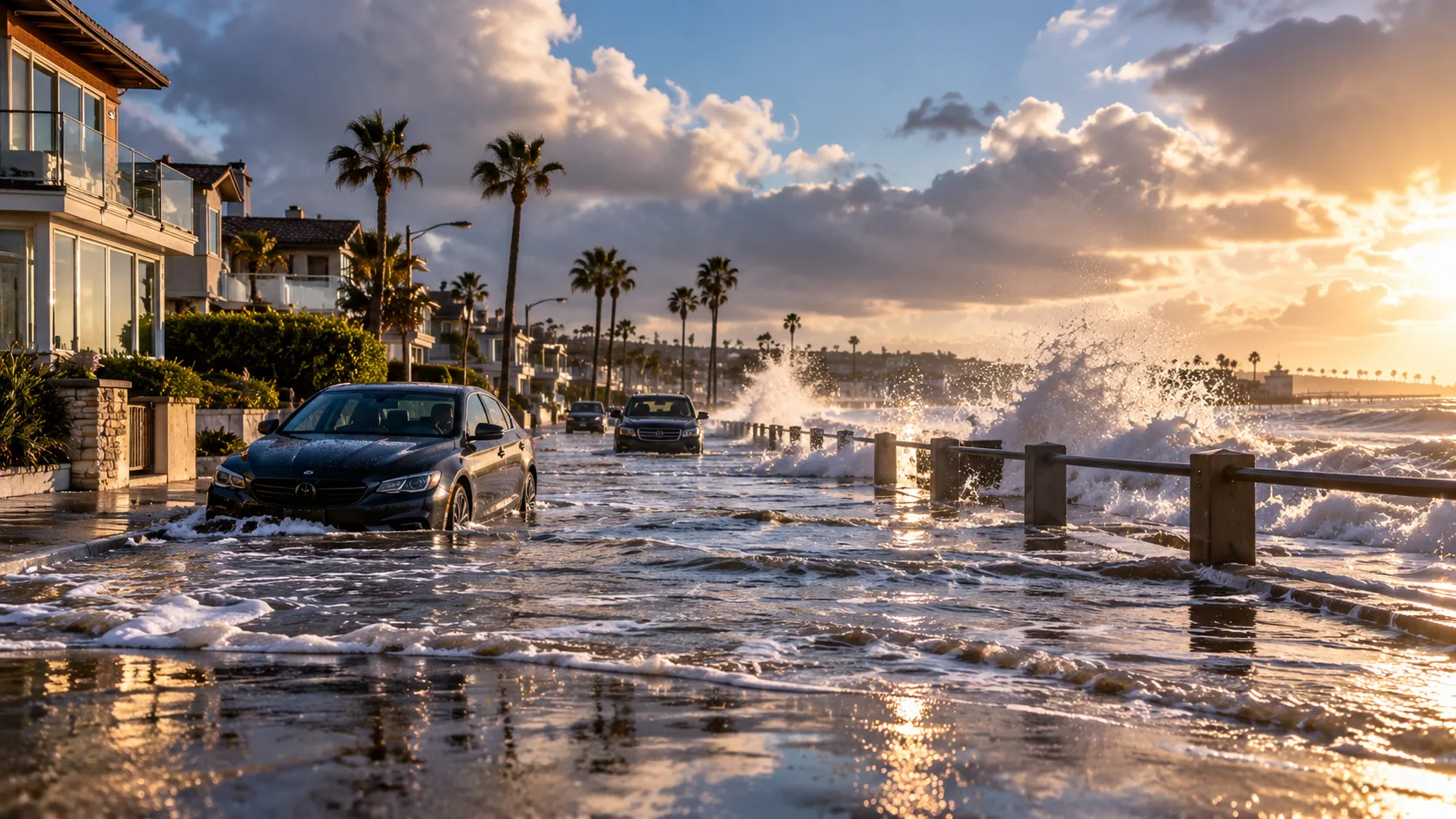
After the October 9, 2026 coastal flooding, affected owners face a threshold question: which insurance policies may cover the loss, and how to preserve a claim.
Newport Beach declared a local emergency on October 9, 2026, after high surf and elevated ocean levels flooded portions of the Balboa Peninsula, inundating streets and affecting nearby properties and vehicles.
City crews deployed pumps, reinforced beach berms, and distributed sandbags as officials prepared for additional coastal flooding associated with Tropical Storm Rachel. The extent of the property damage remains uncertain.
For affected homeowners, landlords, businesses, and vehicle owners, the immediate legal question is which insurance policies may cover their losses and what steps they should take to preserve a claim.
What Happened in Newport Beach?
According to the City of Newport Beach, unusually high ocean levels and powerful surf caused significant coastal flooding on October 9. Floodwaters affected streets along the Balboa Peninsula, including low-lying neighborhoods exposed to incoming seawater.
The City declared a local emergency to coordinate additional resources and continued flood-mitigation efforts. City officials warned that further flooding remained possible through the weekend.
As of October 10, the total number of damaged properties and overall financial losses had not been established. (Sources: City of Newport Beach, October 9 Update; Los Angeles Times, October 9.)
Does Homeowners Insurance Cover Coastal Flooding?
Generally, standard homeowners insurance does not cover flood damage. The California Department of Insurance explains that homeowners, renters, and commercial property policies typically exclude flooding, subject to the particular policy and applicable exceptions.
The source of the water matters. Damage caused by seawater overflowing onto normally dry land may fall within a flood exclusion. By comparison, rain entering through a roof damaged by a covered wind event may present a different coverage question.
The governing policy language and actual cause of damage must be reviewed. Different storm-damage coverage questions are addressed in our article on construction-related storm damage and insurance.
What Does Separate Flood Insurance Cover?
The National Flood Insurance Program (NFIP) recognizes overflow of tidal waters as a potential cause of covered flooding. A qualifying flood may therefore include coastal seawater inundation, subject to the policy's definition, exclusions, coverage limits, and deductibles.
NFIP policies separately address building and contents coverage. Not every damaged item or resulting economic loss is necessarily insured. For example, standard NFIP coverage generally does not pay for damaged automobiles or lost business income. Private flood policies may provide different terms and should be reviewed independently.
NFIP policies also generally have a 30-day waiting period before newly purchased coverage becomes effective, subject to specified exceptions. New insurance does not retroactively cover damage that occurred before coverage began.
What About Flooded Vehicles and Commercial Property?
Different property losses may involve different insurance policies.
- Vehicles: Comprehensive automobile coverage may cover flood damage, if that coverage was purchased and applies to the loss.
- Businesses: Commercial property policies commonly exclude flooding unless separate flood protection or applicable additional coverage exists. Inventory, equipment, and business-interruption losses must be evaluated under the relevant provisions.
- Rental properties: A landlord's policy does not automatically insure a tenant's personal belongings. Tenants may need their own applicable contents or flood coverage.
Coverage depends on the policy in effect when the damage occurred, the property involved, and the cause of loss.
What Should Property Owners Do After Flooding?
Once conditions are safe, the priority is preserving evidence and preventing additional loss. Property owners should:
- Document the damage. Photograph floodwater levels, affected rooms, equipment, vehicles, and inventory before cleanup where safely possible.
- Preserve financial records. Retain repair estimates, purchase records, receipts, cleanup expenses, and evidence of damaged property.
- Review all potentially applicable policies. Check homeowners, commercial, flood, automobile, and other relevant coverage.
- Notify the appropriate insurers promptly. Follow policy-specific notice and proof-of-loss requirements.
- Mitigate further damage safely. Keep records of reasonable protective measures and document damaged items before disposal where possible.
The California Department of Insurance recommends maintaining a record of communications with insurers and requesting the specific policy provision relied upon if coverage is disputed. (Source: California Department of Insurance, Residential Property Claims Guide.)
Can a Property Owner Recover Damages From Another Party?
Potentially, but flooding alone does not establish negligence or other third-party liability. A claim against a contractor, neighboring owner, or other party requires an independent legal basis supported by evidence concerning conduct, causation, and damages.
Claims involving public entities can present additional statutory requirements, immunities, and claim-presentation deadlines. (See Gov. Code, §§ 835, 911.2.)
Newport Beach's emergency declaration does not establish that the City or another party caused the flooding through wrongful conduct. The declaration also does not, by itself, create insurance coverage or establish eligibility for federal disaster assistance.
The Bottom Line
The October 2026 flooding illustrates a significant distinction between ordinary storm-related damage and coastal flooding. Standard property insurance may exclude seawater inundation, while separate flood coverage or comprehensive automobile insurance may respond to qualifying losses.
Affected property owners should first document the damage, preserve records, review the applicable insurance policies, and evaluate whether any additional legal claim is supported by the evidence.
Mahrouyan Law, P.C. represents California businesses and individuals in selected property-damage and civil disputes, including California property-damage claims and Newport Beach civil and business matters.
Frequently Asked Questions
Does homeowners insurance cover flooding caused by high tides?
Generally not under standard homeowners policies. Separate flood insurance may cover qualifying coastal-water inundation, subject to its terms.
Does flood insurance cover seawater entering a home?
Potentially. The NFIP recognizes overflow of tidal waters as a cause of flooding, but coverage depends on the policy's definition, insured property, and applicable limitations.
Does automobile insurance cover flood damage?
Comprehensive coverage may cover a flooded vehicle if the policy was in effect and applies to the loss.
Can I buy flood insurance after the flooding occurs?
New flood insurance generally cannot cover an earlier loss. NFIP policies ordinarily have a 30-day waiting period, subject to specified exceptions.
Does Newport Beach's emergency declaration mean affected homeowners will receive compensation?
No. A local emergency declaration does not automatically establish insurance coverage, governmental liability, or eligibility for federal disaster assistance.
Sources & Authorities
- City of Newport Beach, “City of Newport Beach Declares Local Emergency” (Oct. 9, 2026)
- City of Newport Beach, City Manager's Community Bulletin (Oct. 9, 2026)
- California Department of Insurance, “Commissioner Lara Urges Californians to Review Insurance Coverage Before El Niño Storms” (Sept. 22, 2026)
- California Department of Insurance, Flood Insurance Resources
- National Flood Insurance Program, “What Is a Flood?”
- National Flood Insurance Program, “Buying Flood Insurance”
- California Department of Insurance, Residential Property Claims Guide
- Cal. Gov. Code § 835 (dangerous condition of public property)
- Cal. Gov. Code § 911.2 (time for presenting claims)
- Los Angeles Times, “Newport Beach, other coastal spots hit by flooding prepare for more damage” (Oct. 9, 2026)
Mahrouyan Law handles these matters directly. Read more about how the firm approaches commercial property, equipment & cargo damage in California, or discuss your own situation with the firm.
Questions After Flood Damage?
Contact Mahrouyan Law, P.C. to discuss the loss, the applicable policies, and whether any additional claim may be supported.

Omeed Mahrouyan is the founder of Mahrouyan Law, P.C., a California firm handling business and commercial litigation, property and cargo damage claims, personal injury, landlord representation, startup transactions, and practical intellectual property matters. Clients work directly with him on strategy, drafting, and case decisions.
More about Omeed Mahrouyan →