
A new AI trade-secret lawsuit highlights what startups should document before sharing code, training data, architecture, or technical know-how with a business partner.
- Sept. 24, 2026
- Complaint filed in the Northern District of California
- Complaint stage
- No ruling on the merits; allegations disputed
- DTSA + CUTSA
- Federal and California trade-secret claims asserted
- Key issue
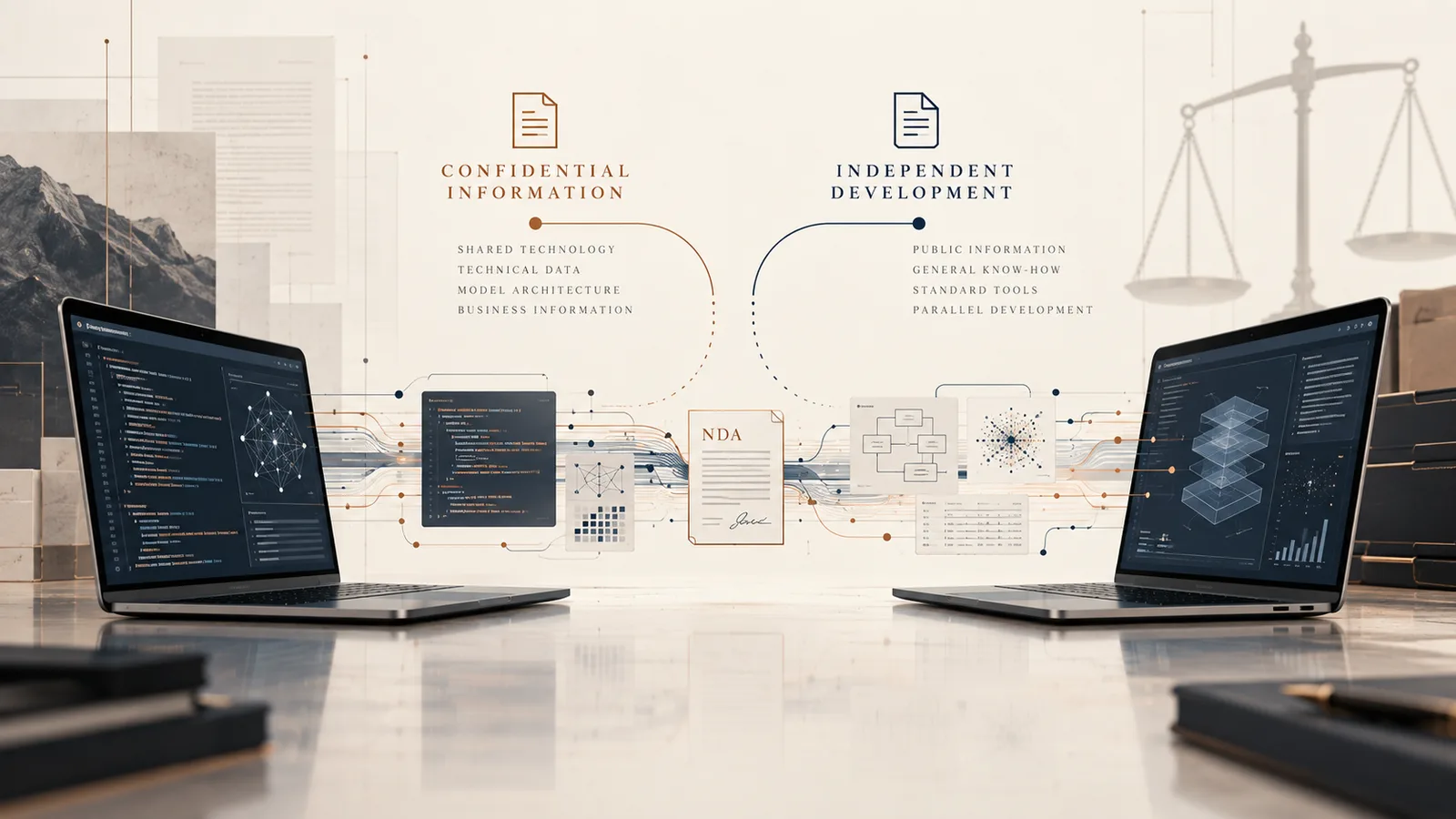
- Protected information vs. independent development
What the Lawsuit Alleges
SyteMLLabs, which does business as DaVoice, filed suit against Perplexity AI in the Northern District of California on September 24, 2026. The federal docket lists the case under the Defend Trade Secrets Act.1
According to contemporaneous reporting based on the complaint, DaVoice alleges that the companies entered into confidential arrangements while exploring or implementing a technology relationship.
DaVoice reportedly alleges that it disclosed proprietary information concerning wake-word technology, including some combination of source code, inference logic, network architecture, training approaches, training data, and technical know-how.2
DaVoice further alleges that Perplexity later used confidential information from the relationship to accelerate development of its own wake-word technology.
These are allegations. The court has not determined that the claimed information constitutes legally protected trade secrets or that Perplexity used any protected DaVoice information.
Because the complaint is heavily redacted, the public record does not currently permit a reliable technical comparison of the parties’ systems.
Perplexity’s Position
Perplexity disputes the allegations. Its chief communications officer told Courthouse News that the lawsuit is a “baseless” attempt to claim ownership over standard wake-word technology and stated that the parties’ agreement preserved Perplexity’s right to independently develop similar or competing products.2
That position is Perplexity’s defense, not an established fact. The central factual dispute may ultimately include whether Perplexity independently developed its technology or instead used information that DaVoice alleges was protected. Disputes of this kind are resolved through business and commercial litigation, evidence, and the court’s rulings—not press statements from either side.
What Actually Qualifies as a Trade Secret?
Under the federal Defend Trade Secrets Act, information can qualify as a trade secret if (1) the owner took reasonable measures to keep it secret, and (2) the information derives actual or potential economic value from not being generally known or readily ascertainable through proper means.3
California’s Uniform Trade Secrets Act uses a similar framework.4
Potential trade secrets can include technical information such as source code, methods, processes, model architecture, algorithms, training techniques, technical workflows, confidential datasets, and engineering know-how. But labeling information “confidential” does not automatically make it a trade secret. The facts can matter substantially. Relevant questions may include:
- Who had access?
- Was access limited?
- Were NDAs in place?
- Were repositories permission-controlled?
- Were disclosure logs maintained?
- Was the information already public or readily ascertainable?
- Was the information identified with reasonable specificity?
- Did the company treat the information consistently as secret?
What Counts as Misappropriation?
Federal law defines trade-secret misappropriation to include certain improper acquisitions, disclosures, or uses of another person’s trade secret. It also expressly distinguishes lawful acquisition methods: independent derivation and reverse engineering are not, by themselves, improper means.3
California law likewise provides that reverse engineering or independent derivation alone is not improper means.4
That distinction is particularly relevant here because Perplexity reportedly contends that its contract preserved independent-development rights. The existence of similar technology therefore does not, by itself, prove trade-secret misuse.
Why an NDA Is Not the Whole Story
A nondisclosure agreement can be important evidence that the parties intended information to remain confidential. But an NDA does not automatically establish:
- that every disclosed item is a trade secret;
- that the receiving company may never develop competing technology;
- that independent development is prohibited; or
- that later similarity proves misuse.
The actual agreement matters. Key provisions in startup and business transactions of this kind may include what counts as “Confidential Information”; permitted uses; exclusions for previously known, independently developed, publicly available, and third-party information; residual-knowledge clauses; reverse-engineering restrictions; IP ownership; joint-development rights; and return or destruction obligations.
How the DaVoice–Perplexity agreements will ultimately be interpreted is a question for the court.
Before Sharing Core Technology
A practical checklist for founders before a technical collaboration:
- Use a written NDA.
- Define permitted use precisely.
- Identify background IP.
- Define ownership of newly developed IP.
- Limit access to people who need it.
- Maintain repository and access logs.
- Preserve version histories.
- Record what was disclosed and when.
- Mark sensitive technical materials appropriately.
- Separate public know-how from claimed secrets.
- Document return or deletion obligations.
- Preserve evidence of independent development on both sides where relevant.
The goal is not simply to sign an NDA. It is to create a record showing what information was protected, who received it, what they were allowed to do with it, and how each party developed its own technology.
What the Case Does Not Yet Tell Us
At this early stage, the public record does not establish:
- whether DaVoice’s asserted information legally qualifies as trade secrets;
- exactly which technical information is at issue;
- whether Perplexity accessed or used any protected information;
- whether the technologies materially overlap;
- whether Perplexity independently developed its implementation;
- which contractual interpretation will prevail; or
- whether any party is entitled to damages or other relief.
These issues remain disputed.
Footnotes
- SyteMLLabs v. Perplexity AI, Inc., No. 3:26-cv-10909-PHK (N.D. Cal., filed Sept. 24, 2026) — Northern District of California new-filings record (nature of suit: Defend Trade Secrets Act (of 2016)). ↩
- Courthouse News Service, “Swiss startup accuses Perplexity AI of stealing passive listening tech,” Sept. 25, 2026 (reported allegations and Perplexity’s response). ↩
- 18 U.S.C. §§ 1836, 1839.See also18 U.S.C. § 1836 ↩
- Cal. Civ. Code § 3426.1. ↩
Sources & Authorities
- SyteMLLabs v. Perplexity AI, Inc., No. 3:26-cv-10909-PHK (N.D. Cal.) — Northern District of California filing record.
- 18 U.S.C. § 1836
- 18 U.S.C. § 1839
- Cal. Civ. Code § 3426.1
- Courthouse News Service, Sept. 25, 2026 — Reporting concerning the complaint and Perplexity’s response.
Mahrouyan Law handles selected intellectual-property matters. Read more about how the firm approaches trademarks & practical intellectual property counsel in California, or discuss your own situation with the firm.
Discuss Your Matter
Mahrouyan Law advises startups and businesses on intellectual property and selected trade-secret matters, including confidentiality agreements, IP ownership, licensing, and disputes involving confidential business information. Highly technical trade-secret matters may also involve specialized co-counsel depending on the issues presented.

Omeed Mahrouyan is the founder of Mahrouyan Law, P.C., a California firm handling business and commercial litigation, property and cargo damage claims, personal injury, landlord representation, startup transactions, and practical intellectual property matters. Clients work directly with him on strategy, drafting, and case decisions.
More about Omeed Mahrouyan →