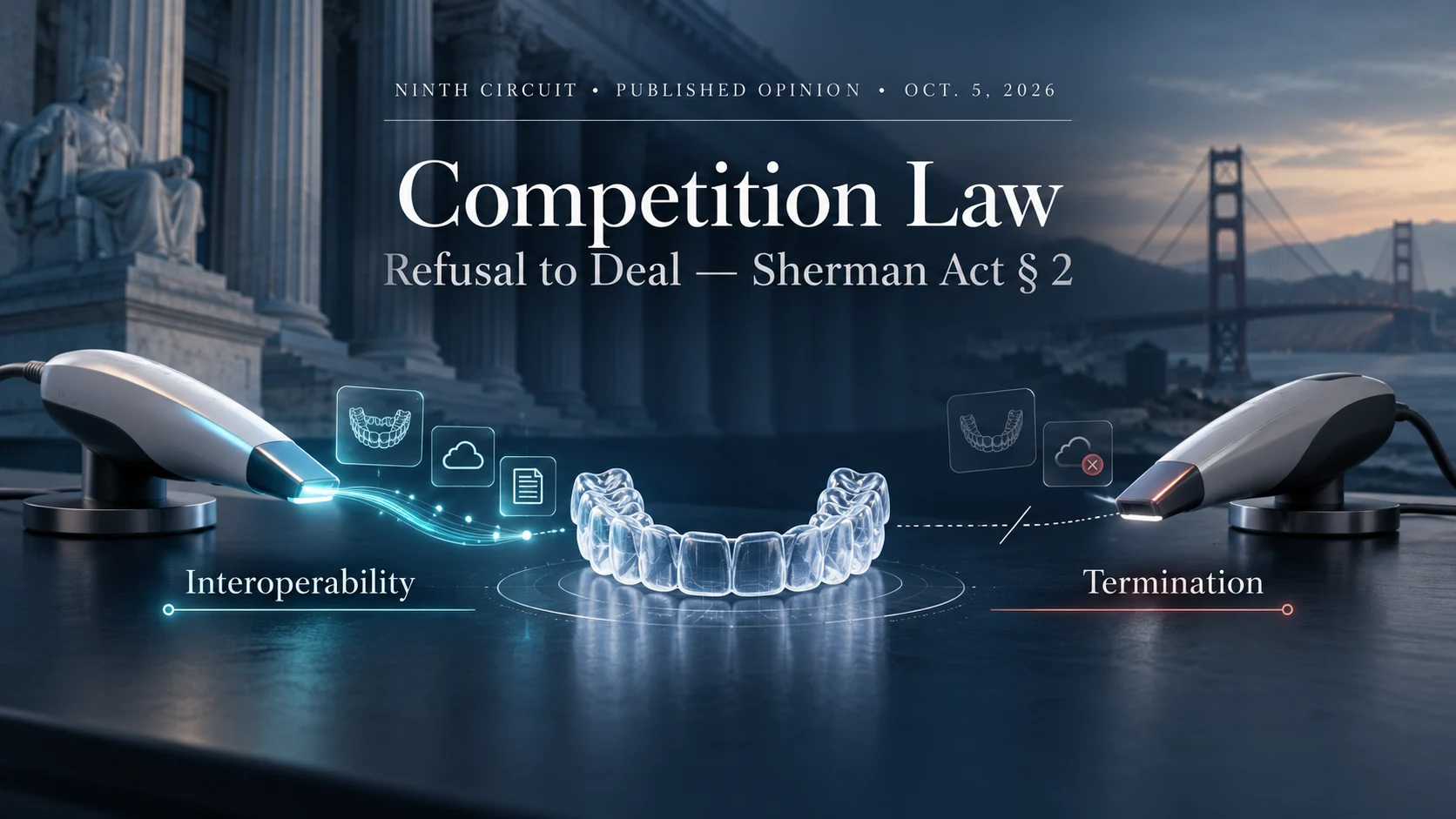
The Ninth Circuit revived antitrust claims against Align Technology over terminated Invisalign interoperability, clarifying when refusal-to-deal claims may proceed under Sherman Act § 2.
The Ninth Circuit has revived two antitrust class actions against Align Technology, the maker of Invisalign, after concluding that factual disputes remain over why the company terminated interoperability with a competing dental scanner.
In a published October 5, 2026 opinion, Simon and Simon, PC v. Align Technology, Inc., Nos. 24-1703, 24-1783, the court reversed summary judgment for Align and sent the consolidated cases back to the Northern District of California for further proceedings.
The decision does not hold that Align violated federal antitrust law.
Instead, the Ninth Circuit held that the plaintiffs presented enough evidence for a factfinder to determine whether Align's stated business justification for ending its relationship with competitor 3Shape was genuinely procompetitive or instead pretextual.
The case provides useful guidance on a broader business question: when can a company stop dealing with a competitor without creating potential monopolization liability under Sherman Act § 2?
The Invisalign–TRIOS Relationship
Align manufactures Invisalign clear aligners and the iTero intraoral scanner. During the period addressed by the litigation, the Ninth Circuit stated that Align controlled approximately 90% of the U.S. aligner market and was also a leading participant in the intraoral-scanner market. Market share alone, however, does not establish a § 2 violation.
In December 2015, Align entered into an interoperability agreement with 3Shape, a competing scanner manufacturer. The agreement allowed dental professionals using 3Shape's TRIOS scanner to submit digital scans directly for Invisalign treatment. TRIOS was designed as an open system capable of working with multiple aligner manufacturers.
The agreement permitted termination, but the relationship proved profitable for Align. In December 2017, with roughly one year remaining on the agreement, Align announced that it would terminate TRIOS interoperability in the United States. According to the Ninth Circuit, TRIOS had become a growing non-iTero channel through which Invisalign orders were placed.
Plaintiffs alleged that terminating this interoperability was part of an unlawful effort to protect Align's position in the aligner and scanner markets. Those remain allegations.
Businesses Generally Have No Duty to Help Their Competitors
Antitrust law generally allows businesses to decide with whom they will deal, including whether to cooperate with competitors. The Supreme Court has described refusal-to-deal liability as a narrow exception to that rule, noting in Verizon v. Trinko that Aspen Skiing sits at or near the outer boundary of § 2 liability.
In Aspen Skiing Co. v. Aspen Highlands Skiing Corp., the Supreme Court found potential antitrust liability after a monopolist terminated a previously voluntary and profitable cooperative relationship with a smaller competitor. The Ninth Circuit applied that framework to Align's conduct.
Why the Plaintiffs Established a Prima Facie Case
At the first step, the Ninth Circuit concluded that the plaintiffs had established a prima facie refusal-to-deal claim. The court treated the circumstances identified in Aspen Skiing as especially probative—not as a rigid checklist—and found each present:
- Align ended a voluntary and profitable course of dealing with 3Shape;
- by terminating interoperability, Align allegedly gave up Invisalign sales occurring through TRIOS scanners at prevailing retail prices; and
- Align continued permitting Invisalign interoperability through certain other non-iTero scanners, so the relevant products remained available to others.
That conclusion did not establish liability. It moved the analysis to Align's explanation for the termination.
Align's Business Justification—and Why the Case Was Sent Back
Align argued that terminating interoperability strengthened its position in patent litigation involving 3Shape. The Ninth Circuit held that this explanation satisfied Align's intermediate burden of identifying a potentially procompetitive, nonpretextual business justification.
Under the court's framework, the burden then shifted back to the plaintiffs to show that the justification was not legitimately procompetitive or was pretextual. The plaintiffs pointed to circumstantial evidence surrounding the timing and reasons for the termination, which the court found could reasonably support competing interpretations.
Genuine disputes of material fact therefore remained over whether Align's patent-litigation justification was legitimately procompetitive and whether it was instead pretextual. Those disputes could not be resolved against the plaintiffs on summary judgment, so the court reversed and remanded. It left the plaintiffs' broader alleged-scheme theory for the district court to address in the first instance.
The Ninth Circuit did not determine that Align's explanation was false or that Align violated the Sherman Act. A factfinder must resolve the disputed evidence.
A Contractual Right to Terminate Is Not Necessarily the End of the Analysis
Align and 3Shape's agreement allowed termination. But a contractual right to terminate and the antitrust consequences of exercising it are separate legal questions.
In ordinary commercial relationships, businesses generally remain free to terminate agreements according to their terms. Antitrust scrutiny becomes relevant only in unusual circumstances involving market power and allegedly exclusionary conduct.
The decision should not be read as requiring companies to continue integrations, APIs, licensing arrangements, distribution relationships, or other dealings with competitors. Refusal-to-deal liability remains exceptional.
Judge Miller Warned Against Expanding Refusal-to-Deal Liability
Judge Eric Miller concurred only in the judgment. He agreed that the plaintiffs produced enough evidence to create a factual dispute over whether Align's justification was pretextual, and therefore that summary judgment should be reversed.
But he disagreed with the per curiam opinion's broader framework—particularly its potential balancing of anticompetitive harm against procompetitive benefit even where a legitimate justification exists—which he called a significant and unwarranted expansion of refusal-to-deal liability. The opinion responded that it merely clarified the existing framework. The broader implications may remain contested.
What Businesses Can Take From the Decision
Interoperability and platform-access disputes arise in software and APIs, technology platforms, medical devices, marketplaces, fintech, licensing, distribution networks, and vertically integrated businesses. These are potential analogies, not holdings of the case.
The practical lesson is not that companies must keep doing business with competitors. It is that companies with substantial market power should recognize that terminating an established, profitable competitive relationship can receive greater scrutiny in unusual circumstances.
Contemporaneous documentation may also matter. If a significant competitive decision rests on intellectual-property concerns, security, product quality, economics, regulatory risk, or another legitimate consideration, documenting the actual rationale when the decision is made can become important later. Those issues can also be addressed when structuring interoperability and licensing agreements in the first place.
California Business and Commercial Disputes
The Align decision is published Ninth Circuit precedent and therefore carries particular significance for businesses operating in California and elsewhere in the Ninth Circuit.
Mahrouyan Law, P.C. represents businesses, founders, vendors, and other commercial parties in contract and business disputes, including business litigation in Irvine, and advises startups concerning commercial agreements and risk allocation. The firm is not a dedicated antitrust boutique, but competition-law issues can intersect with commercial disputes involving licensing, distribution, exclusivity, integrations, and termination rights.
Frequently Asked Questions
Did the Ninth Circuit find that Align violated the Sherman Act?
No. The Ninth Circuit reversed summary judgment because genuine disputes of material fact remain concerning Align's justification for terminating interoperability. Liability has not been established.
Do businesses generally have to deal with competitors?
No. Businesses generally have substantial freedom to choose with whom they deal. Refusal-to-deal liability under Sherman Act § 2 is a narrow exception involving unusual circumstances.
Why did the Ninth Circuit allow the claims against Align to continue?
The court concluded that the plaintiffs established a prima facie refusal-to-deal case and produced sufficient evidence for a factfinder to determine whether Align's patent-litigation justification was genuinely procompetitive or instead pretextual.
Does a contractual right to terminate prevent an antitrust claim?
Not necessarily. Contractual rights and antitrust liability involve different legal questions. The existence of a termination right does not automatically resolve whether particular conduct violates federal competition law.
What did Judge Miller disagree with?
Judge Miller agreed that factual disputes over pretext required reversal but objected to the broader framework allowing potential balancing of anticompetitive harm against procompetitive benefits. He described that approach as an expansion of refusal-to-deal liability.
Sources & Authorities
Mahrouyan Law handles these matters directly. Read more about how the firm approaches small business & commercial litigation in California, or discuss your own situation with the firm.
Facing a Dispute With a Competitor or Commercial Partner?
If your business is dealing with a significant commercial dispute involving a competitor, vendor, licensing relationship, distribution arrangement, or technology integration, contact Mahrouyan Law, P.C. to discuss the circumstances.

Omeed Mahrouyan is the founder of Mahrouyan Law, P.C., a California firm handling business and commercial litigation, property and cargo damage claims, personal injury, landlord representation, startup transactions, and practical intellectual property matters. Clients work directly with him on strategy, drafting, and case decisions.
More about Omeed Mahrouyan →