
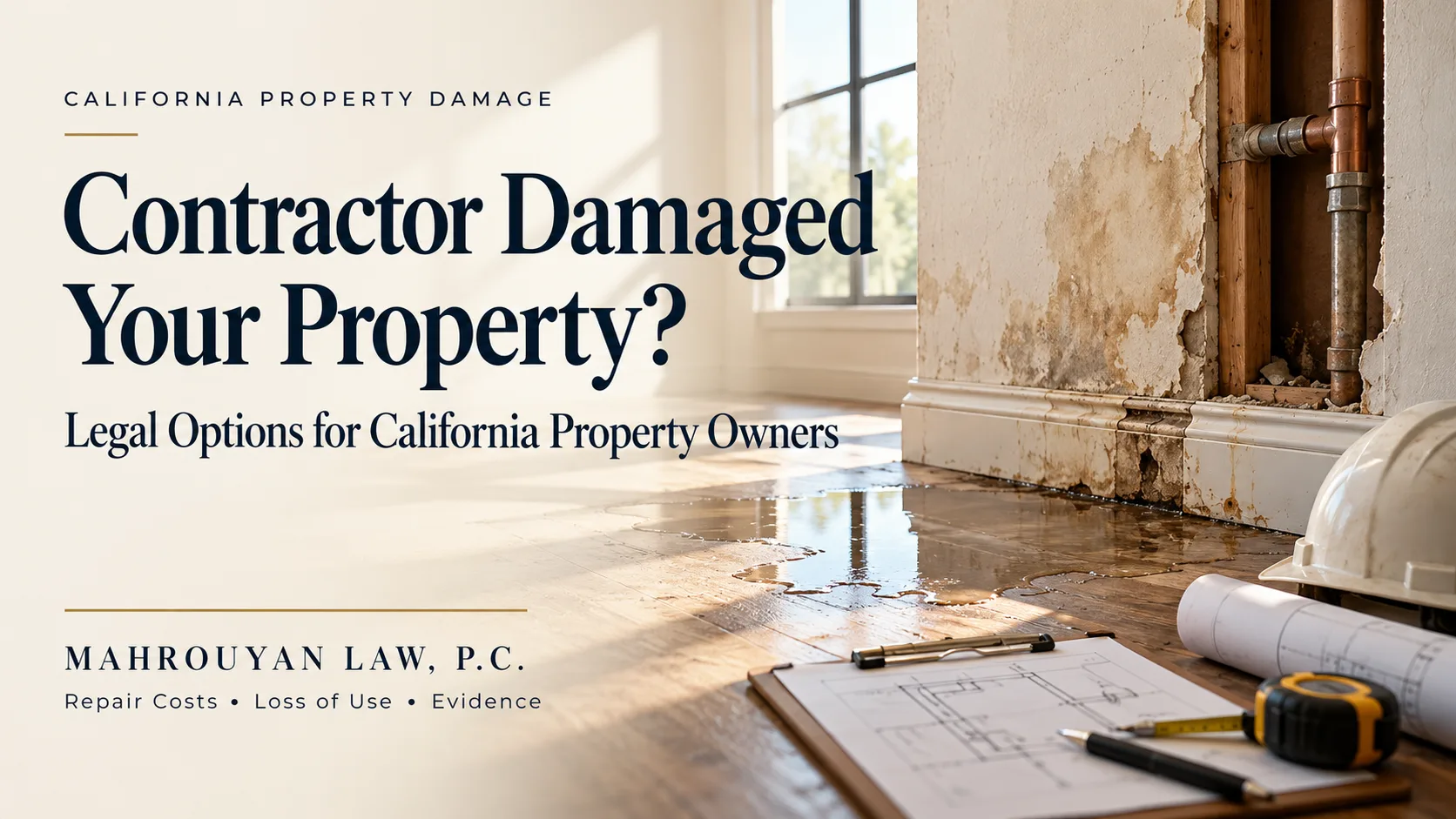
A contractor who damages property may be responsible under contract, negligence, or another theory. Recovery depends on duties, causation, provable losses, and procedural requirements.
Hypothetical illustration: A contractor reroutes plumbing during a remodel. Days later, a failed connection floods finished flooring and drywall in an existing part of the building. This example is illustrative only; it does not describe a firm matter or a reported event. Whether the owner has a claim would depend on the contract, the cause of the leak, and the losses the owner can prove.
Liability Depends on the Duty, Conduct, and Damage
Failing to perform a contract and acting negligently are distinct legal theories. A contract claim generally turns on what the contractor promised. A negligence claim generally requires an applicable duty of care, a breach of that duty, causation, and damage. California’s general negligence statute provides that everyone is responsible for injury caused by a want of ordinary care, subject to legal limits. (Civ. Code, § 1714, subd. (a).) 1
The California Supreme Court has distinguished contractual duties from tort duties in the construction context. In Erlich v. Menezes (1999) 21 Cal.4th 543, the Court rejected emotional-distress damages for negligent home construction on the facts before it. The decision does not bar every construction-related negligence claim. 2
Repairing defective work itself is often a different question from physical damage to existing or other property, such as a flooded floor or a damaged neighboring structure. Not every construction defect supports a negligence claim, and the absence of a direct contract does not necessarily defeat a property-damage claim.
Damage discovered after construction does not alone establish who caused it. Identifying responsible parties may require contracts, subcontractor records, permits, inspection records, and technical evidence. Whether a general contractor is responsible for a subcontractor’s work depends on the agreements and the facts.
What Damages May Be Recoverable?
The measure of damages depends on the legal theory. Contract damages generally compensate for the detriment proximately caused by the breach, while tort damages generally compensate for the detriment proximately caused by the wrongful conduct. (Civ. Code, §§ 3300, 3333.) 34
Repair cost or diminished value. For tortious damage to real property, CACI No. 3903F generally uses the lesser of reasonable repair costs and the reduction in the property’s value when evidence supports both. A legally sufficient personal reason for restoring the property may justify reasonable repair costs exceeding diminished value. That exception does not automatically apply to every owner or govern every construction-contract claim. 5
Loss of use. In appropriate circumstances, an owner may recover for loss of use during a compensable period, including a supported rental-value measure. (CACI No. 3903G.) 6
Lost profits. A business must prove causation and reasonably certain lost profits. Lost revenue is not the same as lost profit. The Supreme Court addressed the required certainty in Sargon Enterprises, Inc. v. University of Southern California (2012) 55 Cal.4th 747, a contract case; it does not make lost profits available in every property-damage dispute. 7
Insurance, License Bonds, and CSLB Complaints Are Separate
Liability does not automatically establish insurance coverage. Whether a contractor’s liability policy responds depends on its terms, exclusions, the insured parties, and the facts. 8
A contractor’s license bond is a separate, limited potential remedy for qualifying claimants and violations. It is not unlimited property-damage insurance. 9
A complaint to the Contractors State License Board may lead to a licensing investigation or discipline, but it does not guarantee financial recovery and does not replace an evaluation of civil remedies. 10
Preserve Evidence and Check Procedures Promptly
Safety and preventing further damage come first. Do not leave dangerous conditions unrepaired to preserve evidence. Where it is safe, practical steps include:
- Photographing and documenting the damage before and during mitigation.
- Preserving contracts, change orders, invoices, and communications.
- Obtaining qualified assessments and repair estimates.
- Keeping records of mitigation expenses and any business losses.
Before proceeding, review the contract for notice, opportunity-to-cure, mediation, and arbitration provisions. Qualifying claims involving new residential construction may also be subject to the Right to Repair Act’s prelitigation procedures. (McMillin Albany LLC v. Superior Court (2018) 4 Cal.5th 241.) That framework does not govern every commercial project or ordinary repair job. 11
There Is No Universal Filing Deadline
Claims for injury to real property generally have a three-year limitations period. (Code Civ. Proc., § 338, subd. (b).) Qualifying claims on a written contract generally have four years. (Code Civ. Proc., § 337, subd. (a).) When a period begins and ends requires a claim-specific analysis. 1213
Construction-specific statutes add outer limits. Section 337.1 generally sets a four-year limit, measured from substantial completion, for specified actions involving patent deficiencies, and section 337.15 generally sets a ten-year limit from substantial completion for specified latent deficiencies, each subject to statutory exceptions. Under subdivision (f), section 337.1, subdivisions (a) and (b), does not apply to owner-occupied single-unit residences. Neither statute generally extends a shorter limitations period that otherwise applies. 1415
None of these numbers is a reader’s calculated deadline. The practical takeaway: document the loss, investigate causation, identify the proper parties, and assess remedies and deadlines before deciding whether to sue.
Related firm services are described on the property damage and business litigation practices pages.
Footnotes
- 1.
- 2.
- 3.
- 4.
- 5.
- 6.
- 7.
- 8.
- 9.
- 10.
- 11.
- 12.
- 13.
- 14.
- 15.
Mahrouyan Law handles these matters directly. Read more about how the firm approaches commercial property, equipment & cargo damage in California, or discuss your own situation with the firm.
Contractor Damaged Your Property?
Mahrouyan Law, P.C. assists California property owners and businesses with evaluating contractor-related property damage, potential claims, and available remedies.

Omeed Mahrouyan is the founder of Mahrouyan Law, P.C., a California firm handling business and commercial litigation, property and cargo damage claims, personal injury, landlord representation, startup transactions, and practical intellectual property matters. Clients work directly with him on strategy, drafting, and case decisions.
More about Omeed Mahrouyan →