
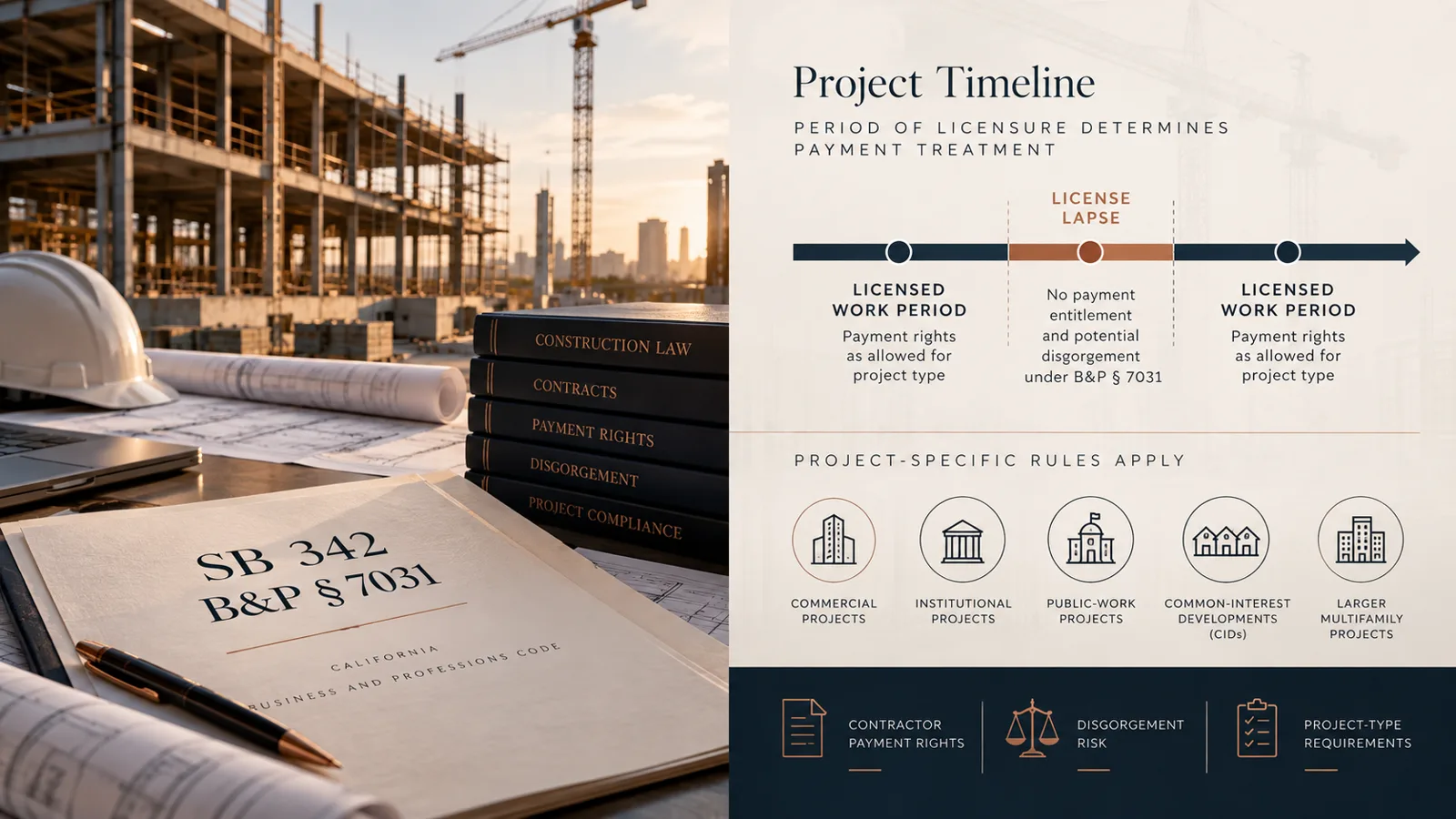
SB 342 does not eliminate California’s contractor-licensing rule. Beginning January 1, 2027, it creates a narrower, project-specific framework under which payment and disgorgement may turn on which portion of the work was performed while the contractor was licensed or unlicensed.
Why This Matters
California Business and Professions Code section 7031 has long imposed unusually severe consequences when work requiring a contractor’s license is performed during a period of nonlicensure.
Historically, a licensing lapse could create disputes not merely over payment for work performed during the lapse, but over the contractor’s right to recover compensation more broadly and the customer’s ability to recover compensation already paid.4
SB 342 changes that framework for several specifically identified categories of construction projects beginning January 1, 2027.
- Chapter 967, Stats. 2026
- Enacted
- September 30, 2026
- Approved
- January 1, 2027
- Effective
- Bus. & Prof. Code § 7031
- Amended
Why Contractor Licensing Matters to Payment
Under the version of Business and Professions Code section 7031 currently in effect through December 31, 2026, subdivision (a) generally bars a person acting as a contractor from bringing or maintaining an action to collect compensation for work requiring a license unless the person was duly licensed at all times during performance, subject to statutory exceptions.1
Subdivision (b) generally permits a person who used the services of an unlicensed contractor to recover compensation paid to the unlicensed contractor, again subject to statutory exceptions.1 SB 342 preserves those baseline rules in newly numbered subdivisions (a)(1) and (b)(1), while adding the project-specific exceptions discussed below beginning January 1, 2027.
These civil compensation rules are not the only consequences of unlicensed contracting. Licensing, enforcement, and disciplinary rules administered by the Contractors State License Board operate separately.
SB 342 Creates a Project-Specific Exception
The amended statute carves out actions for compensation arising from a contract for any of the following:1
- a public work of improvement;
- a commercial construction project;
- an institutional construction project;
- construction of a common interest development, as defined in Civil Code section 4100, if a tenant or resident is not a party to the contract; or
- construction of a multifamily residential project consisting of four or more units, if a tenant or resident is not a party to the contract.
The list is specific. It does not cover all residential or multifamily work, and the common-interest-development and multifamily categories each depend on a tenant or resident not being a party to the contract.
What Can the Contractor Recover on a Covered Project?
Under amended section 7031(a)(2)(B), a person may maintain an action for compensation on one of these contracts if the person “was a duly licensed contractor at the time the contract was executed and during the portion of the performance of the contract for which compensation is sought.”1
In practical terms: if a contractor is properly licensed when entering a covered commercial contract, performs part of the work while licensed, experiences a lapse, and later returns to proper licensure, SB 342 does not necessarily require the contractor to forfeit compensation for every portion of the project.
Recovery is not guaranteed. The contractor must still satisfy the statutory requirements and prove the underlying claim, including the contract terms, the work performed, and the amount owed. Disputes over commercial construction and payment disputes still turn on the full record.
What Can the Contracting Party Recover?
SB 342 makes a matching change to section 7031(b). For the same project categories, section 7031(b)(2)(B) provides that a person may bring an action “to recover the portion of compensation paid to the unlicensed contractor for work performed during the time in which the contractor was unlicensed.”1
For covered projects, the analysis shifts toward the period of nonlicensure rather than automatically treating the entire contract as subject to disgorgement merely because a licensing lapse occurred during performance.
The Traditional Rule Still Matters
SB 342 does not rewrite section 7031 for every California construction contract. Projects outside the enumerated categories remain governed by the statute’s existing framework, including the all-times licensure requirement and the broader recovery of compensation paid.
An ordinary homeowner-contractor dispute should not be assumed to fall within the new exception. Property owners facing contractor and construction-related property disputes should first determine how the project is classified.
SB 342 Is Not a Safe Harbor for Never-Licensed Contractors
The new recovery provision requires the contractor to have been duly licensed when the contract was executed. It should not be described as allowing someone who was never properly licensed to recover payment.
Section 7031(e) also continues to provide that the judicial doctrine of substantial compliance does not apply where the person acting as a contractor has never been a duly licensed contractor in California.1
One Important Rule Did Not Change
Section 7031(c) continues to provide that a security interest taken to secure payment for work requiring a license “is unenforceable if the person performing the act or contract was not a duly licensed contractor at all times during the performance of the act or contract.” SB 342 does not eliminate every financial consequence of a licensing lapse.1
When Does SB 342 Take Effect?
SB 342 was approved by the Governor and chaptered on September 30, 2026, as Chapter 967, Statutes of 2026. The Legislature classifies it as a non-urgency measure.2
Under California Constitution article IV, section 8(c), the amendments take effect January 1, 2027. Until then, the existing version of section 7031 continues to govern. SB 342 does not expressly address how the amendments apply to contracts, work, payments, or disputes predating January 1, 2027, so parties dealing with earlier periods of nonlicensure should not assume the new framework applies retroactively.3
What Should Contractors and Property Owners Review?
Before assuming SB 342 applies, identify:
- Project type: does the project actually fall within one of the enumerated categories?
- Contract execution date and license status: was the contractor duly licensed when the contract was executed?
- License history during performance: the exact dates of any lapse, suspension, reinstatement, or other licensing issue.
- Work performed during each period: what work was performed while properly licensed, and what work, if any, during nonlicensure.
- Payment history: match invoices and payments to the periods and work actually performed.
- CSLB records: preserve and verify licensing records.
- Contract remedies: review payment, termination, indemnity, breach, and dispute-resolution provisions separately.
What SB 342 Does Not Mean
SB 342 does not mean that:
- unlicensed contracting is now lawful;
- all unlicensed contractors may recover payment;
- section 7031 has been abolished;
- disgorgement has been eliminated;
- every residential construction contract receives the new treatment;
- contractor licensing no longer matters;
- a licensing lapse automatically entitles either side to judgment; or
- other CSLB licensing and disciplinary rules no longer apply.
SB 342 also has a genuine Orange County connection: its author, Senator Thomas Umberg, represents a district that includes several Orange County communities.
For a separate California contractor-regulation development, see California Signs SB 1263: New Rules for Hazardous Disaster Debris Removal, which addresses contractor qualifications for certain post-disaster debris work rather than payment rights.
Footnotes
- SB 342 (2025–2026 Reg. Sess.), ch. 967, Stats. 2026, amending Bus. & Prof. Code § 7031, subds. (a)(2)(B), (b)(2), (c), (e) (California Legislative Information). ↩
- California Legislature — SB 342 Status and History (approved by the Governor and chaptered Sept. 30, 2026; Chapter 967; Non-Urgency). ↩
- Cal. Const., art. IV, § 8, subd. (c). ↩
- Senate Judiciary Committee, Analysis of SB 342 (Jan. 13, 2026), background on prior law only; the enacted text controls. ↩
Sources & Authorities
- California Legislature — SB 342, Chapter 967, Statutes of 2026 (enacted text) — Amends Business and Professions Code section 7031.
- California Legislature — SB 342 Status and History — Inactive Bill – Chaptered; Non-Urgency.
- California Constitution, article IV, § 8 — Effective date of regular-session statutes.
- California Business and Professions Code § 7031 — Current codified text.
- Senate Judiciary Committee — Analysis of SB 342 — Contextual background only; analyzes an earlier version.
Mahrouyan Law handles these matters directly. Read more about how the firm approaches small business & commercial litigation in California, or discuss your own situation with the firm.
Discuss Your Matter
Mahrouyan Law represents contractors, businesses, property owners, and other parties in selected California commercial and construction-related disputes. When payment rights depend on contractor licensing, project classification, contract terms, or the timing of work, those issues should be evaluated together rather than in isolation.

Omeed Mahrouyan is the founder of Mahrouyan Law, P.C., a California firm handling business and commercial litigation, property and cargo damage claims, personal injury, landlord representation, startup transactions, and practical intellectual property matters. Clients work directly with him on strategy, drafting, and case decisions.
More about Omeed Mahrouyan →