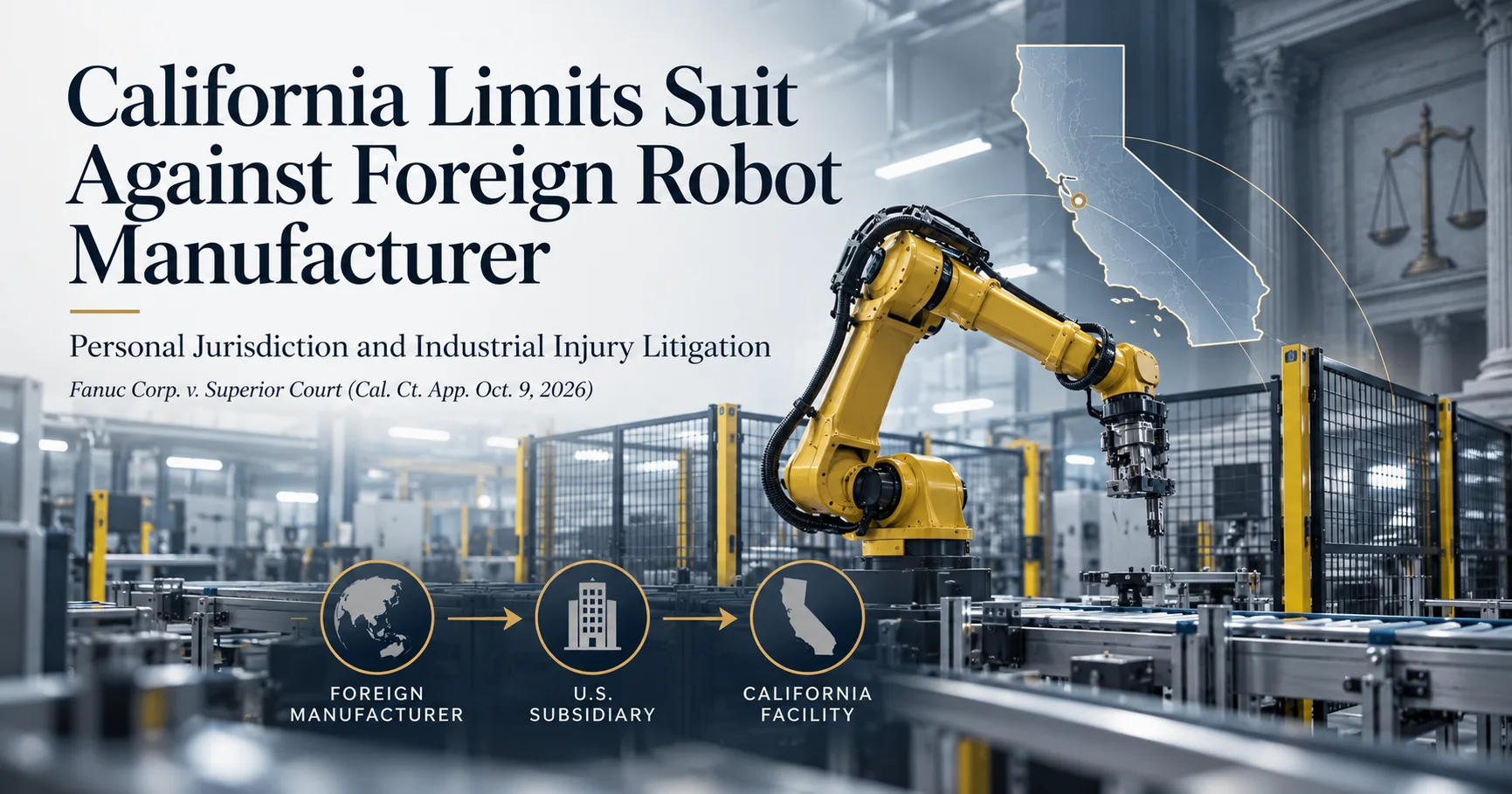
In Fanuc Corp. v. Superior Court, the Court of Appeal held that personal jurisdiction over a Japanese robot manufacturer was not established on the record presented. The ruling did not address the merits.
On October 9, 2026, the California Court of Appeal ruled that a Japanese industrial-robot manufacturer could not be sued in California based on the jurisdictional record presented, despite its American subsidiary's business activities in the state.
The published decision, Fanuc Corp. v. Superior Court (Oct. 9, 2026, E086688), highlights an important distinction: whether a manufacturer may be held liable for an injury is separate from whether a California court has jurisdiction over that manufacturer.
What Happened?
In June 2020, maintenance technician Abraham Bernal was seriously injured while troubleshooting industrial equipment at a Niagara Bottling facility. According to the appellate opinion, a depalletizer released its gripper head while Bernal was positioned below it.
Bernal sued Krones, Inc., which manufactured the depalletizer; Fanuc Corporation (Fanuc Japan), which manufactured an industrial robot involved in the incident; and Fanuc America Corporation, Fanuc Japan's wholly owned American subsidiary.
Fanuc Japan challenged the California court's personal jurisdiction. The San Bernardino County Superior Court denied its motion to quash service of summons, but the Court of Appeal reversed. (Fanuc Corp. v. Superior Court (Oct. 9, 2026, E086688) [slip opn. pp. 2–4, 20].)
Why Did the Court Reject Jurisdiction?
The appellate court examined two forms of personal jurisdiction.
General jurisdiction: A corporation is ordinarily subject to general jurisdiction where it is incorporated or maintains its principal place of business, although exceptional circumstances may support jurisdiction elsewhere.
Fanuc Japan was incorporated and headquartered in Japan. Its American subsidiary was incorporated in Delaware and headquartered in Michigan.
The court concluded that the subsidiary's California operations were insufficient to establish general jurisdiction over Fanuc Japan—even assuming the subsidiary's contacts could be attributed to its parent. (Fanuc, slip opn. at pp. 6–12; Daimler AG v. Bauman (2014) 571 U.S. 117, 137–139.)
Specific Jurisdiction: Connecting the Claim to California
A lawsuit must arise out of or relate to the defendant's relevant contacts with California.
The court assumed, without deciding, that Fanuc America's California activities could be attributed to Fanuc Japan. Nevertheless, the plaintiff had not established a sufficient connection between those activities and the particular robot model involved in the incident.
The record did not establish relevant California sales, marketing, or installation of that model. The subsidiary's California service locations and sales of other robot models were insufficient on the evidence presented.
The court distinguished Ford Motor Co. v. Montana Eighth Judicial District Court (2021) 592 U.S. 351, where extensive marketing, sales, and servicing of the relevant vehicle models supported specific jurisdiction. (Fanuc, slip opn. at pp. 13–19.)
What Does This Mean for California Injury Claims?
The decision underscores that a foreign manufacturer's relationship with an American subsidiary does not automatically establish jurisdiction in California. Plaintiffs must identify evidence connecting the defendant and the particular dispute to the state.
Importantly, the ruling did not determine whether the equipment was defective, whether any defendant was negligent, or what damages Bernal might recover. The court also acknowledged that different evidence could support jurisdiction over Fanuc Japan in another case.
The broader lesson applies to injury claims and commercial disputes involving overseas manufacturers: identifying a potentially responsible company and establishing where it may be sued are separate legal questions.
Mahrouyan Law, P.C. represents individuals and businesses in selected civil litigation matters throughout California, including personal injury claims and small business and commercial litigation. If you have questions about a potential injury claim or commercial dispute, contact the firm to discuss your circumstances.
Sources & Authorities
- Fanuc Corp. v. Superior Court (Oct. 9, 2026, E086688) (Cal. Ct. App., 4th Dist., Div. 2) (certified for publication) — Official published opinion.
- Fanuc Corp. v. Superior Court (Oct. 9, 2026, E086688) — full opinion text (Justia)
- Daimler AG v. Bauman (2014) 571 U.S. 117
- Ford Motor Co. v. Montana Eighth Judicial District Court (2021) 592 U.S. 351
Mahrouyan Law handles these matters directly. Read more about how the firm approaches personal injury in California, or discuss your own situation with the firm.
Questions About an Injury Claim or Commercial Dispute?
Contact Mahrouyan Law, P.C. to discuss your circumstances.

Omeed Mahrouyan is the founder of Mahrouyan Law, P.C., a California firm handling business and commercial litigation, property and cargo damage claims, personal injury, landlord representation, startup transactions, and practical intellectual property matters. Clients work directly with him on strategy, drafting, and case decisions.
More about Omeed Mahrouyan →