
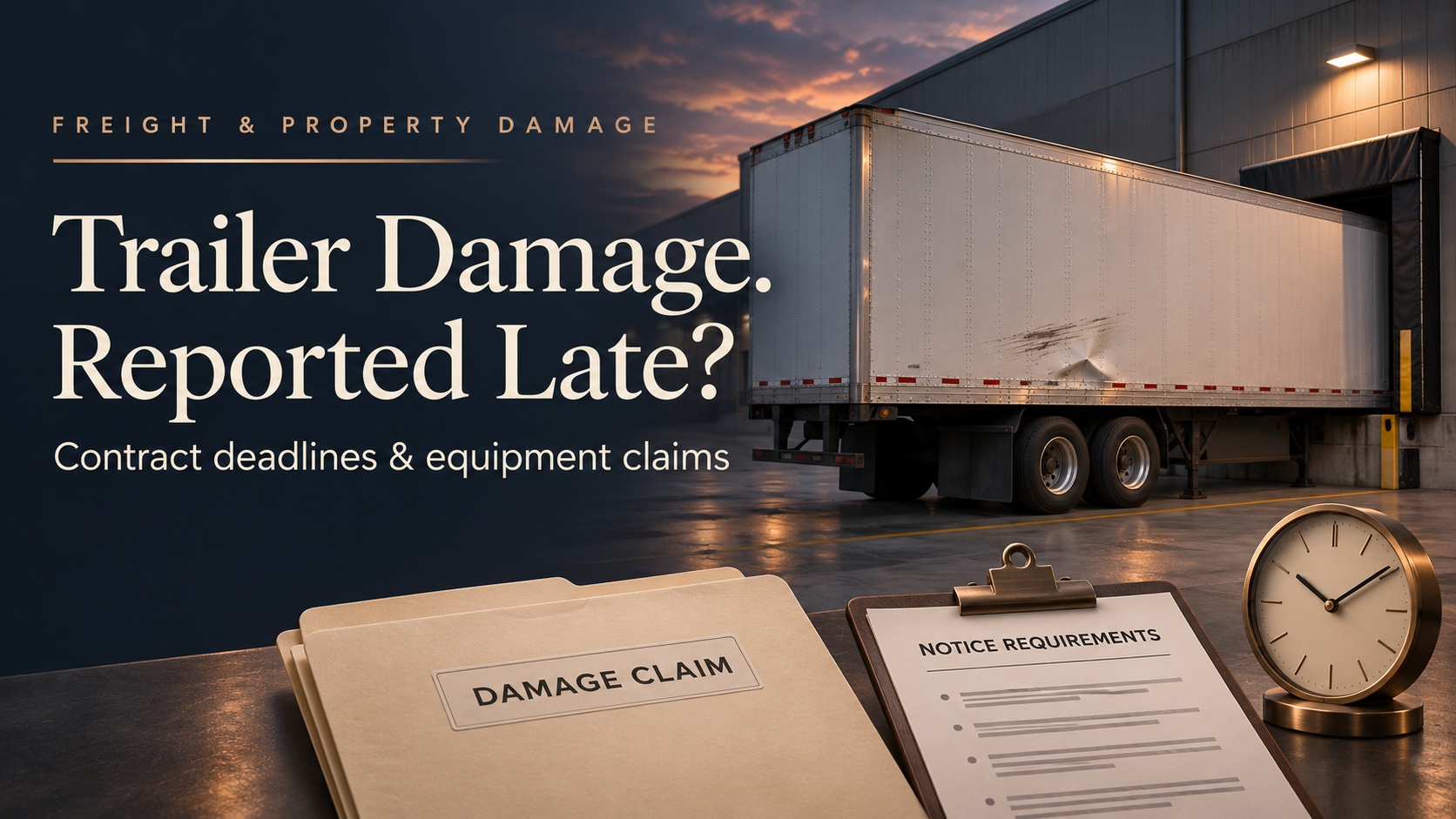
A late report may affect a trailer-damage claim, but it does not automatically end every theory of recovery. The governing agreement, the wording of the notice provision, and the type of claim all matter.
A denial that says only “reported too late” is a position, not a conclusion. Whether a late report defeats a trailer-damage claim depends on which agreement applies, what the notice provision actually says, and which claim is being asserted. This article is general information, not a review of any specific contract.
Identify the Governing Agreement and Obligation
Freight transactions layer several documents: a broker-carrier agreement, a shipper’s load tender or rate confirmation, a bill of lading, and sometimes a warehouse or interchange agreement. Each can contain its own deadlines. Distinguish incident reporting to a dispatch platform, a formal written claim, a contractual condition precedent to recovery, insurance notification, and a deadline for filing arbitration or litigation. They are different obligations with different consequences.
A broker-carrier agreement does not automatically govern a separate claim against a shipper or warehouse. Identify which entity allegedly caused the damage and which contract, if any, binds that relationship. Check the governing-law provision before applying California principles; many freight agreements select another state’s law or federal frameworks.
Read the Clause Before Accepting a Forfeiture Argument
A provision requiring prompt notification of an incident is not necessarily the same as a provision expressly extinguishing a claim. Courts generally read contract language according to its terms, and a reporting obligation may serve purposes—such as investigation and mitigation—short of forfeiture. At the same time, do not assume every short notice window is unenforceable: parties to commercial contracts can agree to meaningful deadlines, and an enforceable notice requirement can bar recovery.
What the California Decisions Actually Decided
California appellate decisions show courts reading short contractual windows narrowly in other settings. In Charnay v. Cobert, the court rejected treating a ten-day billing-objection provision in an attorney retainer as barring the client’s claims. 1 In Cordoba Corp. v. City of Industry, an invoice-dispute provision did not require discovery and litigation of alleged concealed fraud within thirty days. 2 In Moreno v. Sanchez, a home-inspection contract’s one-year limitations period running from the date of inspection was found unreasonable because it cut off delayed discovery of hidden defects. 3
These decisions did not decide a carrier-versus-shipper trailer-damage notice dispute, and Moreno does not create a universal discovery rule for commercial freight contracts. They are analogies about how courts approach forfeiture-style readings—not controlling freight precedent.
Equipment Damage Is Not a Cargo Claim
Federal cargo-claim rules are frequently cited in freight disputes, but their scope is specific. Under 49 U.S.C. section 14706(e)(1), a carrier may not provide a period shorter than nine months for filing a claim, or two years for bringing a civil action, under that section; the lawsuit period runs from the carrier’s written notice disallowing the claim. 4 Related regulations address formal cargo-claim requirements. 5
These are statutory minimum periods for qualifying claims under that section—not universal deadlines for all freight disputes. They do not automatically govern a carrier’s claim against a shipper or broker for damage to its own operating trailer. Identify the legal theory and the claimant’s role before importing any cargo-claim deadline.
Prior Communications and the Correct Recipient
Emails, dispatch messages, photographs, and platform reports may matter, depending on what the contract requires and to whom notice must go. Notice to a broker does not automatically constitute notice to a shipper, and a claims administrator’s handling of a file does not itself establish liability or authority to bind another party.
Claims against brokers may require a separate federal preemption analysis under 49 U.S.C. section 14501(c) rather than assuming state law always applies. 6
Preserve the Record and Protect the Deadline
Whatever the clause says, preserve the evidence, and do not assume that negotiations extend any filing deadline:
- Signed agreements and every version, including rate confirmations, load tenders, and bills of lading.
- A chronology of when the damage occurred, when it was discovered, and when each party was told.
- Original communications and delivery records, including dispatch messages and platform reports.
- Denial or reservation-of-rights correspondence.
- Inspection and maintenance records, photographs, repair estimates, and supported downtime losses.
Give prompt, compliant notice where possible and take safe mitigation steps. Recovery still requires a viable legal theory, causation, and supporting evidence, without duplicate compensation; missed-load gross revenue is not the same as recoverable lost profits. Our overloaded-trailer article discusses related loading disputes.
Sources
- 1.
- 2.
- 3.
- 4.
- 5.
- 6.
Discuss Your Matter
If a trailer-damage claim was denied as late, you may contact Mahrouyan Law to discuss your agreement and circumstances. Read more about our property and equipment damage practice and business litigation practice.

Omeed Mahrouyan is the founder of Mahrouyan Law, P.C., a California firm handling business and commercial litigation, property and cargo damage claims, personal injury, landlord representation, startup transactions, and practical intellectual property matters. Clients work directly with him on strategy, drafting, and case decisions.
More about Omeed Mahrouyan →