
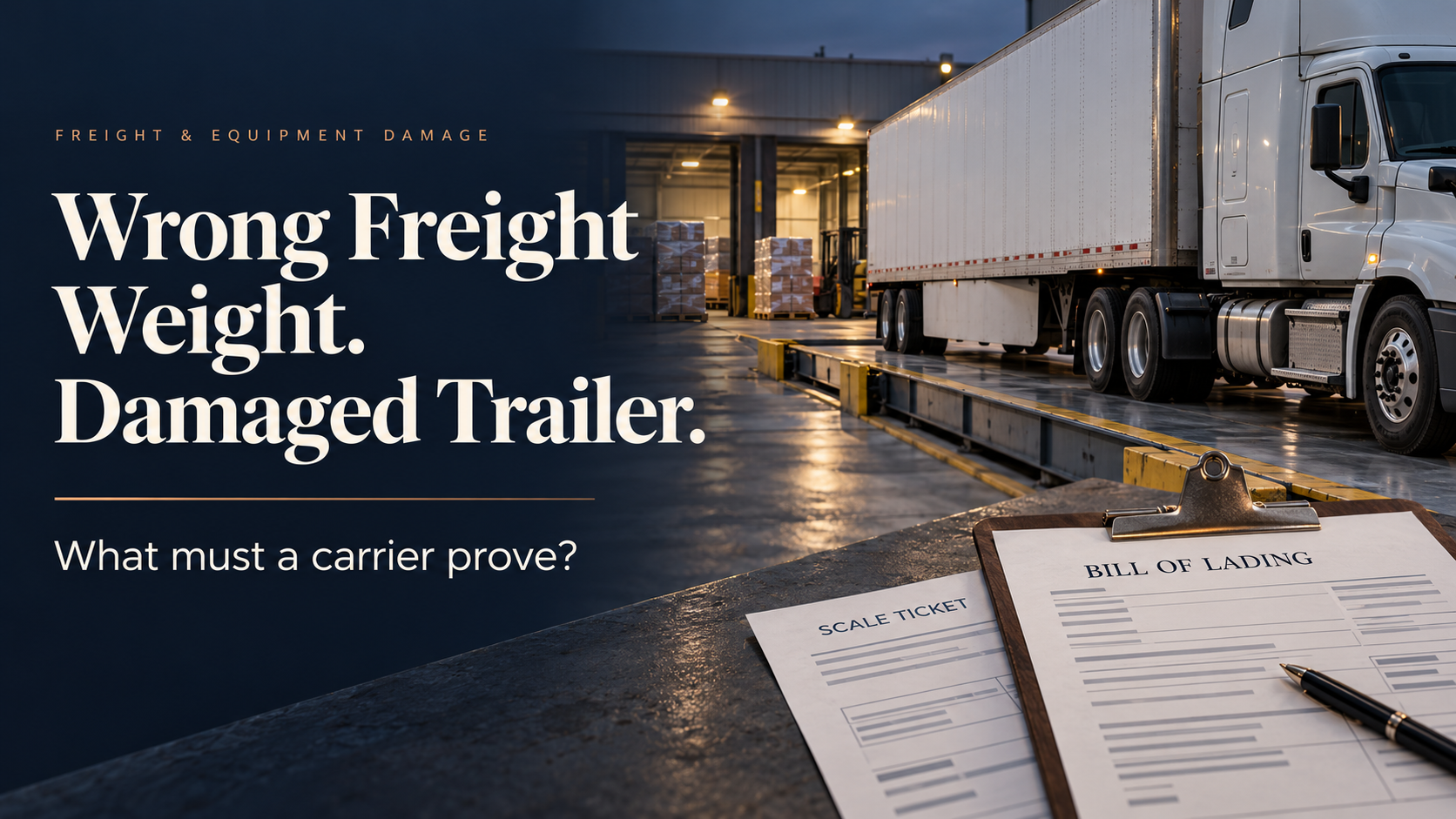
Recovery may be possible when inaccurate freight-weight information causes trailer damage, but the claim depends on the agreement, applicable duties, reasonable reliance, and proof of the loss.
A mismatch between the bill of lading and a scale ticket is a starting point, not a complete case. The central question is whether actionable misinformation caused physical trailer damage and identifiable losses. This differs from simply proving an overloaded trailer or damage caused by a forklift during loading.
Identify the Claim, Not Just the Discrepancy
Breach of contract requires identifying an enforceable obligation to provide accurate shipment information and loss resulting from its breach. A bill of lading, rate confirmation, or other shipping document does not necessarily guarantee every listed weight. Read the governing agreement, including responsibility allocations and limitations.
Negligence requires an applicable duty, breach, causation, and harm. California Civil Code section 1714 supplies a general ordinary-care principle, not a freight-specific finding of shipper liability. Every contractual breach does not support an independent tort claim. 1
Negligent misrepresentation involves a false factual representation made without reasonable grounds for believing it true, intended to induce reliance. The carrier must have reasonably relied on it, with reliance substantially contributing to actual harm. Intentional misrepresentation requires additional proof of knowing falsity or recklessness and the remaining elements, including intent to induce reliance, reasonable reliance, and harm. A discrepancy alone does not prove fraud. 234
Show How the Weight Affected the Carrier’s Decision
Identify who supplied the weight, when it was communicated, and what the carrier did because of it. Did dispatch select a trailer or accept the load based on that number? Preserve communications and equipment-selection records connecting the representation to the decision. 5
Actual reliance and its reasonableness are separate issues. Knowledge of the true weight before acting may undermine reliance; contradictory information and opportunities to assess the load matter to the circumstances. Do not assume a document alone proves that a transportation decision depended on it. 56
Prove Why the Trailer Failed
Cargo weight is different from gross vehicle weight, axle loading, equipment ratings, and concentrated floor loading. A trailer may suffer damage from load placement or preexisting deterioration rather than total cargo weight alone. Maintenance records and a technical inspection can help distinguish competing explanations.
Evaluate a later scale ticket against the vehicle configuration and timing: which tractor and trailer were weighed, what cargo was aboard, and whether loading changed. The discrepancy itself does not explain the failure mechanism or establish that different paperwork would have prevented it.
Shipper Paperwork Does Not Excuse Unsafe Operation
Where applicable, 49 C.F.R. section 392.9 requires cargo to be properly distributed and adequately secured and imposes driver inspection duties. Subsection (b)(4) limits subsection (b) for sealed vehicles the driver has been ordered not to open, or loading that makes inspection impracticable. Those exceptions do not erase subsection (a)’s requirements. 7
Carrier responsibilities remain part of the analysis. Our overloaded-trailer article discusses loading and carrier conduct more broadly; this article focuses on inaccurate information and the decisions allegedly made in reliance on it.
Identify Each Participant and the Governing Law
Shippers, warehouses, brokers, and carriers have different roles. Merely transmitting a shipper’s weight does not automatically establish broker liability. Claims against a broker may require claim-specific federal preemption analysis under 49 U.S.C. section 14501(c), rather than assuming state law always applies. 8
Damage to a carrier’s operating equipment is distinct from loss of goods received for transportation under the Carmack Amendment, 49 U.S.C. section 14706. Examine the transaction and claimed loss; do not automatically import cargo-claim deadlines into trailer-damage claims or categorically exclude all equipment-related losses from Carmack. Governing law, contracts, and the claim asserted affect deadlines. 9
Document the Loss and Preserve the Evidence
Potential recovery may include property damage, loss of use, and reasonably certain lost profits, subject to the applicable measure, proof, mitigation, and avoidance of duplicate recovery. Full replacement cost is not automatic; neither is cumulative recovery of every category. Gross freight revenue is not lost net profit. 101112
Preserve these records while taking necessary safety and reasonable mitigation measures:
- Original bills of lading, rate confirmations, manifests, and weight-related communications.
- Scale tickets, loading photographs, equipment specifications, maintenance records, and technical inspections.
- Dispatch and equipment-selection records demonstrating reliance.
- Repair estimates, rental records, and financial records supporting downtime losses.
Document conditions before repairs when safely possible, retain damaged components where practicable, and record expenses and avoided costs. An evidence-based assessment connects the representation, transportation decision, physical failure, and claimed loss rather than assuming one proves the others.
Sources
- 1.
- 2.
- 3.
- 4.
- 5.
- 6.
- 7.
- 8.
- 9.
- 10.
- 11.
- 12.
Discuss Your Matter
If inaccurate freight information may have caused equipment damage, you may contact Mahrouyan Law to discuss your circumstances. Read more about our property and equipment damage practice.

Omeed Mahrouyan is the founder of Mahrouyan Law, P.C., a California firm handling business and commercial litigation, property and cargo damage claims, personal injury, landlord representation, startup transactions, and practical intellectual property matters. Clients work directly with him on strategy, drafting, and case decisions.
More about Omeed Mahrouyan →