An insurance applicant’s disclosure obligations under California law may extend beyond the questions printed on the application when the applicant knows of a material fact affecting the risk.
What Happened in Passport 420?
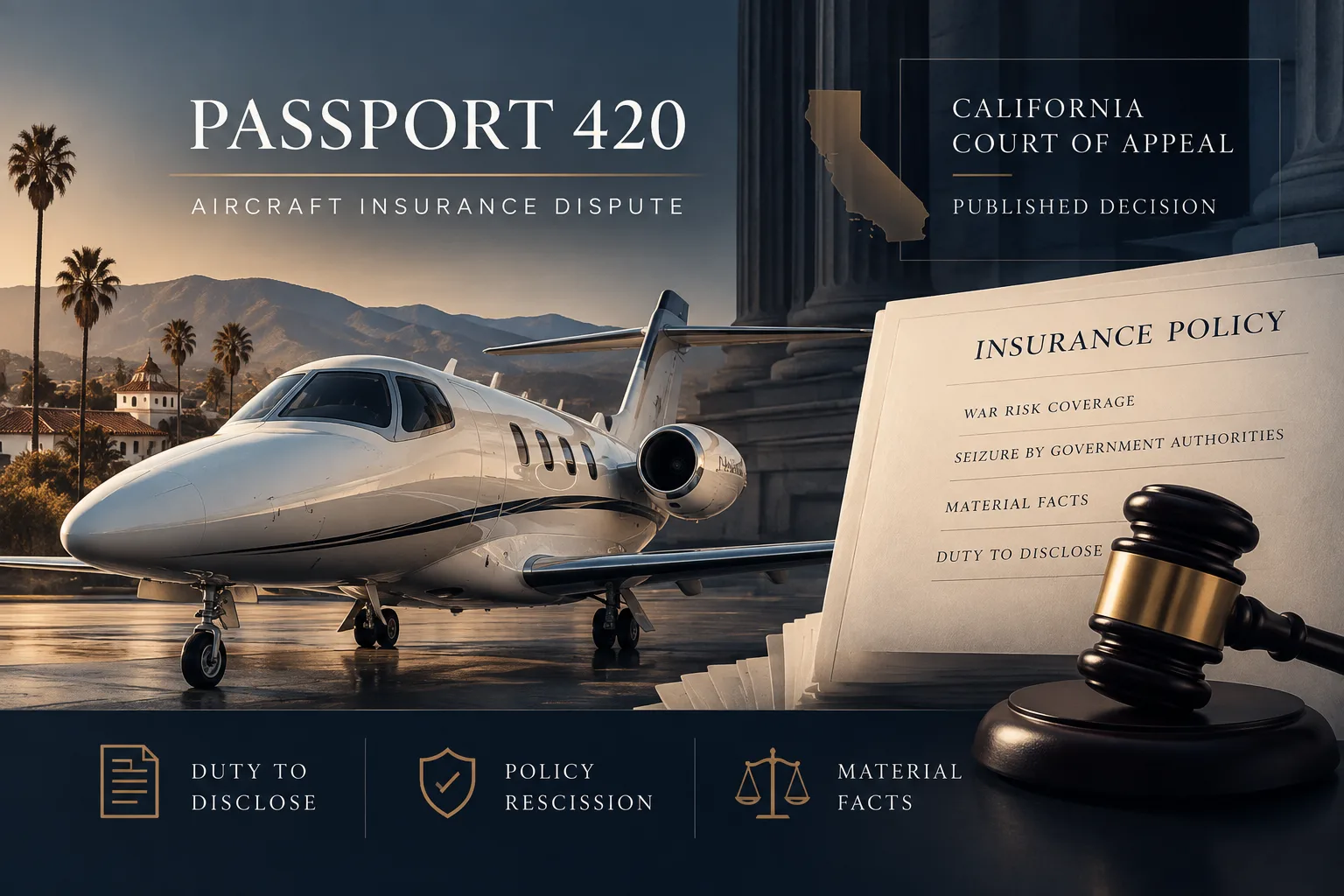
Passport 420, LLC owned a HondaJet. Its two members were an entity controlled by William Parrish and attorney Michael Avenatti’s law firm, and the purchase price was funded through those entities. Avenatti was appointed Passport’s manager under its operating agreement.
The Court of Appeal described it as undisputed that Avenatti embezzled approximately $2 million from a client and used the money to pay his share of the purchase price. It was also undisputed that Parrish had no actual knowledge of, and did not participate in, the embezzlement.1
Starr Indemnity & Liability Company insured the aircraft. The policy included a war-risk endorsement covering physical loss of the aircraft caused by seizure by or under the order of a government authority. In April 2019, federal authorities seized the aircraft in connection with Avenatti’s criminal prosecution. Passport submitted a claim; Starr ultimately denied coverage and sought rescission.
- B343113 / B344423
- Case Nos.
- October 1, 2026
- Filed · Published
- 2d Dist., Div. 6
- Court of Appeal
- Reversed
- Disposition
The Insurance Application Never Asked About the Source of the Purchase Funds
According to the opinion, Starr’s application asked about the aircraft, its pilots, maintenance arrangements, and liens or loans secured by the aircraft. It did not ask about the source of the funds used to buy the aircraft, Passport’s financial condition, or the finances of its members. Starr also had not investigated the source of the purchase funds when underwriting the policy.1
Passport argued that a fact Starr never asked about could not have been material to Starr. The Court of Appeal rejected that theory.
The Trial-Court Judgment Exceeded $21 Million
The Santa Barbara County jury found for Passport. The resulting judgment included $3,990,000 in policy benefits, $15,000,000 in punitive damages, approximately $1.048 million in prejudgment interest, approximately $1.417 million in attorney fees, and $125,971.01 in costs—approximately $21.58 million in total.1
That figure illustrates the practical effect of rescission: once the policy was rescinded, the judgment built on it was reversed.
Materiality Does Not Depend on Whether the Insurer Asked
The court read Insurance Code sections 332, 334, and 336 together and stated that “the materiality of a concealed fact does not depend on the insurer’s inquiry or the reasonableness of any investigation it conducts.”1
In plain English, section 332 imposes an affirmative duty on each party to communicate, in good faith, facts within its knowledge that are or that it believes to be material to the contract and that the other party does not have the means of ascertaining. The court therefore rejected the argument that the application form alone defines the outer boundary of disclosure.3
The opinion also recognizes limits. Citing section 336 and prior cases, it explains that an insurer may waive its right to disclosure in some circumstances—for example, by failing to follow up obvious leads or where a fact is distinctly implied from other facts revealed.5
What Makes a Fact “Material”?
Under section 334, materiality is judged by the probable and reasonable influence of the facts on the party receiving the information. The court framed the question not as whether Starr asked, but whether Starr’s underwriting decision would have been different had the true facts been disclosed.4
Relying on prior case law, the court described the test as whether the information would have caused the underwriter to reject the application, charge a higher premium, or amend the policy terms.
In Passport 420, the court held the undisclosed source of the purchase funds material as a matter of law. Because the use of embezzled funds greatly increased the risk of government seizure—the very risk the endorsement covered—the court concluded that a rational insurer would decline the risk, exclude seizure, or charge more.1
The Concealment Allowed Starr to Rescind
Insurance Code section 331 provides that concealment entitles the injured party to rescind. The court concluded that the source of the purchase funds was material, that Passport was legally charged with Avenatti’s knowledge, that Passport therefore concealed a material fact, and that Starr was entitled to equitable rescission.2
The judgment was reversed. Passport’s cross-appeal, which concerned the prejudgment-interest calculation, was dismissed as moot.
Why Avenatti’s Knowledge Was Attributed to the LLC
As a general rule, an agent’s knowledge may be imputed to the principal. The court relied in part on Civil Code section 2332 and agency-law principles.6
Passport argued that the “malevolent agent” or adverse-interest exception should prevent imputation. The court disagreed on these facts. Although the embezzlement itself was criminal and adverse, Avenatti used the funds to complete Passport’s aircraft purchase, which initially benefited the LLC, and he was acting as Passport’s manager when Passport obtained the Starr policy.
The decision does not mean that every act or every piece of knowledge held by a rogue employee or manager is automatically imputed to a company; the result depended on the agency relationship and the specific facts concerning how the conduct related to Passport.
An Innocent Co-Owner Did Not Change the Result
The opinion expressly states that Parrish had no actual knowledge of and did not participate in the embezzlement. The problem for Passport was that the relevant knowledge was attributed to the entity through Avenatti’s role as its manager.1
That distinction matters for businesses that purchase insurance through managers, officers, or other agents.
What the Court Did Not Reach
Because rescission resolved the appeal, the court expressly did not reach Starr’s remaining contentions, including arguments concerning policy exclusions, Insurance Code section 533, bad faith, punitive damages, Brandt attorney fees, and other issues.1
The opinion therefore does not hold that Starr acted reasonably or in good faith, does not uphold Starr’s exclusions, and does not independently invalidate the punitive-damages award.
What Should California Businesses Take From the Decision?
When applying for or renewing significant commercial insurance:
- Do not treat the application form as necessarily defining every disclosure obligation.
- Identify unusual facts that materially affect the risk being insured.
- Consider whether a manager, officer, or other agent knows facts that may legally be attributed to the entity.
- Preserve underwriting and broker communications.
- If uncertain whether a fact should be disclosed, obtain appropriate insurance or legal advice before the policy issues rather than after a loss.
What the Decision Does Not Mean
Passport 420 does not hold that:
- insureds must volunteer every fact related to their business;
- insurers may rescind for immaterial omissions;
- insurers can automatically rescind whenever an application is incomplete;
- an innocent co-owner is personally responsible for another owner’s wrongdoing;
- every rogue employee’s knowledge is automatically imputed to the company;
- Starr prevailed on its alternative coverage and bad-faith arguments; or
- the case arose in Orange County.
The holding is narrower: California’s statutory disclosure rules can require disclosure of a material fact even when the insurer never expressly asks about that fact. The case arose in Santa Barbara County, but as a published Court of Appeal decision it is citable precedent statewide.
For a related coverage question involving causation rather than policy formation, see California Court Clarifies Insurance Coverage When Construction and Storm Damage Combine.
Footnotes
Sources & Authorities
- Passport 420, LLC v. Starr Indemnity & Liability Co., Nos. B343113/B344423 (Cal. Ct. App. Oct. 1, 2026) — Official slip opinion; certified for publication.
- California Insurance Code § 331
- California Insurance Code § 332
- California Insurance Code § 334
- California Insurance Code § 336
- California Civil Code § 2332
- California Judicial Branch — Published/Citable Opinions
Mahrouyan Law handles these matters directly. Read more about how the firm approaches commercial property, equipment & cargo damage in California, or discuss your own situation with the firm.
Discuss Your Matter
Mahrouyan Law represents California businesses and property owners in selected commercial property and equipment losses, insurance-related matters, and business and commercial disputes. When a significant loss raises questions about policy terms, underwriting disclosures, coverage, or the conduct of company managers and agents, those issues should be evaluated together with the underlying facts and contracts.

Omeed Mahrouyan is the founder of Mahrouyan Law, P.C., a California firm handling business and commercial litigation, property and cargo damage claims, personal injury, landlord representation, startup transactions, and practical intellectual property matters. Clients work directly with him on strategy, drafting, and case decisions.
More about Omeed Mahrouyan →