
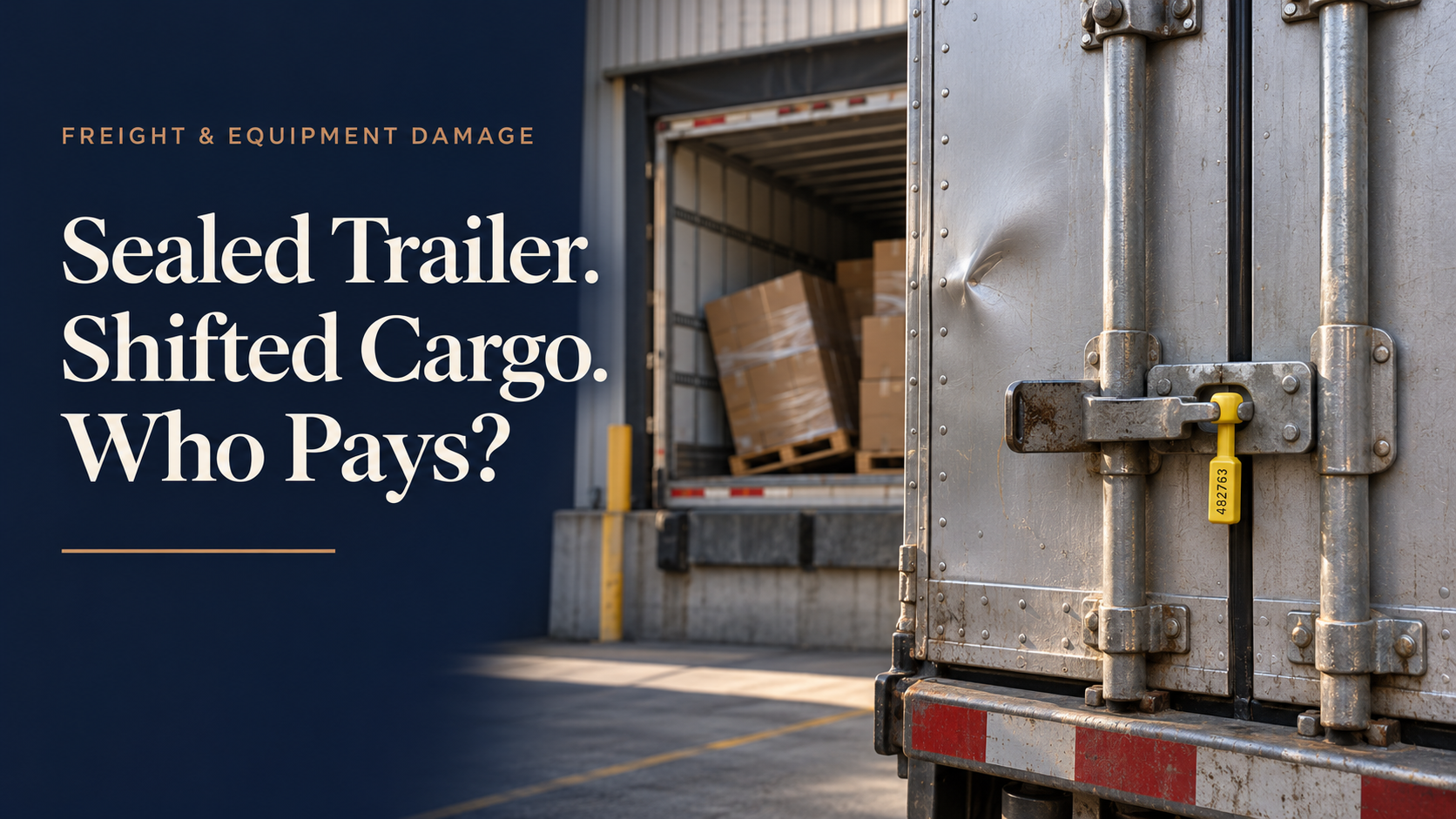
When freight shifts inside a sealed trailer, responsibility depends on who loaded and secured it, whether the defect was discoverable, causation, and proven damages.
What the Sealed-Trailer Exception Actually Covers
Federal safety rules generally prohibit a driver from operating, and a motor carrier from requiring or permitting operation of, a commercial vehicle unless its cargo is properly distributed and adequately secured. That general requirement appears in 49 C.F.R. § 392.9(a). 1
Paragraph (b) adds specific driver duties: confirming compliance before driving, inspecting cargo and securement devices within the first 50 miles, and reexamining them during the trip. Under paragraph (b)(4), those paragraph (b) rules do not apply in two alternative situations: the driver of a sealed vehicle has been ordered not to open it to inspect the cargo, or the vehicle was loaded in a manner that makes inspection impracticable. 1
A seal alone does not satisfy the first alternative; the regulation refers to a driver who has been ordered not to open the vehicle. The exception also addresses paragraph (b), not the general safety requirements of paragraph (a). It does not permit a driver to knowingly operate a vehicle that appears unsafe. 1
Who Loaded and Secured the Freight?
Identify each participant separately: the shipper, any warehouse or loading contractor, the carrier and driver, and any broker. Each may have performed different tasks or made different contractual commitments.
Under 49 C.F.R. § 393.106(b)–(c), cargo generally must be firmly immobilized or secured by structures of adequate strength, dunnage, shoring bars, tiedowns, or a combination, and certain articles must be restrained against rolling or shifting. The section has stated exceptions, and commodity-specific rules may take precedence. 2
A securement violation does not by itself establish which party owes civil damages. That question depends on the facts, contracts, and applicable law.
What the Cases Establish—and What They Do Not
United States v. Savage Truck Line, Inc. (4th Cir. 1953) 209 F.2d 442 is frequently cited for the principle that the carrier bears the primary duty of safe loading, while a shipper that assumes loading may be liable for defects that are latent and not discernible by the carrier’s ordinary observation. If the improper loading is apparent, the carrier may remain liable. Savage is federal background, not controlling California state authority, and it does not guarantee recovery for sealed-load damage. 3 4
In State of California ex rel. Department of Transportation v. Herc Rentals, Inc. (Cal. Ct. App., Sept. 14, 2026, No. A174303), a shipper loaded a boom lift onto a flatbed truck, and the lift struck a highway overcrossing. The published analysis held that Savage did not bar the State’s third-party negligence claims under California comparative-fault law, and that neither federal regulations nor the Vehicle Code created a categorical defense based on carrier duties. 3 4
The court reversed summary judgment for the shipper. It did not determine that the shipper was ultimately negligent, and it did not resolve a carrier’s own claim for trailer damage. The opinion is certified for partial publication; part E of its Discussion is unpublished and is not relied on here. 3 4
California applies comparative negligence. If the carrier also contributed to the loss, its recovery may be reduced in proportion to its own fault rather than barred outright. 5
What Evidence Matters?
Useful records often include:
- Loading photographs or video, seal numbers and custody history, and any instruction prohibiting opening.
- Bills of lading, shipping contracts, broker agreements, and loading or securement instructions.
- Pre-trip inspection and maintenance records for the trailer.
- Photographs of displaced freight and damaged components, trip and telematics data, and repair or expert findings.
An intact seal supports continuity of custody; it is not conclusive proof of negligent loading. A “shipper load and count” notation also does not automatically decide liability. The other side may point to alternative causes, such as prior deterioration, forklift impact, hard braking, or a collision, so the evidence should address them.
Equipment Damage, Broker Claims, and Recovery
A carrier’s own operating trailer is not the same as goods received for transportation. The Carmack Amendment, 49 U.S.C. § 14706, governs carrier liability for loss or injury to property it receives for transportation. Equipment shipped as cargo may require a different analysis, and Carmack claim deadlines should not be applied to every trailer-damage dispute. 6
Any broker claim should focus on the broker’s actual conduct and contractual undertakings. Federal law preempts certain state laws related to a broker’s price, route, or service with respect to the transportation of property, subject to stated exceptions, so preemption must be evaluated claim by claim. 7
Depending on applicable law, causation, and mitigation, recoverable items may include reasonable repair costs or other property damage, reasonable loss of use, and sufficiently proven net lost profits. California’s civil jury instructions address these categories in CACI Nos. 3903J, 3903M, and 3903N. Missed gross revenue is not the same as lost profits, and the same loss cannot be recovered twice. 8
Act promptly to preserve the trailer, freight, and records, and review the bill of lading, carrier agreements, and insurance policies for notice and filing deadlines. No single deadline governs every freight dispute.
Mahrouyan Law’s Commercial Property, Equipment & Cargo Damage and Small Business & Commercial Litigation practices address disputes over damaged equipment and the commercial agreements behind them.
Sources
- 1.
- 2.
- 3.
- 4.
- 5.
- 6.
- 7.
- 8.
Discuss Your Matter
Contact Mahrouyan Law to discuss trailer or equipment damage from a loading problem. The appropriate approach depends on the facts, agreements, and applicable law.

Omeed Mahrouyan is the founder of Mahrouyan Law, P.C., a California firm handling business and commercial litigation, property and cargo damage claims, personal injury, landlord representation, startup transactions, and practical intellectual property matters. Clients work directly with him on strategy, drafting, and case decisions.
More about Omeed Mahrouyan →