
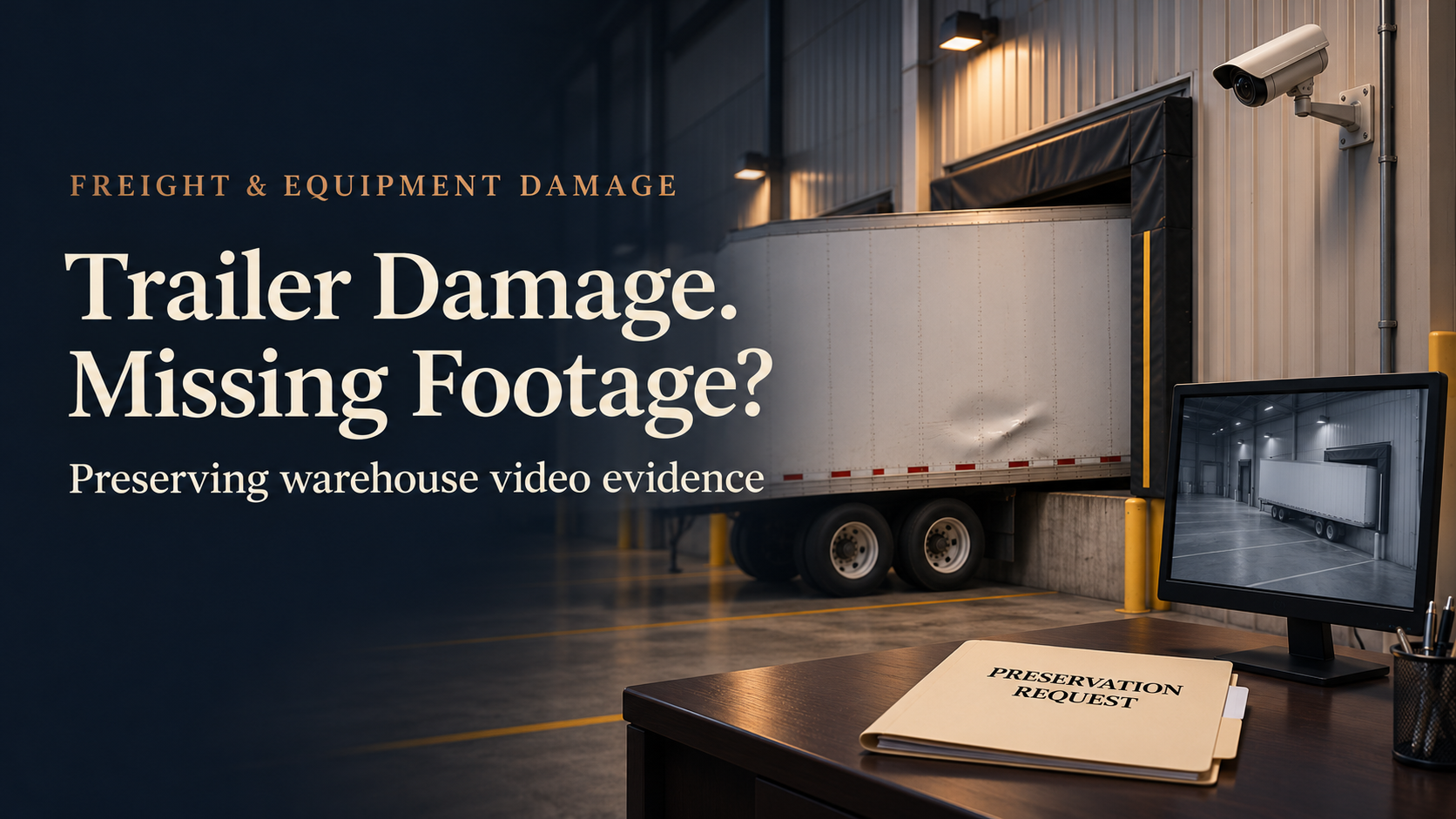
A carrier can ask a warehouse to preserve surveillance video of trailer damage, but a request is not a court order. Preserving footage, obtaining a copy, and seeking a remedy for lost evidence are separate questions.
Three questions are easy to blur together: whether the recording is preserved, how a copy can be obtained—through cooperation or legal process—and what remedy may exist if evidence is improperly destroyed. Each has its own rules.
What a Targeted Preservation Request Should Identify
A clear, specific request makes it harder for anyone to claim they did not know what to keep. It should generally identify:
• The incident date and a reasonably defined time window. • The facility address, dock number, and trailer identification. • Relevant camera locations, and footage before, during, and after the incident. • A request to suspend routine overwriting of relevant recordings and retain available associated metadata. • A request to identify the custodian and confirm that the footage has been preserved.
The warehouse operator, property owner, loading contractor, and security provider may be different entities. A letter to one does not establish that another received notice or controls the recording. There is no single retention period that applies to every facility, and a request does not require anyone to keep all footage indefinitely.
Foreseeable Litigation and Automatic Overwriting
In Victor Valley Union High School District v. Superior Court (2023) 91 Cal.App.5th 1121, the Court of Appeal explained that a duty to preserve relevant evidence can arise before a lawsuit is filed, once litigation is objectively reasonably foreseeable—probable or likely, not merely possible. 1
Code of Civil Procedure section 2023.030, subdivision (f), generally bars discovery sanctions for electronically stored information lost through the routine, good-faith operation of an electronic information system, absent exceptional circumstances. It also states that it does not alter any obligation to preserve discoverable information. 2
In Victor Valley, the court held that this safe harbor did not protect the district on the record presented, but directed reconsideration of the severity of the sanctions, including whether lesser measures would suffice. 1 That was a school-district surveillance case, not a warehouse or freight decision, and its application to a commercial dispute depends on the facts. Automatic overwriting is not necessarily a defense once a preservation obligation exists—but the safe harbor is neither absolute immunity nor automatic liability.
How Footage May Be Obtained
The available procedure depends on the custodian’s role and whether a lawsuit is pending:
| Custodian’s role | Potential procedure |
|---|---|
| Party to a pending California action | Demands for documents and electronically stored information under Code Civ. Proc. § 2031.010 |
| Nonparty holding relevant business records | A properly issued deposition subpoena under §§ 2020.010 and 2020.410 |
| Before the anticipated lawsuit | Limited preservation proceedings under §§ 2035.010–2035.060, if statutory requirements are satisfied |
Limits on Each Procedure
Relevance, possession or control, procedural deadlines, privacy, burden, and objections still matter. 3 4 A subpoena is not a guarantee of immediate delivery.
Prefiling proceedings are not routine pre-suit discovery or an automatic emergency remedy. They require a verified petition that sets out, among other things, the petitioner’s present inability to bring the expected action or cause it to be brought, and notice and service requirements apply. 6 The procedure may not be used to find out whether a claim exists or to identify potential defendants. 5
If Footage Is Lost or Destroyed
California does not recognize an independent tort for intentional spoliation by a litigation party where the destruction was or should have been discovered before the underlying litigation concluded. 7 The California Supreme Court also rejected an independent tort for intentional spoliation by a third party. 8
Those decisions do not eliminate every consequence of destroying evidence, but sanctions, evidentiary consequences, or independently enforceable obligations each require their own legal basis. Negligent loss differs from intentional suppression, and an adverse inference, default judgment, separate recovery, or sanctions against a nonparty is not guaranteed.
Practical Evidence Steps
Do not rely on warehouse video alone. Preserve your own photographs, inspection and maintenance records, dock assignments, dispatch messages, shipping documents, repair estimates, and relevant correspondence. Our articles on forklift damage at the loading dock and late notice of freight trailer damage discuss related evidence and deadline issues.
Footage may help show what happened, but liability, repair costs, and downtime still require supporting proof. Continue necessary safety measures and reasonable mitigation. Preservation efforts do not extend contractual notice periods or lawsuit deadlines. Our Commercial Property, Equipment & Cargo Damage practice addresses these disputes.
Sources
- 1.
- 2.
- 3.
- 4.
- 5.
- 6.
- 7.
- 8.
Discuss Your Matter
If a facility will not release footage of damage to your trailer or equipment, contact Mahrouyan Law to discuss your circumstances. This article is for general informational purposes only and does not constitute legal advice. Reading this article does not create an attorney-client relationship.

Omeed Mahrouyan is the founder of Mahrouyan Law, P.C., a California firm handling business and commercial litigation, property and cargo damage claims, personal injury, landlord representation, startup transactions, and practical intellectual property matters. Clients work directly with him on strategy, drafting, and case decisions.
More about Omeed Mahrouyan →