
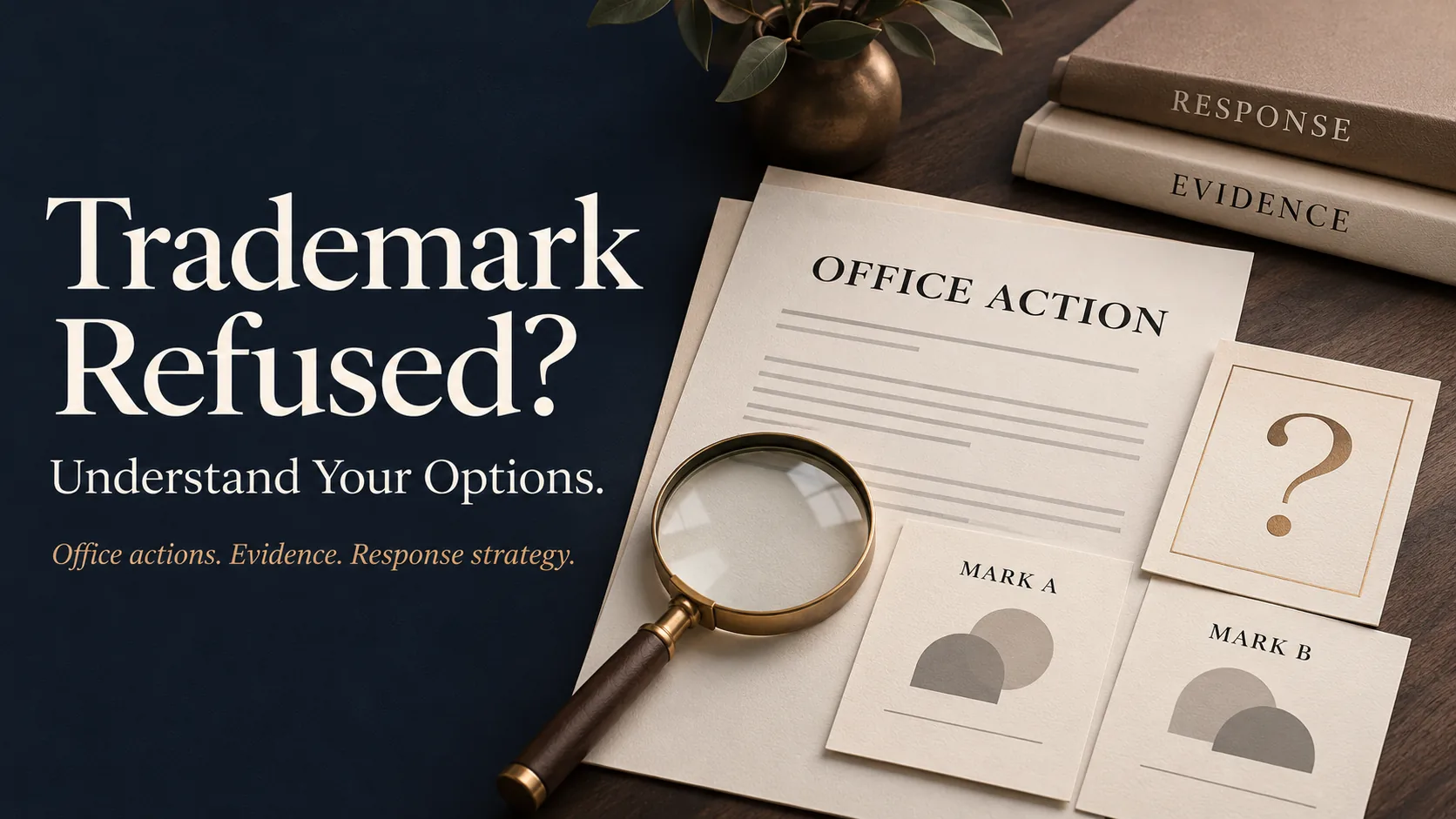
A likelihood-of-confusion refusal can sometimes be overcome with supported arguments, evidence, an amendment, or a consent agreement. Deadlines and appeal rights need attention from the start.
Often, yes—but not always. A likelihood-of-confusion refusal may be overcome through supported arguments, evidence, a permissible amendment, or an appropriate consent agreement. Whether any of those succeeds depends on the particular application and the registration cited against it.
Addressing the refusal and assessing infringement exposure are separate tasks, and a sound plan considers both.
What the Refusal Means
Section 2(d) of the Lanham Act, 15 U.S.C. § 1052(d), in relevant part bars registration of a mark that so resembles a mark already registered with the USPTO that it is likely to cause confusion, mistake, or deception when used with the applicant’s goods or services. 1
Examination focuses on whether consumers are likely to be confused about source because similar marks are used with related goods or services. The question is likelihood. A refusal does not require a finding that the applicant copied anyone or that any customer has actually been confused.
A refusal based on an existing registration differs from a potential conflict with an earlier-filed pending application. According to the USPTO’s likelihood-of-confusion guidance, the examining attorney searches the federal database for registered and pending marks, refuses registration when a registered mark conflicts, and advises the applicant that registration may be refused if an earlier-filed application registers. 2 Examination is not ordinarily a forum for deciding who first used an unregistered name.
What Matters in the Comparison
Marks are compared for appearance, sound, meaning, and overall commercial impression. They need not be identical, and a different spelling does not automatically resolve a conflict if the marks sound alike or convey the same impression.
Goods and services are compared for relatedness, including whether they reach the same purchasers through the same trade channels. Class numbers do not automatically resolve a conflict either; a conflict can exist between goods or services in different classes.
The comparison rests on the goods and services identified in the application and the cited registration, not merely on the narrower way either business currently operates. An argument that the registrant really serves only a niche market generally carries little weight if its registration is not so limited.
Practical Response Options
Depending on the record, a response may include:
- Supported arguments distinguishing the marks or the relevant goods and services.
- Relevant marketplace and coexistence evidence. A lack of reported confusion alone does not guarantee success.
- Narrowing or clarifying the identification of goods and services.
- A supported consent agreement addressing why confusion is unlikely and how the parties will prevent it.
- Checking the cited registration’s status and evaluating any legally supported challenge through the proper procedure.
Under 37 C.F.R. § 2.71(a), an identification may be clarified or limited but not broadened. 3 Narrowing can also limit the resulting registration, so the trade-off deserves thought before amending.
The USPTO’s examining manual, TMEP § 1207.01(d)(viii), treats a consent agreement as one factor weighed with the other circumstances. A detailed agreement describing specific arrangements to avoid confusion can receive substantial weight, while a bare consent may carry little. 4 Neither guarantees registration. Consent to registration is also not necessarily unrestricted permission to use the mark; the agreement’s terms control.
If a cited registration is no longer active, the USPTO’s office-action guidance says it can no longer bar registration and that the examining attorney should be told. 5 That status does not prove the owner abandoned all trademark rights. Conversely, an unsupported allegation that a registrant is not using its mark does not eliminate an active registration; that kind of challenge belongs in a separate proceeding, not in the response itself.
Ordinary Response Deadlines
Under 37 C.F.R. § 2.62(a), the ordinary response periods for an office action in an application are: 6
| Application basis | Ordinary response period |
|---|---|
| Sections 1(a), 1(b), or 44 | Three months from issuance; a timely request and fee generally permit one additional three-month extension |
| Section 66(a), Madrid Protocol | Six months from issuance; no ordinary three-month extension |
Check the actual office action for the deadline that applies, because an office action may state a different period. These are not universal deadlines for every USPTO communication.
Final Refusals and Preserving an Appeal
After a final refusal on a substantive ground, 37 C.F.R. § 2.63(b) permits an applicant to request reconsideration or appeal to the Trademark Trial and Appeal Board (TTAB), subject to the applicable procedural requirements. 7 If reconsideration does not resolve every refusal and no timely appeal has been filed, the application is abandoned.
Under 37 C.F.R. § 2.142(a) and (d), the appeal must be filed within the response period, and the record should be complete before the appeal is filed. 8 New evidence generally cannot simply be attached to an appeal brief. Adding evidence after an appeal is filed ordinarily requires asking the Board to suspend the appeal and return the application to the examining attorney.
Registration Is Separate From the Right to Use
An office action is not an injunction requiring a business to stop using its name. The TTAB, as the USPTO describes the Board, determines only the right to register. It does not decide infringement, award money damages, or issue injunctions against use. 9
Nevertheless, the cited registration may reveal a separate infringement risk that a registration response will not address. Those questions are decided in court.
Response strategy should account for the investment already made in the brand, the evidence available, cost, the restrictions an amendment or consent agreement would impose, and whether rebranding would better serve the business.
Sources
- 1.
- 2.
- 3.
- 4.
- 5.
- 6.
- 7.
- 8.
- 9.
Discuss Your Matter
If your business has received a likelihood-of-confusion refusal, contact Mahrouyan Law to discuss the office action and appropriate next steps. Learn more about our Trademarks & Practical Intellectual Property Counsel and Startup & Business Transactions practices. Every application depends on its own record, and no result can be guaranteed.

Omeed Mahrouyan is the founder of Mahrouyan Law, P.C., a California firm handling business and commercial litigation, property and cargo damage claims, personal injury, landlord representation, startup transactions, and practical intellectual property matters. Clients work directly with him on strategy, drafting, and case decisions.
More about Omeed Mahrouyan →