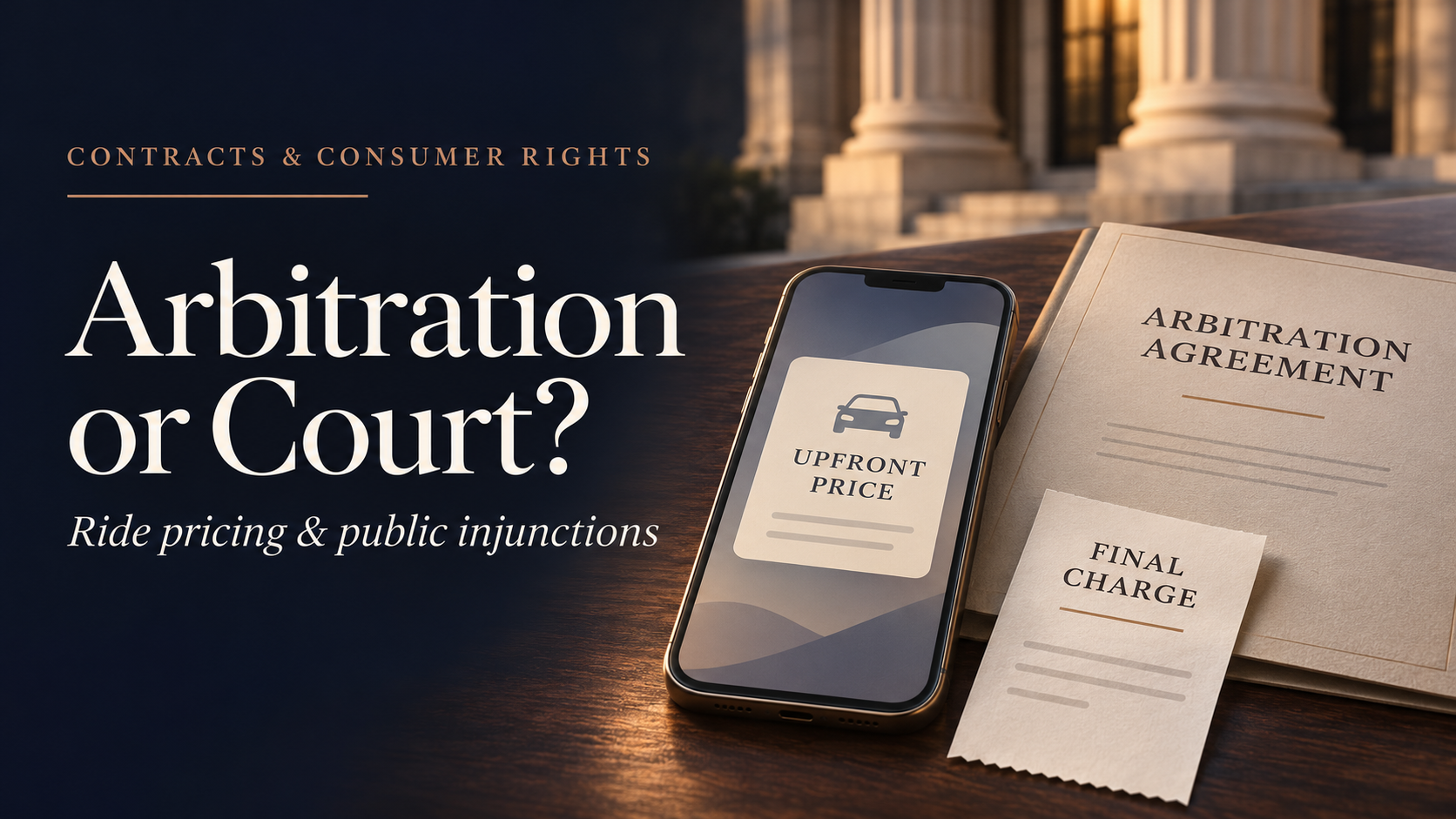
A California appellate court kept riders’ upfront-pricing case in court. The decision turned on public injunctive relief and ambiguous severance language—not on whether any pricing was deceptive.
Two riders filed a putative class action alleging that Uber advertised upfront prices as the amount riders would pay, yet frequently charged more. They asserted claims under California’s unfair competition law and false advertising law, seeking an injunction and restitution or disgorgement. These are allegations, not findings. 1
On November 4, 2026, the First Appellate District affirmed the trial court’s order denying Uber’s motion to compel arbitration. The ruling did not determine that deceptive pricing occurred, certify a class, or award refunds or an injunction. 1
The McGill Rule
In McGill v. Citibank, N.A., the California Supreme Court held that a predispute agreement waiving the right to seek public injunctive relief in any forum is unenforceable, and that the Federal Arbitration Act does not preempt that rule. 2
Public injunctive relief has the primary purpose and effect of prohibiting unlawful acts that threaten future injury to the general public. It differs from compensation for past losses and from relief that primarily benefits the plaintiff or a defined group. 2
McGill does not prohibit all arbitration involving injunction requests. The problem is a waiver that eliminates the remedy in every forum; an agreement can instead allocate remedies between forums. A class-action waiver is also a different provision, and merely requesting an injunction does not defeat arbitration.
Why the Requested Injunction Was Public
Uber argued the injunction was private because compliance would require examining each ride’s individualized pricing. The court disagreed, explaining that McGill’s inquiry focuses on the injunction’s primary purpose and effect, and that Uber had not shown this forward-looking request required more individualized inquiry than comparable pricing injunctions courts have treated as public. 1
The court concluded that a request to stop allegedly deceptive pricing practices on a widely used platform sought a public injunction, so the agreement’s waiver of nonindividual relief was unenforceable as to that request. 1
Claims, Remedies, and Severability
Uber’s terms provided that, if the class-action waiver was unenforceable, any “class, collective, coordinated, consolidated, and/or representative claims” subject to the unenforceable portion would proceed in court, while severance would not affect the arbitrability of “any remaining claims.” A general severability clause used similar “claims” wording. 1
Uber asked the court to send the riders’ individual monetary requests to arbitration and stay the injunction request in court. The dispute turned on the word “claim.” If it means a cause of action, each statutory claim seeking a public injunction proceeds in court in full; if it means a demand for relief, the remedies could be divided. The court found both readings reasonable and the agreement ambiguous—unlike agreements in other cases that expressly allowed severance of a particular request for relief. 1
Under Civil Code section 1654, when uncertainty is not removed by the preceding interpretation rules, contract language is interpreted most strongly against the party who caused the uncertainty. It is a last-resort rule, not an automatic first step against every drafter. Applying it to this adhesion contract, the court construed the ambiguity against Uber. 3 1
The Federal Arbitration Act Argument
Uber argued that the Federal Arbitration Act requires resolving ambiguities in favor of arbitration. The court distinguished Lamps Plus, Inc. v. Varela, which held that the rule against the drafter cannot be used to impose class arbitration without consent. Here, the court reasoned, applying section 1654 kept the parties out of arbitration absent clear consent, consistent with the Act’s consent principle. That reasoning is tied to this agreement; it does not mean ambiguity always defeats arbitration. 1
Practical Takeaway
For businesses, mandatory arbitration terms, public-injunction provisions, class waivers, and severability clauses operate together. Whether a clause refers to claims or to particular requests for relief can determine whether a dispute is divided between forums or proceeds in court in full. Our Startup & Business Transactions and Business Litigation practices address drafting and disputes over these terms, and our article on the Yelp Law and online terms discusses related consumer-facing contract issues.
For consumers, the available forum depends on the governing agreement and the substance of the relief sought. This decision does not give every rider an automatic right to avoid arbitration, and the merits of the pricing allegations remain unresolved.
Sources
- 1.
- 2.
- 3.
Discuss Your Matter
For questions about business contracts, arbitration provisions, or a commercial dispute, contact Mahrouyan Law to discuss your circumstances.

Omeed Mahrouyan is the founder of Mahrouyan Law, P.C., a California firm handling business and commercial litigation, property and cargo damage claims, personal injury, landlord representation, startup transactions, and practical intellectual property matters. Clients work directly with him on strategy, drafting, and case decisions.
More about Omeed Mahrouyan →